










Wallets identified by blockchain analytics firm Arkham Intelligence as belonging to the United States government initiated a series of significant digital asset movements on Tuesday, shifting more than $100 million in cryptocurrency. These transactions, which involved both Bitcoin and Binance Coin (BNB), have drawn close scrutiny from market observers, given the government’s massive holdings of seized digital assets and the ongoing debate regarding how these funds should be managed or liquidated.
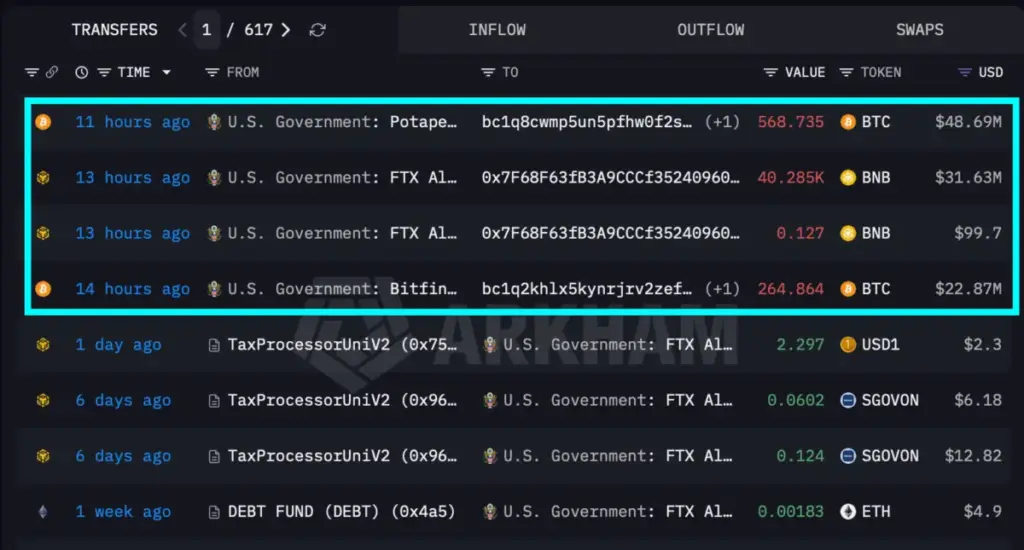
According to the data provided by Arkham, the government’s transfer activity began with the movement of 833.599 BTC. At the time the transaction was executed, this volume of Bitcoin was valued at approximately $71.6 million. The funds were initially dispatched to two separate addresses that remain currently unlabeled in blockchain records. However, the movement did not stop there. Within only a few hours, those two recipient addresses forwarded the entirety of the funds to addresses that Arkham explicitly labels as Coinbase Prime deposit addresses. The use of institutional-grade custodial services like Coinbase Prime often signals a shift in the status of these assets, though it does not provide definitive confirmation of an immediate market sale.
Parallel to the Bitcoin activity, a separate wallet labeled as government-owned executed a transaction involving 40,285 BNB, worth roughly $31.63 million. This digital currency was routed to an unlabeled address, 0x7F68F63fB3A9CCCf352409603421E0A574FbAD90. In a manner consistent with the Bitcoin movement, this address subsequently transferred the full amount to a second, further downstream unlabeled address, 0x6fB3Fe7b7E78AbB84CE007cBC7412C850B15A579. The deliberate obfuscation of these paths—moving funds through intermediate addresses before arriving at their destination—is a common practice in digital asset management, even for government entities handling confiscated property.

The provenance of these assets provides critical context for why they are currently under federal control. The 833.599 BTC originated from two distinct pools of seized capital. A portion, totaling 568.7 BTC, was linked to the forfeiture case involving Sergey Potapenko and Ivan Turogin, who were implicated in a massive cryptocurrency mining and fraud scheme. The remaining 264.9 BTC came from assets recovered during the sprawling investigation into the 2016 Bitfinex hack, one of the most significant security breaches in the history of the cryptocurrency industry. The BNB assets, meanwhile, originated from funds seized from the collapsed hedge fund Alameda Research, the sister company to the bankrupt crypto exchange FTX. These assets represent only a fraction of the federal government’s total digital portfolio, which is estimated to hold approximately $27.5 billion in various cryptocurrencies, all of which were acquired through various enforcement and forfeiture actions. It is important to note that, to date, the U.S. government has maintained a policy of not utilizing taxpayer funds to actively purchase or invest in cryptocurrency markets; the holdings are exclusively the result of seizure and confiscation.
In the volatile world of cryptocurrency, any large movement of funds by a government entity is almost immediately interpreted by market participants as a precursor to a massive sell-off. Such fears often lead to downward pressure on asset prices, as investors worry about a potential flood of supply hitting exchanges. However, analysts suggest that the situation surrounding Tuesday’s activity may not be as straightforward as a simple liquidation. There is a prevailing theory that these movements are part of administrative reorganization rather than a liquidity event.
Market commentator Jose Rosell noted on the social media platform X that the act of moving assets should not be conflated with the act of selling them. Rosell pointed toward recent policy developments, specifically a March 2025 executive order, which stipulates that Bitcoin forfeited to the U.S. government is intended to be held as part of a Strategic Bitcoin Reserve. This policy shift marks a significant departure from the historical practice of auctioning off seized assets to the highest bidder as quickly as possible. If the government is indeed consolidating its holdings into custodial accounts like Coinbase Prime to facilitate long-term storage or institutional management, then the market’s immediate anxiety regarding a price crash may be misplaced.
The mechanics of these transfers highlight the complex interplay between law enforcement, financial oversight, and the decentralized nature of blockchain technology. While the government is arguably one of the largest "whales"—a term used to describe holders of vast amounts of cryptocurrency—in the world, its behavior remains bound by bureaucratic requirements and evolving federal mandates. The transparency provided by firms like Arkham allows the public to witness these movements in near real-time, yet the intent behind the movements remains subject to interpretation until official statements are released or the assets are formally moved into a public exchange order book.
The Bitfinex hack, in particular, remains a focal point for regulators and law enforcement. The recovery of these funds represents years of intensive forensic work by the Department of Justice and the Internal Revenue Service’s Criminal Investigation division. Because these assets are the proceeds of criminal activity, their management is handled with extreme caution, often involving specialized custodial partners to ensure the security of the digital keys. The movement of the Alameda Research BNB adds another layer of complexity, as the FTX/Alameda bankruptcy proceedings continue to be one of the most complicated financial legal cases in recent memory. By moving these assets, the government is likely fulfilling requirements related to the administration of seized property as legal proceedings conclude or transition into new phases.
As the government continues to refine its approach to its multi-billion dollar digital treasury, the market is likely to see more of these periodic transfers. Whether these actions serve to stabilize the government’s holdings for long-term retention or are merely the operational movements required to finalize forfeiture cases remains a central question for institutional and retail investors alike. For now, the crypto community is watching these specific addresses closely, noting that while the $100 million movement is large by any standard, it represents only a small slice of the massive digital footprint left behind by various criminal enterprises that have been dismantled by federal authorities.
The interplay between the executive branch’s strategic initiatives and the operational needs of the agencies responsible for asset recovery will continue to dictate how these billions of dollars in Bitcoin and other assets are handled. While the March 2025 executive order suggests a shift toward a "Strategic Bitcoin Reserve" model, the practical execution of such a mandate requires careful handling of digital infrastructure. The use of Coinbase Prime for these transfers suggests that the government is prioritizing high-security, institutional-grade custody over the risks associated with older or less secure storage methods.
Ultimately, Tuesday’s events reflect the broader maturation of the cryptocurrency market. As digital assets become increasingly integrated into global financial and legal systems, they are no longer merely speculative assets for traders but are now central to the balance sheets of nations. The movement of these funds, while generating short-term speculation, serves as a reminder of the scale of the government’s digital asset enforcement and the ongoing institutionalization of cryptocurrency within the American legal and economic framework. As the government continues to navigate the complexities of managing these seized assets, the focus will likely remain on whether these transfers represent the beginning of a broader strategic initiative or simply the maintenance of a sprawling, state-held digital portfolio.