










Every website enjoys its finest hour on launch day. The final branch is successfully merged, the system goes live precisely as it was designed, and for a fleeting moment, it is entirely perfect. Yet, digital creators and developers know a quiet truth: the site will never be this good again.
This decline rarely happens because something breaks. The underlying code continues to execute, and the servers remain online. Instead, the market shifts beneath the surface, messaging strategies evolve, competitors unveil new offerings, and the carefully crafted digital experience slowly stops matching the reality of the enterprise it represents. Within a year, a once-cutting-edge portal begins to feel like a period piece—not strictly broken, but subtly and steadily behind.
For decades, digital teams have treated this inevitable decay as a fundamental law of nature. Maintenance is viewed as an uphill battle against time, where documentation slips, asset optimizations are rushed under deadline pressures, and design-system updates fail to propagate evenly across every subpage.
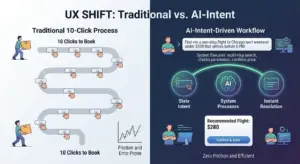
However, emerging paradigms in autonomous software development suggest that this cycle does not have to be permanent. Industry innovators argue that a website could theoretically continue improving long after its initial launch, quietly self-optimizing while the human team behind it focuses on higher-level product work.
Imagine a digital ecosystem functioning overnight: while the development team sleeps, an autonomous agent detects that last week’s design-system adjustment never propagated properly to the pricing page and automatically corrects the discrepancy. Another agent identifies a batch of uncompressed images shipped during a rushed deployment and optimizes them for performance without sacrificing visual fidelity. A third agent flags an accessibility regression introduced by a newly integrated component, resolving the issue independently or filing a clear, actionable review item for human oversight. By morning, the platform is measurably superior to the state it was left in, accompanied by a concise log of decisions that genuinely required human judgment.
Yet, as platform builders begin to take the concept of full website autonomy seriously, they immediately encounter a fundamental paradox that has very little to do with technological limitations: almost nobody actually wants a website that changes entirely on its own.
Why "Just Make It Autonomous" Is the Wrong Goal
The most obvious temptation for developers working with capable artificial intelligence agents is to hand over the entire site. The impulse is to let agents write, edit, optimize, and publish continuously, removing human friction from the pipeline entirely. To many, this sounds like the natural endpoint of web automation and the ultimate vision of an autonomous platform.
In practice, however, it is precisely what users hesitate to embrace once they see it operational. Pierre Burgy and the engineering team behind Fimo, an autonomous website platform, discovered this dynamic through direct experience. Setting out with the initial assumption that full website autonomy was the primary objective, they observed how organizations actually interacted with the technology.
What they witnessed was widespread hesitation—not born of a deep distrust in artificial intelligence, but rather from the organizational reality that a website has no single owner. Different sections of a digital property belong to different stakeholders, and each stakeholder demands a vastly different degree of autonomy over their domain. Consequently, the core architectural challenge was never about whether to trust autonomous agents entirely. It was about discovering where to draw the boundary, and for whom.
Categorizing the Maintenance Load
Once the problem is reframed around granular boundaries, the operational workload of maintaining a modern website splits cleanly into three distinct categories.
The first category comprises the vast majority of website maintenance, and it represents a straightforward no-brainer. Much of what keeps a digital platform healthy is rule-bound, repetitive, and entirely devoid of creative fulfillment. Ensuring continuous accessibility compliance as pages evolve, propagating a design-system token across hundreds of templates, catching broken meta tags, compressing stray images, or repairing internal links that drifted months ago do not require artistic inspiration.
Nobody enters the web industry because of a deep personal passion for spotting missing alternative text attributes. This is the operational toil that teams are actively relieved to delegate, and it happens to be the exact domain where autonomous agents excel, because the work is defined by strict rules rather than subjective taste. An agent that quietly maintains this foundational layer across an entire digital property, operating reliably in the background, does not threaten human employment. Instead, it absorbs the tedious eighty percent of routine chores that previously drained engineering bandwidth.
At the opposite end of the spectrum lies the untouchable work—the small fraction of responsibilities that professionals would never delegate at any price. An automated agent can cross-reference a newly drafted page against every predefined rulebook in the system, confirming that color contrast ratios pass validation, heading hierarchies follow structural logic, design tokens match specifications, and copy aligns with established style guides.
What an agent cannot do is determine what a page should emotionally feel like, or evaluate whether a creative direction is fundamentally good in the subjective sense. That high-level judgment call is precisely why creative professionals and strategists are hired, and no technological advancement removes that responsibility from human hands. This irreplaceable domain is what people instinctively try to protect when they resist automation. The critical mistake lies in assuming that an entire website is composed exclusively of this kind of creative work, when in reality, only a tiny fraction is. Yet, because that small fraction carries immense strategic weight, the prospect of wholesale automation feels deeply counterintuitive.
Between routine chores and untouchable creative judgment lies a vast gray area that software products cannot predetermine. The ideal boundary line runs through different coordinates depending on who is interacting with the system.
Consider a practical example: transitioning a website’s default theme to dark mode upon visitor arrival. An autonomous agent can execute this structural change across the codebase in seconds. The real dilemma centers on who possesses the authority to initiate the change.
For the brand designer who owns the visual identity of the enterprise, the default theme is not merely a toggle setting; it is a profound statement regarding how the brand wishes to make its first impression, and they insist on retaining manual control over that decision. For the software developer implementing the update, however, it is a straightforward configuration parameter backed by clear performance or user-preference data—the exact type of adjustment they would happily let an agent apply before moving on to other tasks.
The same change, applied to the exact same site, yields entirely different boundaries for different stakeholders. This divergence exists because the task carries varying levels of judgment for each individual. For one person, it represents a core strategic decision; for another, it is a routine operational chore. No single default setting shipped by a software vendor can accommodate both perspectives because the definition of correctness is a function of where an individual’s professional value resides, not an inherent property of the task itself.
Building Agents Rather Than Toggling Settings
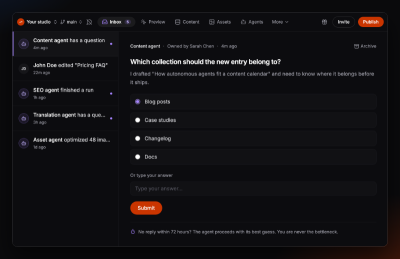
Recognizing that the operational boundary is intensely personal demonstrates why a simple binary toggle between manual approval and full delegation is insufficient. Because the precise threshold depends entirely on the specific task an agent performs, the true unit of digital control must be the agent itself.
This realization shaped the developmental trajectory of platforms like Fimo, where users do not simply select options from a rigid menu of predefined behaviors. Instead, they compose and configure individual agents, determining the exact boundaries of what each entity is permitted to touch. Teams can construct custom agents from scratch or adapt existing ones to align with internal thresholds—deploying an accessibility agent with full autonomy to execute routine fixes while keeping a content agent strictly tethered to human oversight for brand-facing copy.
Furthermore, these agents are designed to be dynamic rather than static. By learning from their executed tasks and ongoing human feedback, the boundaries established on day one do not remain fixed permanently. Actions requiring strict manual oversight initially can gradually transition into delegated tasks not because standards were lowered, but because the agent systematically earned operational trust over time.
Starting Narrow and Widening Scope
Implementing website autonomy rarely involves flipping a global switch on day one. In practice, the adoption curve moves deliberately in the opposite direction. Organizations typically delegate a minimal slice of responsibility, monitor performance closely, and progressively loosen constraints as confidence builds.
This gradual adoption is supported by deep observability. Every agent execution, historical log, and before-and-after visual comparison remains fully accessible for audit. Trust accumulates not through abstract reassurance, but through transparent verification of what occurred. When an agent quietly resolves an oversight that would otherwise have slipped past human reviewers, subsequent delegations become progressively easier to authorize.
Deadlines no longer serve as operational bottlenecks that stall digital progress. If a human reviewer fails to weigh in on a routine optimization within a designated window, the system can proceed safely based on pre-established parameters. The human team ceases to be the single point of friction that the entire website waits upon.
Confronting the Real Risk of Digital Decay
While initial skepticism toward autonomous web systems often focuses on the fear that an agent might alter a live page without direct supervision, industry proponents argue that the true hazard lies in the opposite direction: the prolonged stagnation of a frozen website.
A digital property that remains completely unchanged does not stay secure or pristine; it simply drifts backward into obsolescence in a gradual, unmonitored slide until its public face no longer reflects the active enterprise behind it.
The ultimate purpose of introducing autonomous agents into web development is never to sever the connection between creators and their digital platforms. Rather, the objective is to eliminate the relentless accumulation of digital decay, freeing human talent to concentrate on the few critical decisions that genuinely deserve attention while the foundational layers maintain themselves.