










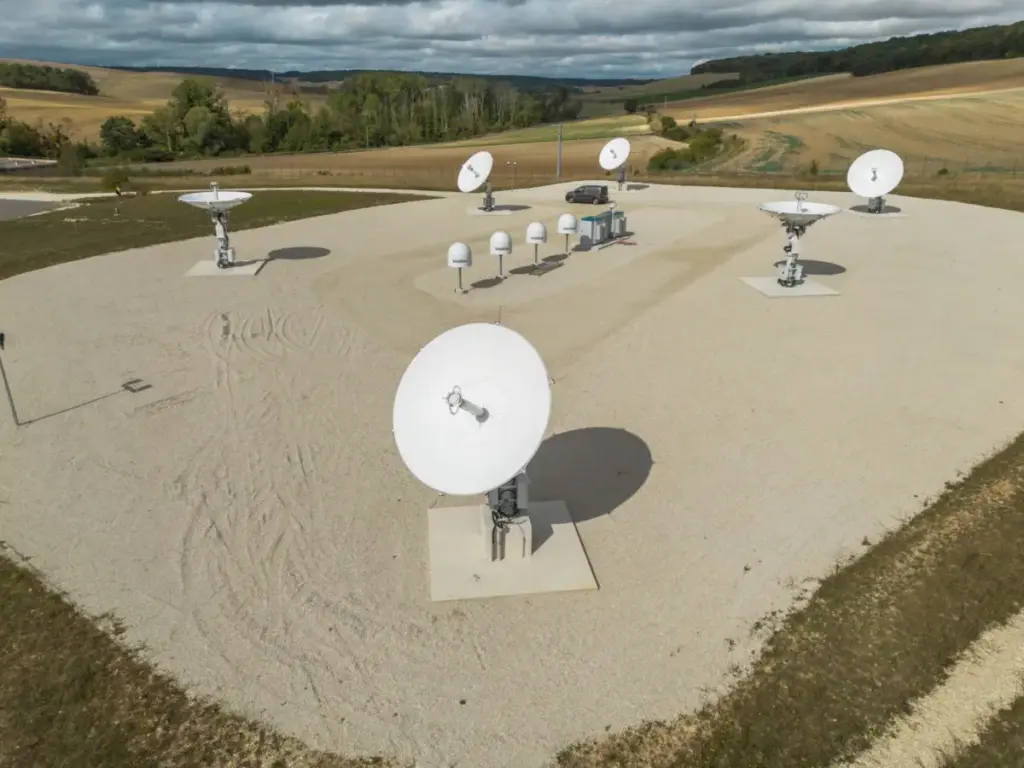
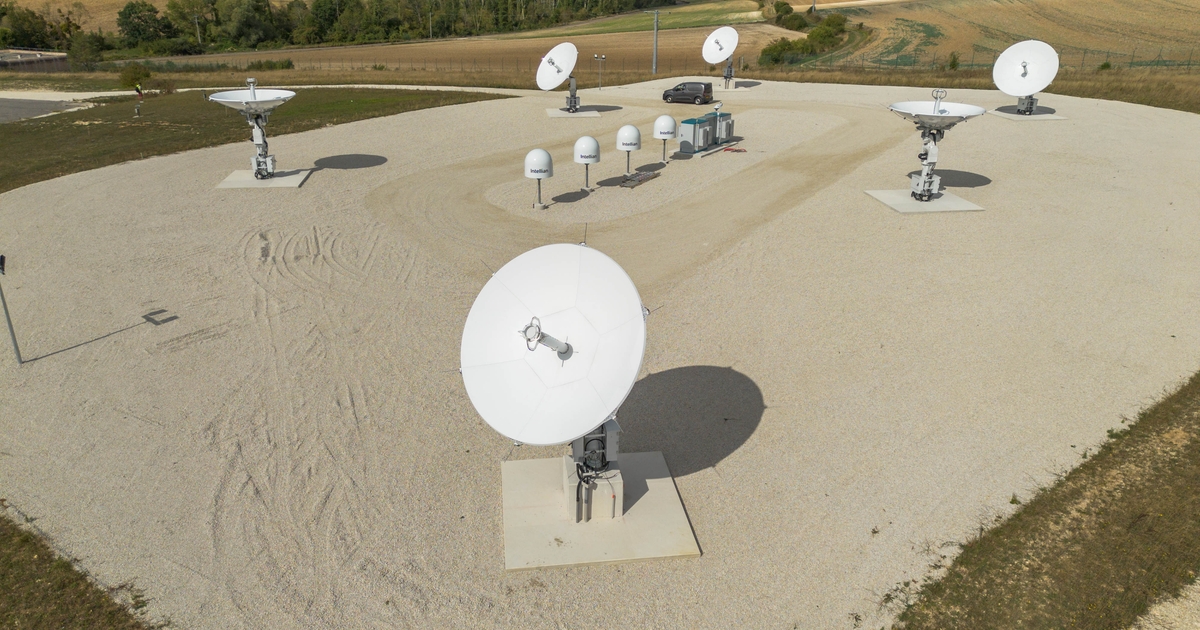
Nearly 50 years after establishing a satellite antenna site in the heart of rural France, roughly 100 miles from Paris, French telecommunications giant Orange has breathed new life into the historic facility. This week, the telecommunications carrier officially unveiled its latest addition to the Bercenay-en-Othe teleport by commissioning the first European gateway for Telesat’s upcoming Lightspeed low-Earth orbit (LEO) satellite constellation.
For Jean-Louis Le Roux, Executive Vice President for Orange International Networks, the inauguration of the new Telesat gateway represents a definitive revival of the location through cutting-edge space technology. The site holds profound historical significance for the carrier, serving as a long-standing hub for satellite operations.
"It’s a very historical site for Orange," Le Roux explained. "We have 46 antennas ranging from one meter to 32 meters. We call the antennas our ears, even if we are not listening to anything… The landscape is quite beautiful. It’s in the middle of nowhere in the country and you can see all the ‘ears.’"

Beyond its picturesque rural setting, the location offers exceptional technical advantages. Le Roux noted that the site provides unobstructed access to "all the orbits" while benefiting from remarkably low levels of electromagnetic noise, making it an ideal environment for sensitive satellite communications and ground station infrastructure.
To clear space for the new Telesat installation—which features a cluster of ten antennas ranging between one and four meters in height—Orange had to dismantle a massive, obsolete geostationary-Earth orbit (GEO) antenna. Standing at 32 meters tall, the older antenna had long since outlived its operational usefulness.
This infrastructure overhaul marks a pivotal operational shift for the facility. Bercenay-en-Othe is no longer just a repository for legacy hardware; it is actively transitioning into a versatile, multi-technology facility. According to Le Roux, the overarching goal is to transform the location into a premier international space hub in Europe capable of seamlessly managing both legacy and next-generation communication technologies.
As part of this deployment, Orange will also provide robust terrestrial connectivity stretching from the Telesat gateway to its planned point of presence in Paris. This high-performance backhaul link is designed to support demanding, mission-critical enterprise applications that require ultra-reliable data transmission.
Operations at Orange International Networks involve an extensive workforce and diverse infrastructure. Le Roux’s unit comprises approximately 2,000 personnel who manage connectivity across international submarine cables, terrestrial fiber-optic networks, and satellite systems to serve the carrier’s wholesale and enterprise customer base. Within this broader organization, a specialized "satellite factory" team of 100 people focuses entirely on satellite communications. Out of that dedicated unit, 25 professionals are stationed permanently at Bercenay-en-Othe to maintain the facility’s expansive array of antennas.
The newly commissioned gateway will serve a dual purpose. Orange will leverage the infrastructure to deliver advanced connectivity services to its own wholesale and business clients, while Telesat will simultaneously utilize the ground station to support its own direct customer base.
Orange positions itself globally as an essential bridge connecting the ground to space. The carrier maintains active partnerships across low-Earth orbit, medium-Earth orbit (MEO), and geostationary-Earth orbit architectures, collaborating with major operators such as Eutelsat OneWeb, Globecast, SES, Starlink, and now Telesat, while remaining open to future industry alliances. Furthermore, in the rapidly expanding mobile satellite direct-to-device market, the carrier has forged strategic working relationships with companies like Skylo and the Vodafone-AST SpaceMobile joint venture.
"We consider satellite a full complement to our terrestrial and submarine networks," Le Roux said. "Today, satellite is only 2% of total communication. It’s not a lot, but that 2% is very important. This allows us to cover remote areas with low coverage. It also allows us to cover emergency situations when our terrestrial networks are no longer working."
Canada’s Telesat Gets Foothold in Europe
For Canadian satellite operator Telesat, the establishment of the European gateway marks a critical milestone in its preparations to deliver commercial services across the region once its Lightspeed LEO constellation becomes fully operational. The Bercenay-en-Othe station is one of 24 planned landing stations that the operator intends to deploy globally.
Telesat’s initial constellation design calls for the launch of 225 advanced LEO satellites, with global commercial services anticipated to roll out in early 2028. This upcoming constellation will complement the operator’s existing GEO fleet, which currently comprises approximately 11 satellites.
One of the standout architectural features that attracted Orange to the Telesat LEO system is the implementation of inter-satellite optical links. Because the satellites communicate directly with one another via lasers rather than bouncing every signal back to Earth immediately, network operators gain significant flexibility regarding data routing. Le Roux emphasized that this capability is particularly advantageous for national and regional sovereignty.
"They have an implementation for inter-satellite communication with lasers, so you can select where you want to land," Le Roux noted.
Under this setup, a customer’s sensitive traffic and data can remain securely routed in space until it is delivered directly to a designated Telesat ground station or a client’s private corporate facility, minimizing exposure to public networks.
Luke Pearce, principal analyst at FDM CCS Insight, pointed out that while laser technology is an impressive feature, Telesat’s true market differentiator lies in how that technology is embedded into an enterprise- and government-focused network architecture.
"This gives customers greater control over where their data is routed and where it ultimately comes back to Earth, potentially avoiding untrusted or foreign terrestrial networks. That is valuable for data sovereignty, security, and defense applications," Pearce explained.
Telesat’s Lightspeed system also distinguishes itself from competing B2B-focused LEO constellations—such as those developed by SpaceX, Amazon Leo, and Blue Origin’s TeraWave—through native support for both Military Ka-band connectivity and traditional commercial spectrum bands. Combined with a significant Canadian defense contract, these capabilities help shape a market proposition centered squarely on secure and sovereign connectivity.
In the European market, Telesat also benefits from its Canadian identity. According to Pearce, the operator is uniquely positioned to present itself as a trusted, non-US alternative at a time when European governments and defense customers are actively seeking greater diversity and stringent control over their critical satellite communications infrastructure.