










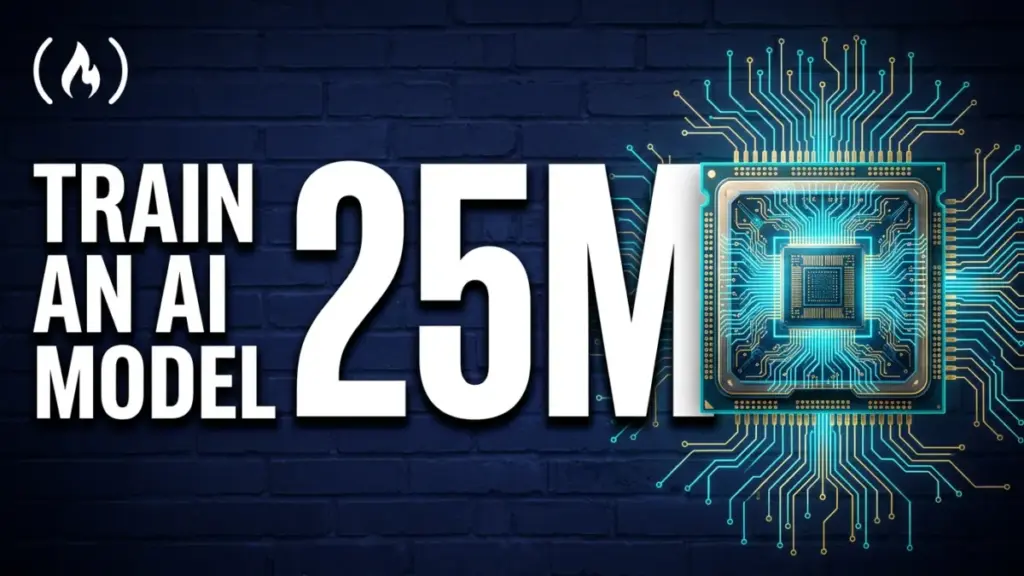
The artificial intelligence landscape is often perceived as an exclusive domain requiring massive financial resources, vast warehouses of specialized hardware, and elite infrastructure found only at leading tech conglomerates and frontier research laboratories. However, a new educational release aims to democratize this knowledge by proving that mastering the mechanics of modern language models does not necessarily demand a multi-million-dollar GPU cluster. Educational platform freeCodeCamp.org has released a comprehensive video tutorial on its official YouTube channel that demonstrates how developers, students, and enthusiasts can build, pre-train, and fine-tune a fully functional 25-million parameter large language model directly on a standard laptop or central processing unit.
While prominent artificial intelligence laboratories routinely train gargantuan systems boasting hundreds of billions of parameters using thousands of specialized graphics processing units, industry experts note that the underlying architecture, foundational mathematics, and operational workflows remain fundamentally identical regardless of scale. By scaling the model architecture down to a manageable 25 million parameters and utilizing a compact byte-level vocabulary, developers can effectively strip away the prohibitive cloud compute costs that typically create a barrier to entry. This reduction allows local training loops to execute directly on a standard CPU within seconds, transforming what is usually a batch-oriented cloud process into an interactive, real-time learning experience.
This rapid iteration cycle provides practitioners with a unique vantage point to observe how subtle alterations to underlying mechanics affect system performance. Developers can directly witness how changes implemented in data curricula, loss functions, and reward designs alter model behavior in real time, bypassing the lengthy waiting periods traditionally associated with distributed cloud training. By bringing the entire pipeline down to local consumer hardware, learners gain a more visceral and intuitive understanding of transformer architectures, tokenization strategies, and the optimization techniques that drive contemporary generative artificial intelligence.
The release arrives at a time when interest in the mechanics of machine learning has reached unprecedented heights, yet practical, hands-on comprehension often lags behind theoretical enthusiasm. Many developers understand the high-level concepts of neural networks and attention mechanisms through academic papers or high-level application programming interfaces, but fewer have experienced the raw mechanics of assembling a model from scratch and watching it learn from raw data. By focusing on a model size that bridges the gap between toy implementations and production systems, the tutorial offers a pragmatic bridge for software engineers looking to transition into artificial intelligence development without requiring enterprise-grade hardware access.
The one-hour video resource is currently available for free public viewing on the freeCodeCamp.org YouTube channel. The initiative aligns with the organization’s broader mission of making technical education accessible to a global audience, building upon an open-source curriculum that has historically helped tens of thousands of individuals secure professional roles as software developers. Through this latest offering, the platform continues its tradition of breaking down complex engineering topics into approachable, practical formats that empower individuals to experiment with cutting-edge technology using the hardware they already own.