










The rumors circulating throughout the tech industry have finally been confirmed: OpenAI is officially launching GPT-6 Astra, a sophisticated frontier model that the company suggests marks the definitive onset of artificial generalized intelligence (AGI). For years, OpenAI has pursued the ambitious goal of creating highly autonomous systems capable of outperforming humans across the vast majority of economically valuable work. With the arrival of Astra, that long-sought objective appears to have moved from the realm of speculative research into the tangible reality of enterprise deployment.
In a closed-door press briefing held earlier today, OpenAI co-founder and president Greg Brockman provided a blunt assessment of the launch, concluding the session with a statement that reverberated through the room: “Welcome to the AGI era.”
This framing is remarkably bold, even by the high-stakes standards of the generative AI sector. Yet, beyond the philosophical implications of AGI, the immediate value proposition for enterprises is grounded in a more practical shift: OpenAI is positioning GPT-6 Astra as a transformative leap in computing. The model is designed to liberate users from the traditional, repetitive drudgery of clicking through menus, navigating browser tabs, and manual typing. As described in the company’s launch materials, Astra is intended to function as the world’s most capable computer-use model.

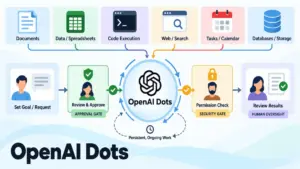
Unlike previous generations of AI that required developers to build dedicated API integrations for every specific application, Astra is designed to interact with software in a manner analogous to a human. It can navigate web browsers, manipulate spreadsheets, operate complex desktop applications, and manage multistep workflows. Rather than simply providing instructions on how to complete a task, Astra executes the work, producing finished documents, presentations, and code.
To illustrate this shift, OpenAI showcased a promotional video that juxtaposed a 1980s AI demo—where a computer laboriously drew a yellow circle—with modern footage of OpenAI employees interacting with Astra. Through voice input alone, employees asked the model to transform a yellow circle into a rocket ship, animate it into a full 3D game, and even create an eBay listing. The demonstration underscored the model’s ability to handle complex, multi-layered requests without constant human guidance. Astra begins its rollout this Thursday to enterprise customers via OpenAI’s “Daybreak” gated access program, with wider availability for ChatGPT Plus, Pro, Business, and Enterprise users expected in the coming days, alongside support for cloud platforms like AWS Bedrock and Microsoft Azure.
From Answering Questions to Operating Computers
The enterprise utility of Astra rests heavily on its "agentic" capabilities—the ability to act as an operator rather than a chatbot. OpenAI reports that the model can handle a wide variety of professional tasks: filling out online forms, updating CRM records, managing calendars, conducting deep web research, and drafting results into emails or formal documents. It is capable of working within specialized environments such as Python notebooks, Power BI, and engineering applications like KiCad and FreeCAD, even assisting with software installation and troubleshooting.
This functionality signals a significant pivot in enterprise AI architecture. Throughout the recent generative AI boom, companies have been forced to bridge the gap between models and corporate systems using a patchwork of APIs, plugins, and custom-built middleware. Brockman argued that the industry has been bottlenecked by the labor-intensive process of writing connectors for tools that were already designed for human use. By creating an agent that understands the standard interface of pixels, keyboards, and mice, OpenAI aims to bypass these integration hurdles.
According to internal benchmarks on an offline subset of OSWorld 2.0, Astra scored 72.6% while taking approximately 40 minutes per task, representing a 47% efficiency improvement over its predecessor, GPT-5.6 Sol, which scored 65.7% with a 75-minute average completion time. More importantly, the model demonstrated the ability to perform disparate tasks simultaneously, such as creating a 3D game while preparing a legal agreement, signaling a move away from the traditional, linear chatbot pattern where a user must provide a new instruction for every minor step.
The Largest Training Jump in OpenAI’s History
Aidan Clark, a researcher at OpenAI, described the development of Astra as the company’s most significant training endeavor to date. It is the first model to be pretrained using more than 100,000 DBUs at the company’s Stargate infrastructure. Furthermore, it marks a milestone in self-supervised learning, as previous iterations played a crucial role in overseeing the training of their successor. Clark noted that the leap in performance from the Sol architecture to Astra is greater than the progress seen in any previous generation of models.
The resulting benchmark scores are striking across the board. Astra achieved 97.6% on FrontierMath Tier 4 v2, 95.9% on BenchCAD, and 100% on ExploitBench. Perhaps most notably, it recorded a 98.6% on the ARC-AGI-3 benchmark, a test specifically designed to measure an AI’s ability to generalize to unfamiliar problems. However, this figure has ignited a broader industry debate regarding how "intelligence" is defined and measured.

The AGI Debate and the Role of the System
The ARC-AGI-3 benchmark has become a flashpoint for researchers questioning whether AI systems are truly generalizing or simply benefiting from specialized external "harnesses." In August, NVIDIA reported that its Agentic Variation Operators (AVO) architecture achieved a 100% score on ARC-AGI-3. However, the underlying model used in that experiment, Claude Opus 5, had a base performance of roughly 30%. The jump to 100% was enabled by the surrounding system, which provided persistent memory, feedback loops, and tool orchestration.
This has sparked a debate within the AI community: is a model’s intelligence defined by its weights alone, or by the complete, deployed agentic system? Some critics argue that adding elaborate external tools makes it difficult to assess true generalization, while others point out that for enterprise users, the distinction is largely academic. Businesses prioritize reliable outcomes—such as the ability to reconcile accounts or write code—over the "purity" of a benchmark score.
Brockman acknowledged this nuance, noting that the search for a singular, well-defined "AGI moment" has proven elusive. "Everyone has a different definition of AGI," he stated. "When we started OpenAI, we kind of thought that there was going to be this well-defined moment… It hasn’t played out like that. It’s a much more gray, fuzzy thing." Yet, he maintained that Astra represents a qualitative shift, stating, "I think it’s not unreasonable to feel that we are now in the AGI era."
Notably absent from the launch materials was OpenAI’s own "GDPval" benchmark, which was designed to measure performance on real-world, economically valuable tasks across 44 occupations. While the omission is conspicuous given the company’s claims about Astra’s economic utility, it may be due to the fact that GDPval is currently a one-shot benchmark, whereas Astra’s strengths lie in iterative, long-horizon workflows that the current version of GDPval is not designed to capture.
Redefining Costs and Governance
Brockman also argued that the industry needs to move away from "price-per-token" as a metric for enterprise AI. Because different models and tokenization schemes vary wildly, he suggested that businesses should instead focus on "price-per-task." By this metric, OpenAI claims Astra is significantly more cost-effective than its predecessors, as its ability to complete complex tasks correctly on the first attempt reduces the need for costly human intervention and retries.
However, the increased autonomy of Astra introduces a complex governance challenge. An agent that can modify files, send information, and take action across applications requires a "defense-in-depth" approach to safety. OpenAI reported that it paused certain training runs to ensure that its security and monitoring infrastructure could keep pace with the model’s capabilities.
For enterprise clients, this means that governing AI will soon resemble traditional enterprise risk management. Organizations will need to establish clear authority boundaries, maintain audit trails, and implement real-time monitoring to ensure that an agent does not exceed its scope. OpenAI is building these safeguards into the model’s core, teaching it to recognize when an objective would require it to bypass security controls and, instead, to return to the human user.
As OpenAI moves forward, Jakub Pachocki, the company’s chief scientist, emphasized that progress in intelligence does not guarantee progress in alignment. Consequently, OpenAI has pledged to prioritize monitorability, even if it requires slowing down or halting the scaling of future models when safety confidence is insufficient.
Ultimately, whether or not Astra is the definitive "AGI" may matter less to the enterprise than the practical reality of what it can accomplish. As organizations begin to restructure workflows around these agents, the shift will likely be viewed not as a single event, but as a gradual economic transition. As Brockman suggested, when looking back a year from now, it will be increasingly difficult to argue that the era of artificial generalized intelligence had not yet begun.