








For platform engineering teams, managing containerized applications at scale on Amazon Elastic Container Service (Amazon ECS) has long been a complex balancing act. As organizations grow, the burden of configuring ingress networking for every individual service often transforms from a routine operational task into a significant bottleneck. Traditionally, whenever a new service was introduced, teams were required to manually provision and orchestrate a constellation of supporting resources: Application Load Balancers (ALBs), AWS Certificate Manager (ACM) certificates, AWS WAF web access control lists (web ACLs), and granular security group configurations.
The operational overhead does not end at the initial provisioning phase. Maintaining these resources—ensuring they remain in sync as services scale, undergo updates, or transition through their lifecycle—creates a persistent risk of configuration drift. This friction can stifle deployment velocity, forcing platform teams to spend more time managing infrastructure plumbing than supporting the core application development needs of the organization. To address these challenges, Amazon Web Services has officially announced the launch of Amazon ECS Gateway, a new account-level resource designed to fundamentally simplify ingress networking for containerized workloads by automating the lifecycle management of essential infrastructure.
Rethinking Ingress Networking with ECS Gateway
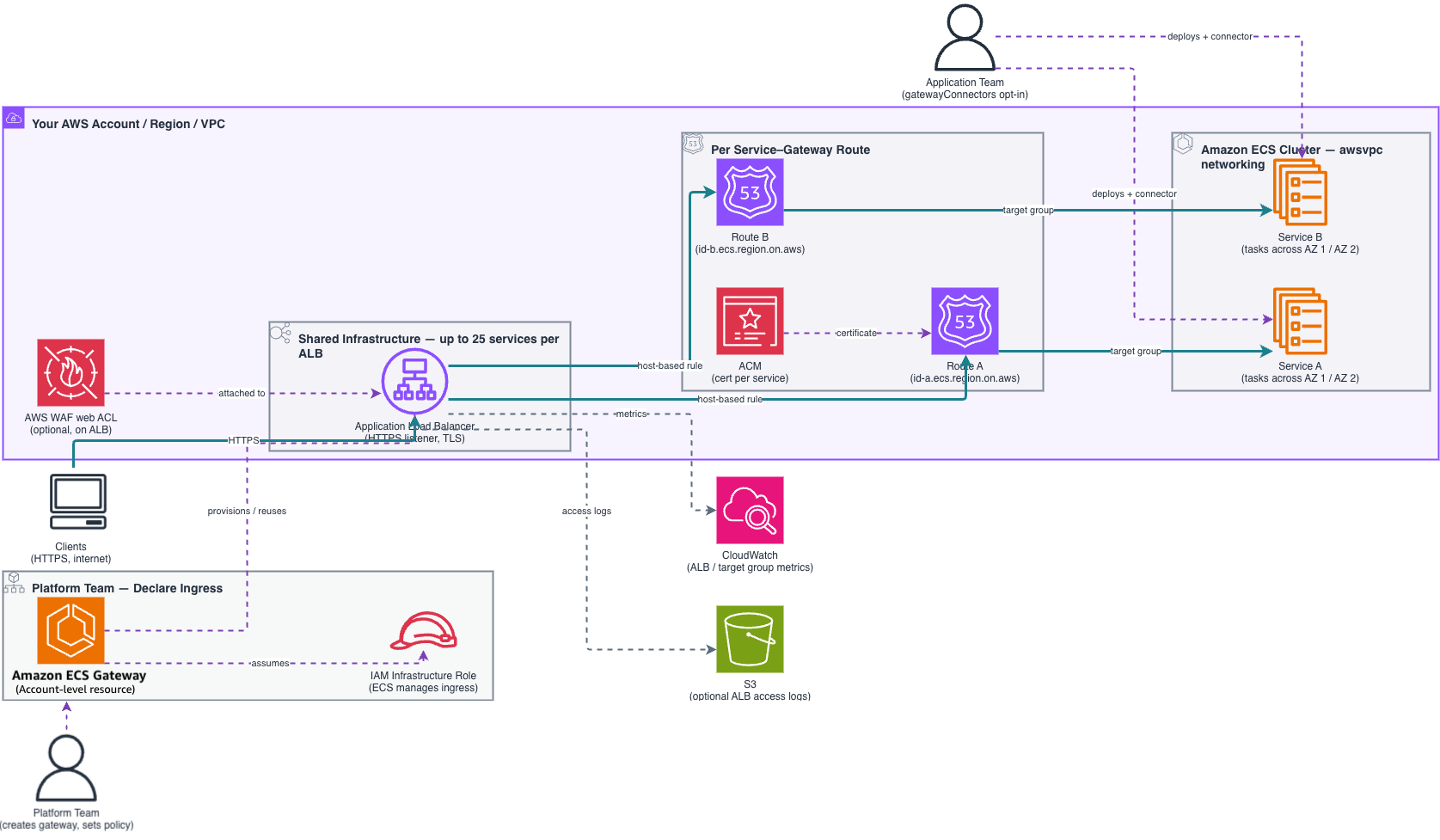
The primary innovation behind the ECS Gateway is its ability to move the burden of infrastructure orchestration from the human operator to the service itself. By acting as an account-level resource, ECS Gateway dynamically provisions and manages the necessary networking infrastructure directly within a user’s AWS account. This transition introduces a clear and much-needed separation of responsibilities: platform teams define the overarching networking standards and gateway configurations, while application teams focus on delivering the code that runs on the compute resources.


One of the most compelling aspects of this new offering is its approach to resource optimization through host-based routing. ECS Gateway enables up to 25 different services to share a single Application Load Balancer. This consolidation significantly optimizes infrastructure costs, as organizations no longer need to maintain dedicated load balancers for every single microservice. The intelligence behind this system ensures that ECS manages the entire lifecycle of the underlying infrastructure automatically. When the first service connects to the gateway, the system provisions the necessary ALB. As that capacity is consumed and additional services are added, the gateway intelligently scales by provisioning further ALBs, and just as importantly, it removes those resources when they are no longer required. Each service is provided with a unique DNS hostname, ensuring that a fully functional, production-ready endpoint is available the moment the provisioning process concludes.
Implementation and Operational Control
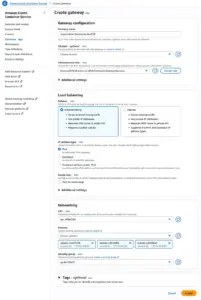
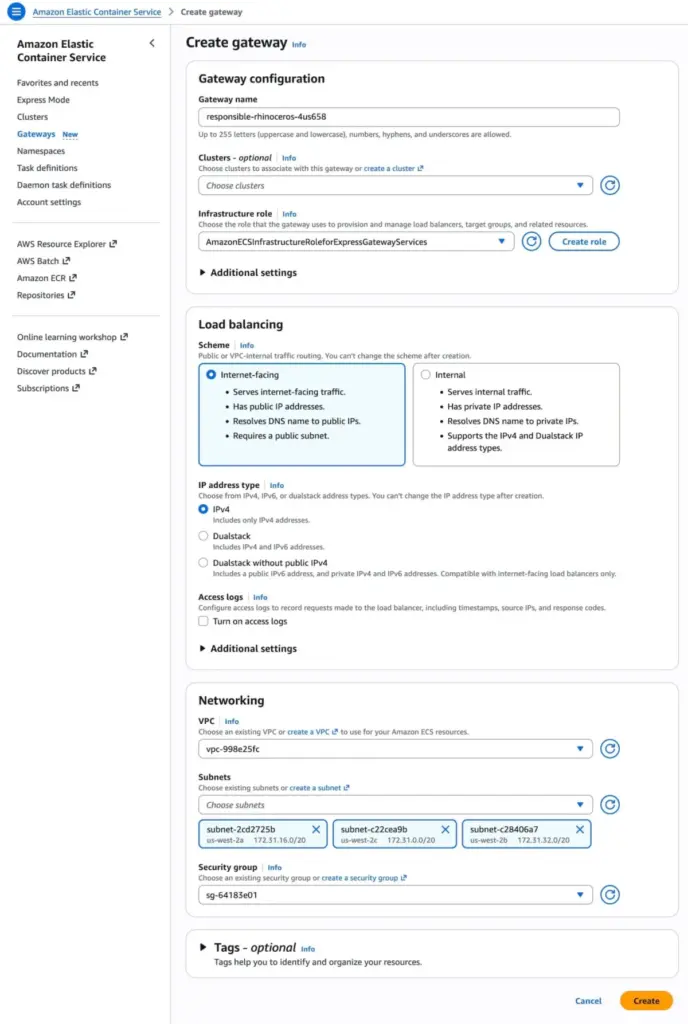
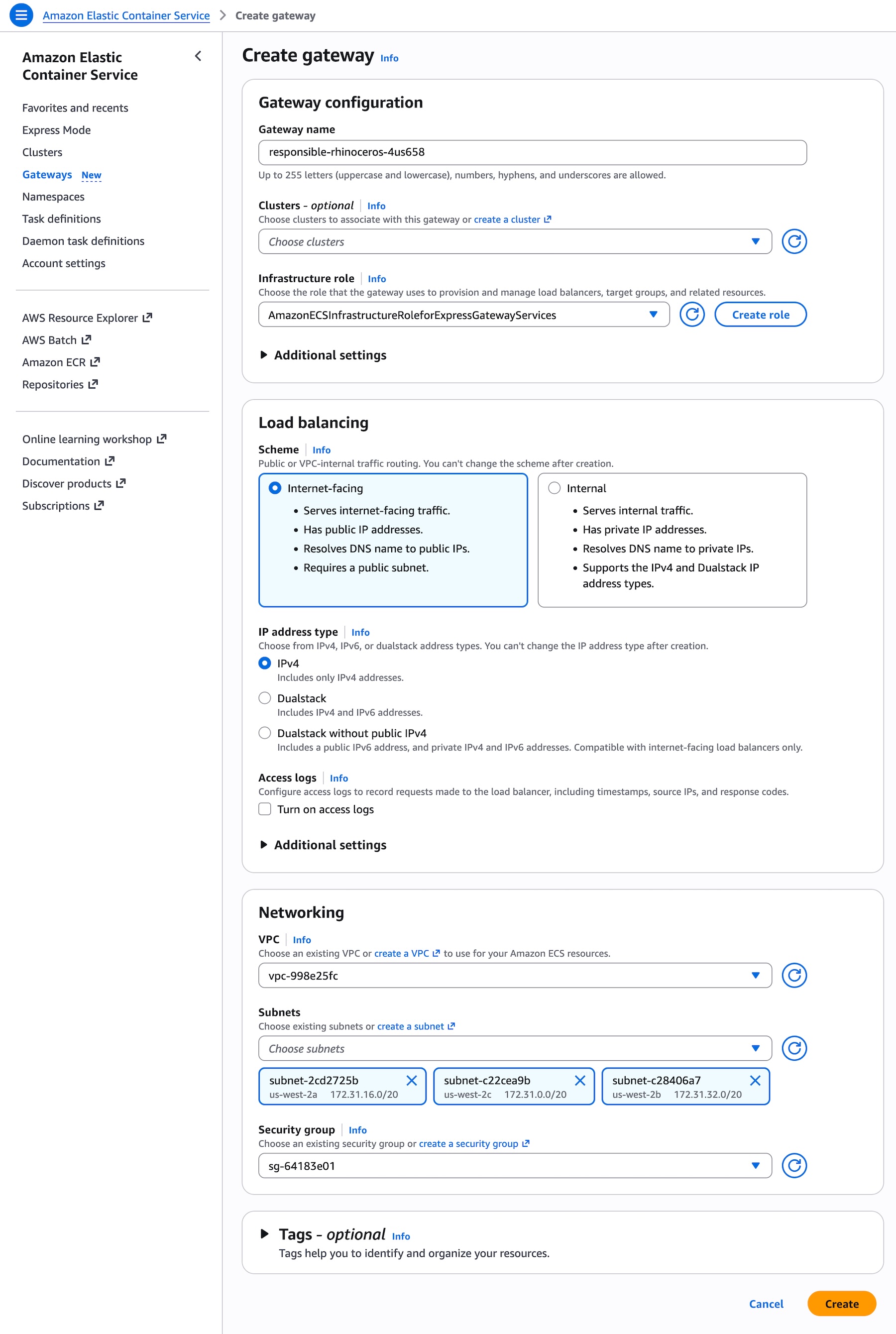
For platform teams looking to implement this new architecture, the experience begins within the Amazon ECS console. An administrator creates a gateway by defining its configuration and assigning an infrastructure role—an IAM role that grants ECS the necessary permissions to provision and manage load balancers, security groups, and certificates on the user’s behalf. During the setup process, teams can define whether the gateway should handle public or VPC-internal traffic. Further settings allow for the customization of listeners, ports, maximum load balancer counts, and the integration of AWS WAF web ACLs to ensure robust security postures from the start.
It is important to note that certain foundational settings, such as the gateway name, scheme, VPC, subnet selections, IP address types, and protocol configurations, are locked upon creation to ensure stability and predictability. Once the gateway is established, it can be associated with one or more ECS clusters. This flexible, many-to-many relationship allows platform teams to share a single gateway across various environments or, conversely, assign multiple gateways—such as distinct public and private entry points—to a single cluster.

This programmatic approach extends to the AWS Command Line Interface (AWS CLI), where the CreateGateway command allows for rapid, repeatable infrastructure deployment. Because the system is designed to be efficient, no actual infrastructure is provisioned until a service explicitly connects to the gateway using a connector. This "on-demand" provisioning ensures that resources are only utilized when there is a tangible need, preventing the waste often associated with pre-provisioning idle infrastructure.
Seamless Integration for Application Teams
The transition to ECS Gateway is designed to be as seamless as possible for application development teams. When defining a service—either through the CreateService or UpdateService API calls—developers simply include a gateway connector in their service definition. For teams that already have existing ECS services running on traditional load balancers, the migration path is intentionally non-disruptive. Organizations can adopt ECS Gateway incrementally, updating services to add the gateway connector while maintaining the original load balancer configuration. This dual-path capability allows developers to rigorously validate the gateway connection in a live environment before decommissioning the legacy setup.
During the deployment phase, Amazon ECS performs an automated evaluation. It looks at the gateways associated with the cluster and connects the service to every gateway that meets the necessary criteria—such as matching access types, existing within the same VPC, and covering the required Availability Zones. Once the connection is established, the system automatically provisions the required ACM certificate, sets up the unique DNS hostname, configures the listener rules for the target group, and manages the security group rules to ensure traffic is strictly limited to the ALB.
Handling Scale and Operational Complexity
Behind the scenes, the architecture is built to handle significant scale. A single gateway can be associated with up to 10,000 clusters, providing immense flexibility for large, enterprise-scale deployments. The operational benefits are particularly evident in the automation of common scenarios. If a service needs to be updated, or if an underlying infrastructure component requires maintenance, the ECS Gateway orchestrates these events without requiring manual intervention from the platform team.
The security model remains a top priority for AWS in this release. By allowing platform teams to control access through specific gateway-to-cluster associations and leveraging IAM policies, organizations can effectively restrict who is authorized to deploy services to specific clusters. This provides a robust guardrail that prevents unauthorized or accidental changes to the production networking environment, maintaining the integrity of the overall system architecture.
Availability and Economic Considerations
Amazon ECS Gateway is currently available across all commercial AWS Regions where Amazon ECS is supported. In keeping with standard AWS practices for infrastructure-level services, there is no additional charge for the gateway itself. Users continue to pay only for the underlying infrastructure that is provisioned in their account as a result of their service connections. This includes standard costs for Application Load Balancers, CloudWatch logs and metrics, ACM certificates, and data transfer charges. This transparent pricing model ensures that organizations only pay for the value they derive from the service, aligning operational efficiency with financial predictability.
For those eager to integrate this into their workflows, the AWS documentation provides a comprehensive overview of the APIs and best practices. Furthermore, the introduction of the AWS MCP Server and associated plugins for AI-driven coding tools underscores a commitment to making these infrastructure tasks accessible through modern, automated development environments. As platform teams begin to adopt this new capability, the feedback loop—facilitated through AWS re:Post and traditional support channels—will likely play a critical role in the continued evolution of how containerized ingress is handled in the cloud. By shifting the focus from manual resource management to automated, policy-driven networking, Amazon ECS Gateway represents a significant step forward in simplifying the complexities of the modern containerized ecosystem.