






Readers visiting Opensource.com lately may have noticed a distinct quietness across the platform. Behind that digital hush, however, lies a period of intensive behind-the-scenes activity. The community is hard at work on something entirely new. While specific operational details and project timelines are not yet ready for a broad public reveal, there is already plenty to discuss regarding the direction of the platform, the nature of open source collaboration, and the fundamental structures that connect the global digital landscape.
To understand where the community is heading, it is helpful to look back at how the internet itself was built, how top-level domains came to categorize human endeavors, and how open source has always functioned primarily as a human network rather than a merely technical one.
The Internet, and Top-Level Domains
Anyone who spends time online knows that the internet is, at its core, a network. By definition, a network is a group of interconnected connections. In fact, the very word "internet" is a portmanteau of "interconnected" and "network."


Historically speaking, the modern internet originated as a combination of two primary networks: the military network and the academic network. In those early days, the user base was relatively small, highly specialized, and tightly controlled. However, once the internet began to expand rapidly in popularity and utility far beyond those initial military and academic groups, a pressing logistical need arose. It became immediately apparent that different designations were necessary to easily and instantly differentiate various types of entities inhabiting the digital space. For instance, society needed a clear way to distinguish a commercial business entity from a charitable organization, an institution of higher education, or a governmental department.
These vital functional designations are known as top-level domains, or TLDs. Today, internet users can choose from a vast and diverse array of TLDs, ranging from niche industry extensions to country-code identifiers. However, for a long period in the early history of the web, there were only a handful of available options.
Those original TLDs have remained remarkably popular and culturally embedded in the architecture of the web. Most internet users intuitively understand their significance today. When an individual navigates to a web address ending in .com, for instance, they immediately recognize that they are visiting a commercial site intended for business or consumer transactions. Conversely, when a user visits an address ending in .org, they understand that they are accessing the digital home of a non-profit organization dedicated to a cause, community service, or public advocacy. These suffixes do more than route traffic; they tell a story about the identity and purpose of the entity behind the screen.
Open Source Is a Network
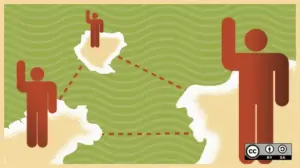
Just as the internet relies on interconnection, open source can manifest in many different forms and fulfill many different roles across society. It can be commercial, driving enterprise software solutions and global tech economies. It can be non-profit, supporting public infrastructure and digital liberties. It can be academic, fostering research, education, and foundational computer science. It can also be cultural, shaping how artists, writers, and creators share their works with the world.

Yet, no matter what specific form open source takes in any given context, it is fundamentally and always a network. Sometimes, that network consists of computers, servers, repositories, and distributed codebases communicating across global data lines. More importantly, however, it is a network of people.
Open source lives and breathes through human connection. Whether contributors, maintainers, and enthusiasts are gathering physically at an international conference, meeting informally at a local pub, or collaborating continuously in an online chat room, open source is first and foremost a community of living, breathing people working toward shared goals.
For the past twelve years, the website Opensource.com has been supported by a commercial entity. That institutional backing provided a stable platform for years of storytelling, documentation, and community engagement. However, the individuals—representing the diverse readership of contributors, advocates, and everyday users that make up the actual Opensource.com community—are not commercial entities. They are people.
The structural tension between commercial backing and human-driven community forms the backdrop for the platform’s current transition. In just one month, Opensource.com is going to resolve that long-standing alignment challenge. The community invites everyone to stay tuned as more details about this exciting new chapter emerge.