









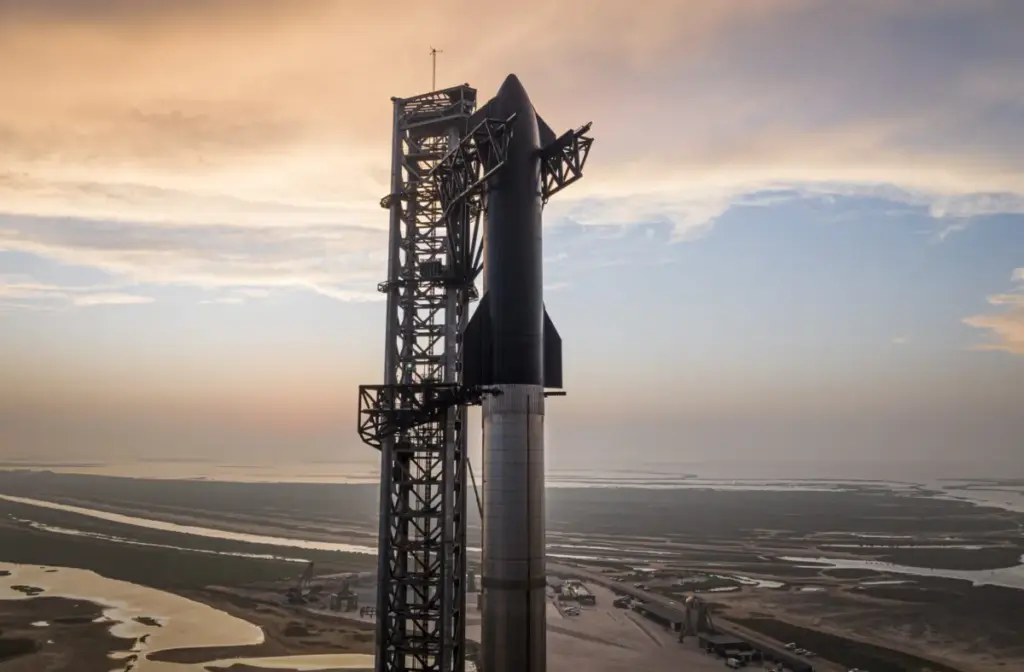
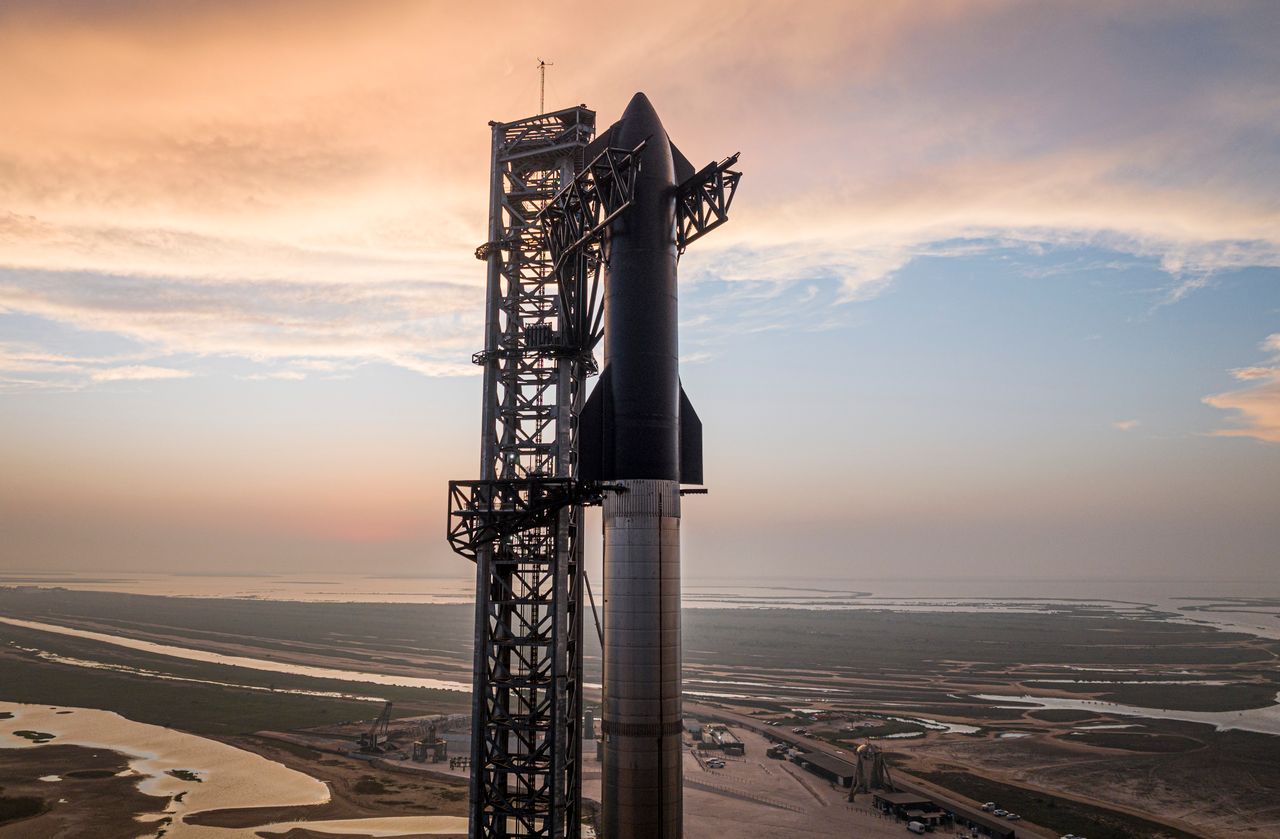
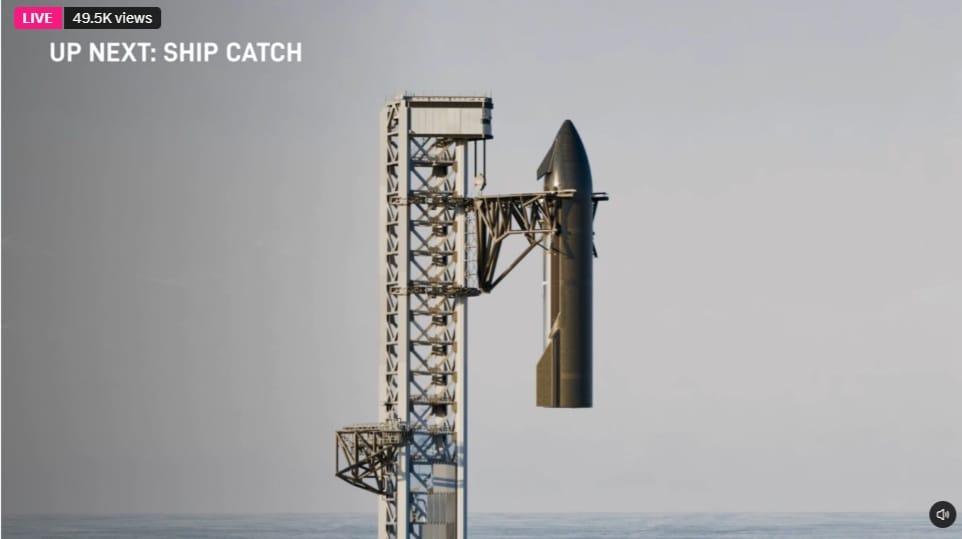
SpaceX CEO Elon Musk confirmed Tuesday that the private aerospace manufacturer and space transportation company will attempt a daring engineering milestone during its next orbital test flight: catching Starship’s upper stage directly out of the air using the launch tower’s mechanical arms.
Speaking during SpaceX’s third-quarter investor call, Musk revealed that the upcoming Starship Flight 15 will feature the unprecedented recovery maneuver. While he did not specify an exact launch date for the mission, Musk expressed high confidence in the team’s preparations, noting that it is "more likely than not that this succeeds next flight." If successful, the operation will mark a historic industrial milestone as the first time an orbital-class launch vehicle has been fully recovered, bringing SpaceX significantly closer to its ultimate vision of a fully and rapidly reusable transportation system designed for frequent commercial, scientific, and interplanetary travel.
The ambitious plan to catch both the massive upper "Ship" portion of the rocket and its corresponding booster is a cornerstone of SpaceX’s long-term commercial strategy. The capability is vital for supporting the rapid deployment of high-capacity broadband payloads, direct-to-device mobile connectivity constellations, and advanced artificial intelligence data center satellites into low Earth orbit. Furthermore, the hardware durability and rapid turnaround times promised by full reusability are foundational elements of the company’s broader roadmap to support crewed and cargo missions to the Moon and, eventually, Mars.

The upcoming test follows closely on the heels of Starship Flight 14, a landmark mission that successfully pushed the upper stage into orbit and deployed a fresh batch of high-capacity V3 Starlink satellites into active operation. The prior test flight had successfully deployed 20 of the V3 broadband units, though those specific pathfinder satellites were intentionally demised—directed back into Earth’s atmosphere to burn up—following a comprehensive series of rigorous operational tests.
Looking forward, SpaceX President and COO Gwynne Shotwell noted that the company will need to deploy a "few hundred" of the advanced V3 satellites before everyday Starlink consumer customers begin to genuinely feel the performance impact in terms of substantially improved network speeds and bandwidth. Shotwell suggested that the company could achieve this critical operational mass by mid-2027.
To meet these sweeping infrastructure goals, SpaceX anticipates a dramatic ramp-up in its Starship launch cadence. Musk stated that he expects the massive rocket to fly on a weekly basis at some point during the first half of 2027, before accelerating to twice-weekly flights—and potentially even higher frequencies—by the end of next year. While minor refurbishment will inevitably be required between individual Starship missions, the ultimate engineering and operational objective remains clear: to land the orbital rocket and turn it around for launch with the operational simplicity of a commercial airliner.
In tandem with the hardware cadence, Shotwell outlined several major technological milestones for the coming year. SpaceX plans to execute critical on-orbit propellant transfer demonstrations next year, paving the way for deep-space missions. Furthermore, the company intends to commence the deployment of its V2 Direct-to-Device satellites alongside a new generation of "Starmind" AI data center satellites starting in 2027.
On the broader operational front, SpaceX maintained an intense flight schedule across its existing fleet during the quarter, conducting a total of 35 launches. This impressive tally included 12 dedicated customer missions and 23 internal flights, delivering a combined total of 476 metric tons of payload to orbit. Among these were 21 Starlink satellite delivery missions successfully executed aboard the workhorse Falcon 9 rocket.
Starlink Adds 1.6M Consumer Subs
Commercial growth for the Starlink satellite internet division continued at a steady, albeit slightly moderated, pace during the quarter. Starlink added 1.6 million net new consumer subscribers, lifting its total active consumer base to 13.6 million accounts. That performance came in slightly below the 14.3 million subscriber consensus expectations anticipated by analysts at ISI Evercore.
Beyond individual residential consumers, Starlink’s expanding footprint increasingly captures enterprise and aviation markets. Shotwell reported that the enterprise and aviation segments account for hundreds of thousands of subscribers, with SpaceX closing out the quarter providing high-speed connectivity to approximately 3,800 commercial and private aircraft equipped with Starlink hardware.
Financial metrics for the broadband service reflected shifts in global market penetration. Starlink’s consumer average revenue per unit drifted downward to $69 per month, compared to $83 in the same quarter a year prior, as the service scales into broader international markets with varied pricing tiers. Geographically, Starlink concluded the period with operational coverage established in 174 countries, supported by a constellation of 11,100 active satellites in orbit.
SpaceX’s connectivity unit, which houses the Starlink business, generated robust third-quarter revenue of $5.24 billion. This total comprised $3.12 billion from consumer subscriptions and $2.12 billion from enterprise and government accounts. By comparison, the traditional space manufacturing and launch segment brought in $1.76 billion, while the company’s AI division recorded $7.56 billion in revenue.
On a consolidated basis, SpaceX revenues surged 161% year-over-year to reach $14.6 billion. Net income experienced a dramatic recovery, improving to $4.4 billion compared to a net loss of $1.1 billion reported in the corresponding period a year ago. Capital expenditures for the quarter stood at a substantial $19.59 billion, strategically distributed across $1.60 billion for space infrastructure, $1.54 billion for connectivity expansion, and $16.44 billion dedicated to artificial intelligence initiatives. Following the strong financial disclosures, SpaceX shares climbed $12.31, or 8.33%, to reach $160.10 each during Tuesday’s after-hours trading session.
Mobile Mission Continues
Turning to its ambitious wireless telecommunications strategy, SpaceX confirmed that it expects its pending acquisition of 800MHz spectrum assets from Grain Management to formally close in the first half of 2027. The company intends to leverage this lowband spectrum to construct and operate a revolutionary hybrid satellite-and-terrestrial mobile network.
The initiative has not been without its skeptics. SpaceX’s broader mobile network strategy has drawn industry criticism regarding whether the company ultimately possesses the necessary spectrum rights and terrestrial infrastructure to pull off the ambitious undertaking, and whether it can successfully deploy the service in the United States without relying on traditional mobile virtual network operator (MVNO) partnership agreements with established carriers like AT&T, T-Mobile, or Verizon.
Addressing these concerns, Shotwell explained that SpaceX expects its S-band spectrum allocations to handle the heavy lifting for space-based mobile connectivity, while the lowband spectrum will be deployed specifically to ensure reliable signal penetration inside buildings. She reiterated the company’s blueprint to build out the terrestrial side of the network by integrating smaller, localized radios directly onto Starlink user terminals and mounting equipment on existing communications towers.
Musk suggested that the company would soon benefit from hosting a more comprehensive, dedicated presentation outlining the overarching strategic game plan for Starlink connectivity, noting that many outside industry watchers are currently "missing some pieces" of the puzzle.
"We do see a clear path to several hundred billion dollars a year in connectivity revenue," Musk concluded.