










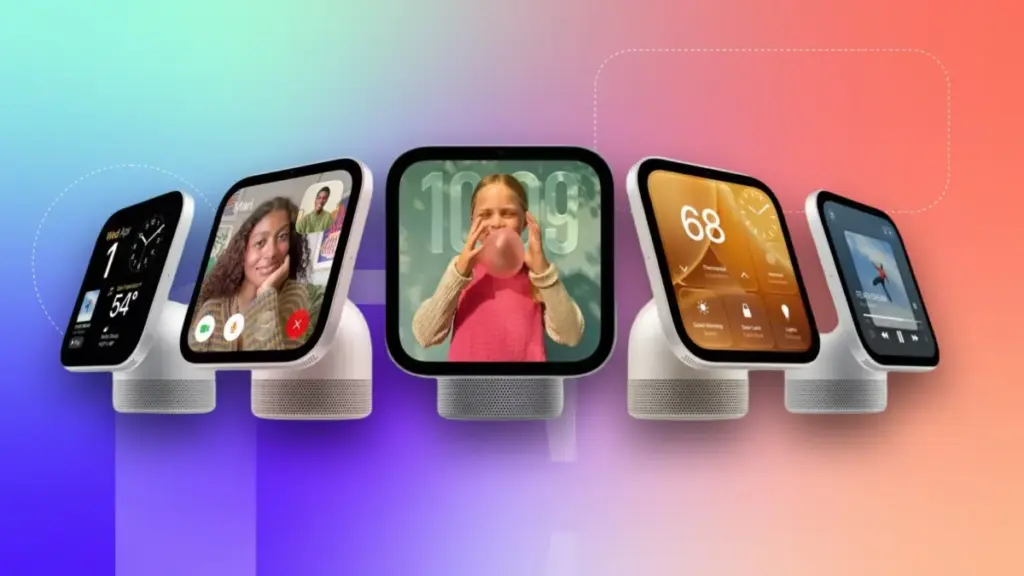
As smart home ecosystems grow increasingly complex, consumers constantly search for cleaner, more centralized ways to manage their connected devices. Enter Apple’s highly anticipated HomeView, a device that has quickly emerged as one of the most promising hardware introductions for tech enthusiasts and casual users alike. However, ahead of its official November 13 release and subsequent preorders, prospective buyers are discovering that choosing the right model is far more complicated than simply picking a favorite color or screen size.
Apple is offering two distinct versions of the HomeView, both priced at $299. The first is a tabletop model equipped with a dedicated speaker base and automatic tilting capabilities. The second is a wall-mounted model that requires users to select from a range of specialized mounting options. Choosing the wall-mounted route means sacrificing the robust, room-filling audio power built into the tabletop’s speaker base. Furthermore, opting for the wall-mounted configuration introduces a series of decisions regarding hardware selection, potential professional installation fees, and wiring requirements.

Despite the physical and acoustic differences, both the tabletop and wall-mounted versions share the same foundational computing power and core interface. Each model features a vibrant 7-inch Liquid Retina display designed to act as a central smart screen for entertainment, household management, and home security monitoring. Both variants support advanced facial recognition technology to seamlessly switch between personalized user accounts, alongside native integration for Messages, FaceTime, Calendar, Reminders, and the Find My network. Furthermore, both versions fully support Siri AI capabilities and other key ecosystem functionalities.
A common misconception circulating through initial launch coverage is that the tabletop HomeView features a detachable screen. In reality, the 7-inch display is permanently integrated directly into the speaker base. Consequently, buyers must weigh their priorities carefully. Purchasing the tabletop model for $299 yields enhanced speaker performance and physical adjustment features, while paying the exact same $299 for the wall-mounted version trades away those built-in speakers entirely. There is no price disparity between the two configurations, and Apple’s hardware design does not allow users to purchase a wall-mounted unit and later acquire a separate base, or vice versa. Once a consumer selects a model, they are permanently locked into that hardware choice.
For renters and those seeking the lowest barrier to entry, the tabletop HomeView presents the most straightforward path to adoption. Beyond its simpler installation process, the tabletop configuration features a robust audio architecture complete with down-firing woofers, two passive radiators, and two full-range drivers. In demonstration environments, the tabletop unit delivers impressively loud, deep, and resonant sound capable of filling spacious areas. Because it relies only on a standard power adapter and a USB-C cable plugged into a nearby wall outlet, renters can easily place the device on counters, desks, or nightstands without altering the property or requiring permanent structural modifications.

For consumers who prefer a streamlined, built-in aesthetic, the wall-mounted HomeView offers an entirely different proposition. Without the bulky speaker base, the wall-mounted unit relies strictly on its internal speakers, making it an ideal choice for a dedicated smart home dashboard, family calendar, and security monitoring station. Users can configure a wide array of widgets to maintain quick access and direct controls for all compatible smart home accessories.
To facilitate wall installation, Apple offers three distinct mounting accessories manufactured by Schneider Home. The first option is the Power Mount USB-C Wall Connector, priced at $59.95. Marketed as a self-installation solution, this kit includes the mount and an attached USB-C cable, though users must supply a separate 20-watt power adapter if they do not already own one. While it represents the most affordable and accessible mounting route, it is also the least visually discreet, leaving a USB-C cable visibly dangling down the wall to the nearest electrical outlet. This solution suits renters who are comfortable drilling a small number of holes for screws and wall anchors, as well as homeowners who prefer a straightforward do-it-yourself project.
For a cleaner, more permanent look, Schneider Home offers the Power Mount AC Wired for $79.95. This hardwired alternating current mount routes power directly through the interior of the wall, sitting completely flush against the surface. The hardwired connection delivers a continuous 30 watts of power through a standard single-gang wall box. While ADT security integration services are available for this setup, Apple representatives have not yet provided detailed specifications regarding the exact nature of the service partnership. Industry professionals note that this option is far better suited for homeowners than renters.

Michael Malfettone, owner of Malfettone Electric and a licensed master electrician based in Jersey City, strongly advocates for the hardwired approach for permanent installations. For most homeowners, Malfettone recommends the AC Wired mount because it connects directly to existing home electrical wiring, fits a standard single-gang box, and results in a clean, cord-free appearance. He notes that while the USB-C wall connector is convenient for avoiding electrical work or utilizing existing outlets, it compromises the visual presentation.
The third option available from Apple is the Power Mount PoE Wired, priced at $129.95. This mount utilizes Power over Ethernet technology, delivering both continuous power and a direct, hardwired internet connection through a single Ethernet cable without relying on Wi-Fi. Operating through a power-over-Ethernet network switch, this configuration provides a stable, always-online network link that does not depend on wireless signal strength. Although ADT installation services are listed as available for this mount, specific coordination details from Apple remain pending. Because it guarantees continuous power and uninterrupted data connectivity, it serves as an optimal solution for intensive home security, smart automation, and climate control hubs.
Malfettone explains that the Power-over-Ethernet mount is specifically engineered for households with extensive smart home equipment, structured wiring panels, or dedicated network closets. Because controlling central heating and air conditioning functions efficiently over either hardwired mount, the decision to choose PoE centers primarily on network reliability rather than basic thermostat management. Furthermore, PoE installations involve low-voltage work with no high-voltage AC wiring exposed at the wall box.

When budgeting for a wall-mounted HomeView, prospective buyers must also factor in the cost of professional installation. Malfettone emphasizes that prices for an AC-wired installation vary widely depending on existing household infrastructure. When a junction box or powered outlet already exists directly behind the desired mounting location, professional labor typically ranges from $150 to $300. However, fishing a new electrical line through a finished wall from a nearby circuit generally increases costs to between $400 and $600. For complex scenarios involving dedicated new circuits from the main electrical panel, challenging physical access, plaster walls, multi-story layouts, or homes lacking attic and basement crawlspaces, labor costs can easily escalate from $600 to $1,000 or more, excluding local permit fees and necessary drywall patching.
Malfettone also cautions that line-voltage installations frequently require formal electrical permits depending on state and local regulations. Executing line-voltage work safely involves installing a single-gang box at the target location with a 120-volt feed, whether tapped from an adjacent circuit or pulled fresh from the panel, followed by securing the mount and repairing any disturbed wall surfaces. In jurisdictions like New Jersey, adding a new electrical box or circuit invariably triggers the need for a formal electrical permit.
For installations utilizing the Power-over-Ethernet mount, labor costs are largely driven by the physical Ethernet cable run back to the central network hardware, typically costing between $150 and $400 per cable run. Households lacking an existing PoE network switch will also need to budget an additional $100 to $250 for networking hardware. Consequently, PoE installations are most cost-effective and practical during new construction projects or major renovations when interior walls are fully open.

While condo owners can also integrate these smart displays, Malfettone notes that single-family homes present the fewest logistical hurdles because owners maintain full authority over their interior walls and electrical panels. Condo and apartment residents must consult their homeowners associations and verify building codes before commissioning licensed electrical work. Regardless of the housing type, both homeowners and property managers stand to benefit from a centralized interface capable of regulating lighting, security systems, climate controls, and connected appliances.
Ultimately, professionals advise viewing a permanent smart home display as an integral component of a residence’s core electrical and networking infrastructure. Selecting the ideal HomeView configuration involves balancing aesthetic preferences, installation complexity, and long-term expansion goals to ensure reliable performance and a clean finish for years to come.