











Following the successful completion of the high-profile Charter-Cox merger, Spectrum is embarking on a significant strategic pivot. Company leadership announced that the telecommunications giant is implementing a brand-new operating model designed to build a leaner, more effective organization. The overarching objective of this radical restructuring is clear: to steer the company back onto a trajectory of sustainable customer and financial growth within an increasingly competitive and complex telecommunications market.
During Friday’s third-quarter earnings call, Spectrum Chief Executive Officer Chris Winfrey addressed the structural changes directly, offering transparency regarding the company’s recent performance.
"We’re announcing a new path forward for Charter to address a more competitive and complex market," Winfrey told investors and analysts. "We recognize that we have not generated the customer growth and performance we expect."

Winfrey explained that the new corporate structure represents a fundamental redesign of how the company operates at every single level. The sweeping corporate overhaul involves a comprehensive reformatting of Spectrum’s core value proposition alongside a fresh go-to-market strategy that prioritizes broadband connectivity above all else. Furthermore, executive leadership has directed heightened attention toward managing customer churn, elevating overall customer service standards, and discovering innovative ways to build long-term value around existing product ecosystems and service bundles.
While executive leadership opted not to inundate the earnings call with exhaustive operational specifics, Winfrey assured stakeholders that additional details will be shared in the near future. He explicitly promised that Spectrum will successfully accelerate its internet sales rate moving forward.
This evolving strategic blueprint is rapidly taking shape under the guidance of newly appointed Chief Operating Officer Nick Jeffery. Jeffery, a seasoned telecommunications veteran who previously served as an executive at Vodafone UK and Frontier Communications, officially assumed the COO role on September 1. Just last month, Jeffery introduced a flatter, significantly simpler operating hierarchy designed to fulfill an ambitious internal campaign he has championed under the banner of "The Great Cable Comeback."

Winfrey praised the new COO during Friday’s call, describing Jeffery as a powerful "change agent" who is effectively forcing Charter to fundamentally rethink how it competes across all regional footprints.
Despite the optimism surrounding the leadership shakeup, company executives acknowledged that predicting an exact timeline for a turnaround remains challenging. There is currently no definitive guidance or formal outlook regarding precisely when Spectrum expects to return to positive broadband subscriber growth.
"We’re not providing any guidance or outlook for exactly when we return to growth," Winfrey noted. "But I want to be very clear: That’s the objective; that’s the determination of success."
Spectrum is far from alone in navigating these difficult industry headwinds. Major cable and internet competitors are similarly grappling with shifting consumer habits and market pressures. Comcast, for instance, is currently undergoing a major internal restructuring aimed at enhancing corporate agility, a transition that has unfortunately resulted in state-level layoff warnings and workforce reductions.
Under-Penetrated Cox Footprint Represents a Major Strategic Opportunity
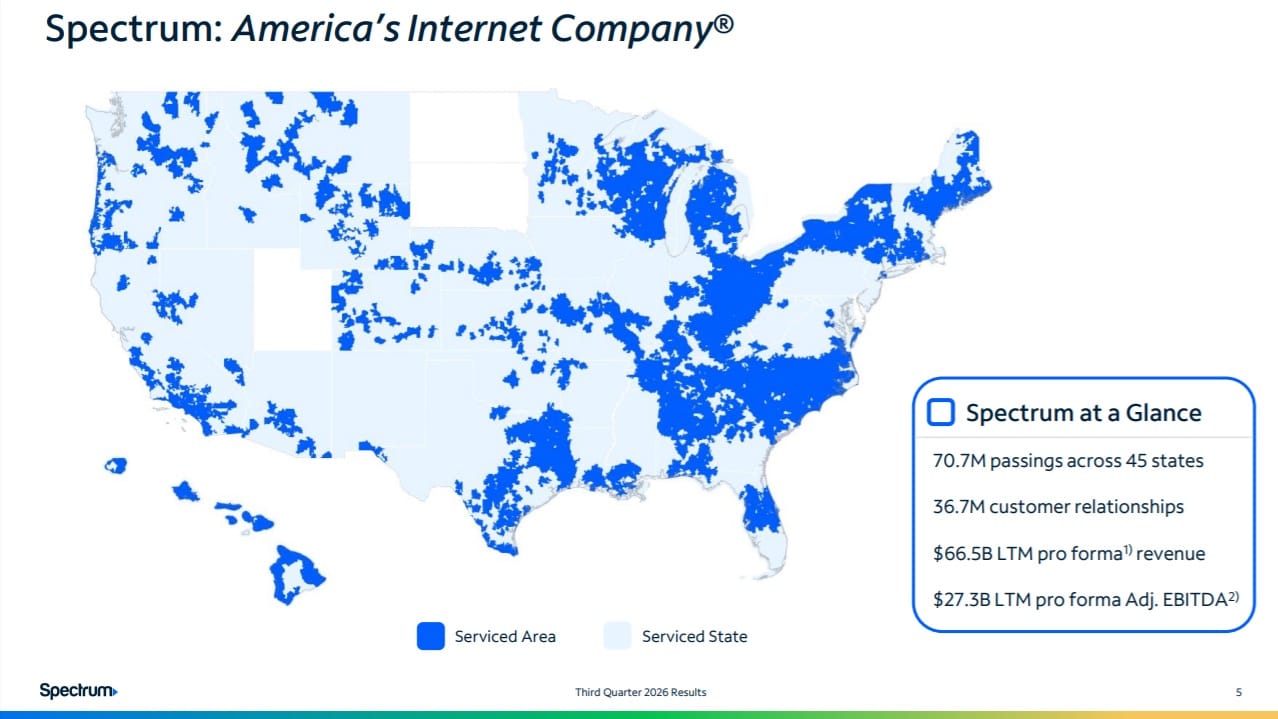
A critical component of Spectrum’s path forward involves optimizing performance within the newly acquired Cox footprint, a massive expansion that introduces approximately 11 million passings and 5 million existing customers to the company’s network.
"The lower starting penetration in the Cox markets is a big opportunity," Winfrey emphasized during the earnings presentation.
According to executive leadership, early indicators of improvement across broadband, mobile, and video services are already visible in these newly integrated regions. These positive shifts follow the official rollout of Charter’s standardized pricing and packaging models across the Cox footprint, which commenced on September 16.
The initial performance metrics in these legacy Cox territories offer encouraging signs for the combined company. During the third quarter, Spectrum successfully added 68,000 mobile lines in the legacy Cox markets, more than doubling the gain of 32,000 recorded during the same period a year earlier.
On the broadband side, the company shed 77,000 subscribers in the Cox markets during the third quarter. While representing a subscriber loss, this figure marks an improvement compared to a loss of 62,000 subscribers a year earlier and a much steeper loss of 103,000 subscribers recorded in the prior quarter. Additionally, video subscriber losses in the Cox markets slowed to 39,000 for the third quarter, representing an improvement from the 51,000 video subscribers lost during the same period in the previous year.
Alongside the $1 billion in financial transaction synergies originally anticipated from the merger combo, Winfrey noted that Spectrum is now actively targeting an incremental $2 billion in annualized run-rate operating expense savings over the next 18 months. A substantial portion of these targeted savings will be achieved by systematically eliminating internal corporate projects that do not directly contribute to core broadband growth.
While the corporate reorganization and reduction of management layers will inevitably shift how the organization functions, company executives noted that these cost-saving measures are not focused on front-line customer service and sales employees who interact directly with consumers.
Pro Forma Subscriber and Financial Snapshot
Looking at the broader financial and subscriber landscape on a pro forma basis—which accounts for the combined operations of legacy Charter and legacy Cox—Spectrum experienced continued pressure in its traditional broadband segment. The combined entity lost 233,000 broadband subscribers during the third quarter, consisting of 228,000 residential and 5,000 business customer losses. This compares unfavorably to a pro forma broadband loss of 171,000 subscribers recorded during the same period last year. Following these adjustments, Spectrum’s grand total of broadband subscribers stood at 34.31 million, which includes 32.28 million residential accounts and 2.02 million business connections.
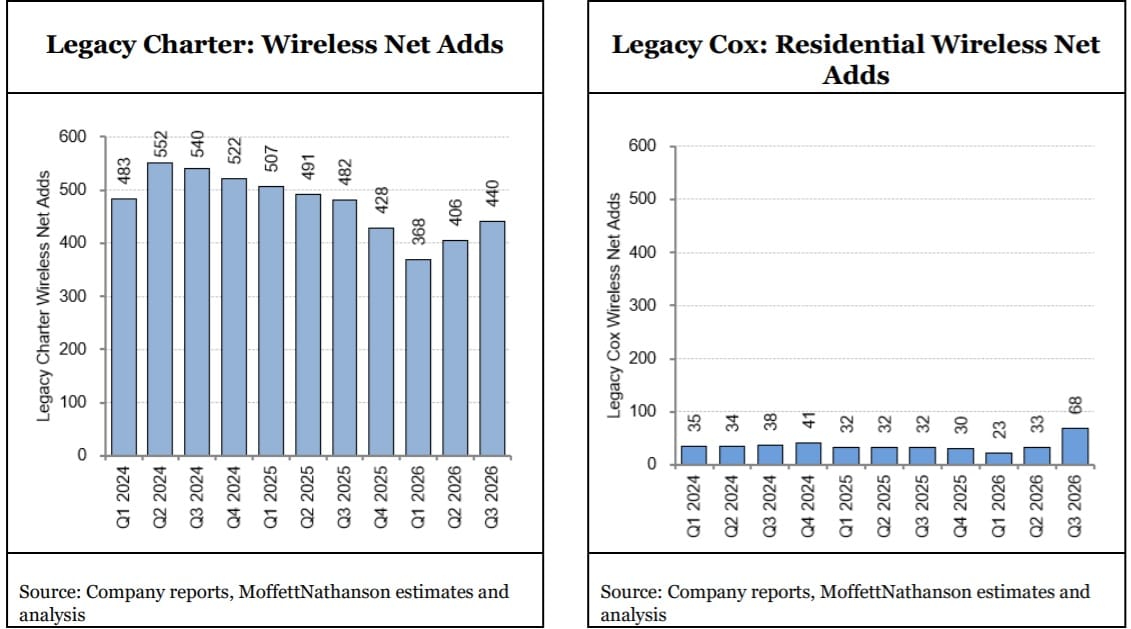
In contrast, the wireless and mobile division continued to serve as a primary engine of growth for the company. The combined enterprise successfully added 508,000 mobile lines during the quarter, broken down into 489,000 residential additions and 19,000 business additions. This robust expansion brought Spectrum’s total mobile subscriber base to 13.45 million lines, comprising 12.99 million residential lines and 460,000 business lines.
The video segment also showed relative stabilization compared to historical trends. The pro forma company lost 77,000 video subscribers during the third quarter, including 66,000 residential and 11,000 business accounts. This performance marked a notable improvement over the 121,000 video subscribers lost during the corresponding period of the previous year, bringing the total video subscriber count to 13.8 million, which includes 13.29 million residential and 503,000 business subscribers.
Financially, pro forma total revenues dropped by 1.5% to reach $16.50 billion for the quarter. Within that total, internet revenues accounted for $7.09 billion, down slightly from $7.36 billion recorded a year earlier.
Network expansion efforts continued steadily, with the combined company adding 390,000 new passings during the third quarter to close out the period with a total footprint of 70.7 million passings.
Wall Street reacted cautiously to the earnings report and strategic update. Charter shares dropped $3.35, or 2.66%, to close at $122.51 per share during Friday afternoon trading. With Friday’s market movement, Charter shares have declined by approximately 41% since the beginning of the year.