


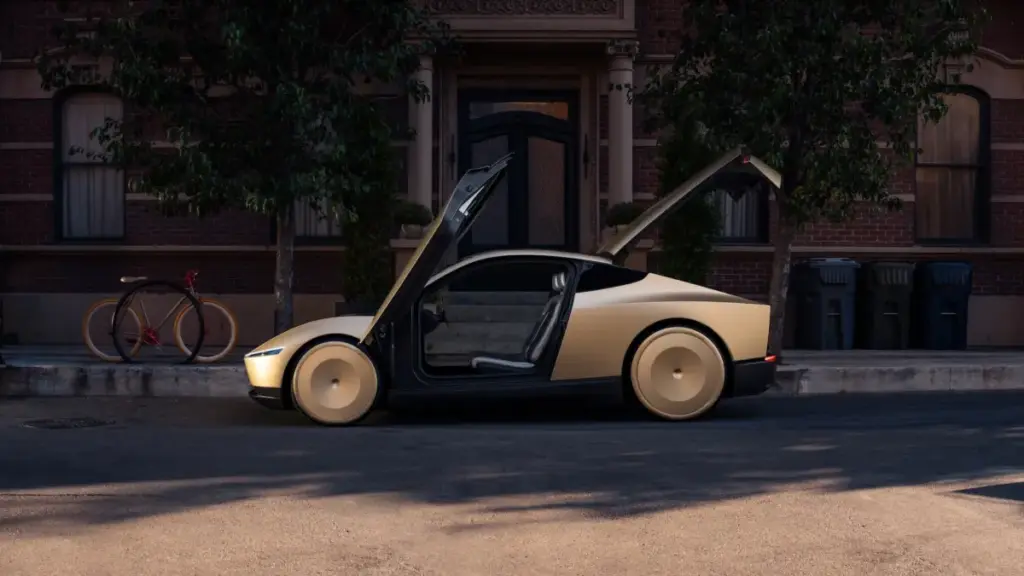
Tesla announced on Wednesday that it intends to begin selling its autonomous Cybercab to customers by the end of the year, a bold assertion that comes even as federal safety regulators have launched a formal investigation into whether the vehicle’s design meets established safety standards. The Cybercab, a distinctive, gold-hued two-seater, is notable for its radical departure from traditional automotive engineering: it lacks a steering wheel, brake pedals, and other manual controls.
The announcement was made during Tesla’s third-quarter earnings call, where the company’s vice president of engineering, Lars Moravy, provided additional clarity on the rollout strategy. According to Moravy, the Cybercabs currently rolling off the production line are earmarked for the company’s own internal robotaxi fleet. However, as the company ramps up production and gains operational experience, Tesla plans to expand its reach.
"We will mainly deliver fully designed autonomous vehicles to our customers," Moravy stated during the call, emphasizing that the initial phase will be modest. He noted that the company intends to scale its efforts deliberately as it gathers data and learns more about the nuances of delivery, ownership models, and the complex logistics of managing fleets of autonomous vehicles.
The notion of selling the Cybercab to third-party operators is a relatively recent pivot for Tesla. The company first signaled this possibility last month during a high-profile Cybercab launch event in Austin, Texas, where it solicited interest from potential buyers through an online form. Until that point, it remained unclear whether Tesla would seriously pursue a business model involving the direct sale of these vehicles, or how such a transaction would even be structured.
For years, CEO Elon Musk’s vision for a massive, cost-effective robotaxi fleet was rooted in a different philosophy: the idea that millions of existing, privately owned Tesla vehicles could be transformed into autonomous taxis through a simple, over-the-air software update. That vision has yet to materialize in a meaningful way, and Musk’s recent commentary on the earnings call underscores a significant shift in the company’s strategic outlook.
Currently, Tesla owners have access to "Full Self-Driving (Supervised)," an advanced driver-assistance system that automates a wide array of driving tasks. Despite the nomenclature, the system still necessitates that a human driver remain fully engaged and prepared to take control of the vehicle at a moment’s notice. While Tesla continues to deploy software updates aimed at enhancing the system’s capabilities, the reality of current operations requires constant human oversight—a requirement that has been tested by some owners who have been filmed pushing the system to its operational limits.
Adding to the complexity of the timeline, Musk revealed on Wednesday that an "unsupervised" version of FSD is slated for release in the second quarter of next year. For many Tesla owners who have purchased or subscribed to the software years in advance, this represents yet another delay in the long-promised arrival of truly autonomous capabilities.
If both the year-end sales timeline for the Cybercab and the mid-year rollout of unsupervised FSD for existing vehicles hold true, a curious scenario emerges: third-party fleet operators could potentially purchase the dedicated, steering-wheel-free Cybercab and deploy it as a robotaxi service before individual Tesla owners are granted the ability to use their own vehicles in a fully autonomous, driverless capacity.
Musk clarified the intended use case for the Cybercab during the call, distinguishing it from the consumer-focused vehicles that currently define the Tesla brand. He characterized the Cybercab as a "transport-as-a-service" vehicle rather than a personal possession.
"Cybercab is primarily going to be something that is offered as like transport as a service, whereas our other cars would be more, you know, the cars that you’d want to own, like the 3 and the Y and whatnot, and the Roadster, obviously," Musk explained. "But, you know, the vast majority of the Cybercab stuff will be essentially Tesla-owned and transported as a service."
Despite the ambition behind this vision, a significant hurdle looms over the project. The National Highway Traffic Safety Administration (NHTSA), the primary federal agency responsible for auto safety, announced last month that it had initiated an investigation into the Cybercab. This regulatory action came only hours after the vehicles were first spotted operating on public streets in Austin.
The crux of the investigation involves the Federal Motor Vehicle Safety Standards (FMVSS). These long-standing regulations mandate that vehicles equipped for public roads must include manual controls, such as brake pedals, as well as specific hardware like rearview and side-view mirrors. The industry standard for compliance has historically relied on a system of self-certification, where manufacturers attest that their vehicles meet these federal benchmarks. Tesla has utilized this same process for the Cybercab.
However, current federal regulations are not designed to accommodate vehicles that lack manual controls entirely. While the Department of Transportation has recently proposed removing these specific requirements for vehicles explicitly engineered for autonomous operation—a move widely seen as a significant win for Tesla—the regulatory landscape remains in a state of flux.
In the interim, the NHTSA has made it clear that its investigation will focus on "examining the process and technical data on which Tesla relied when certifying the Cybercab and related issues." The outcome of this inquiry is critical, as it could dictate the legal pathway for Tesla to operate the Cybercab fleet on public roads, or determine whether third parties would even be permitted to own and operate these vehicles under current law.
As Tesla prepares to enter this new phase, the company faces the challenge of balancing its aggressive production and sales timelines against the cautious, deliberate pace of federal regulators. Whether the Cybercab will indeed hit the streets under private ownership by the end of the year remains a subject of intense speculation, contingent upon both technical execution and the resolution of these foundational regulatory concerns. For now, Tesla continues to refine its software and production capabilities, navigating the uncertain intersection of innovation and government oversight.