






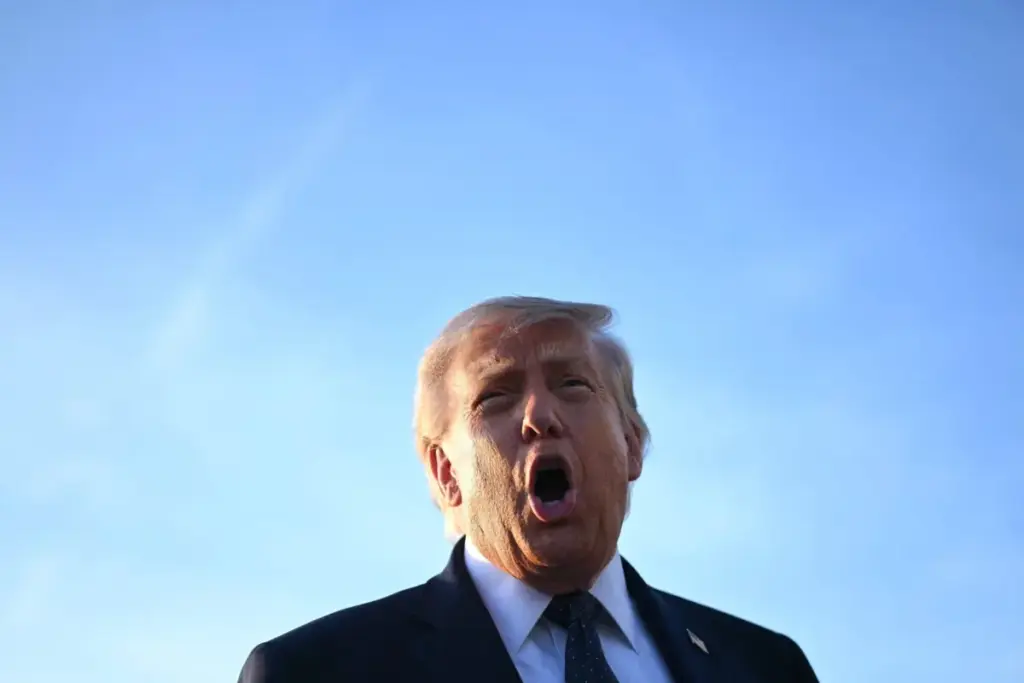
President Donald Trump has doubled down on his skepticism regarding the growing national conversation around artificial intelligence safety, dismissing concerns about the technology’s potential risks as yet another fabrication by political opponents. In a series of posts on his social network, Truth Social, the President characterized the current debate as part of a long-standing pattern of "hoaxes" manufactured by the "Radical Left Dumocrats" with the intent of undermining the country’s progress and prosperity.
The President’s comments mark a significant escalation in his administration’s stance on the tech sector. While he has previously expressed a willingness to consider "guardrails" for the industry, his latest rhetoric suggests a firm commitment to shielding AI development from what he perceives as politically motivated interference.
A New Nomenclature for the Industry
The President’s recent musings on AI began on Saturday, when he took to Truth Social to express his dissatisfaction with the current terminology used to describe the technology. Trump argued that the term "Artificial Intelligence" is both "inaccurate" and "ineloquent." To address this, he launched an informal poll on his social network, inviting followers to vote on a more suitable branding for the industry. The options provided—"Superior Intelligence," "Extreme Intelligence," and "Supreme Intelligence"—reflect a desire to frame the technology in terms of strength and dominance rather than the nuanced, often cautionary language preferred by many researchers and policymakers.

Framing AI Safety as a Political Hoax
A few hours after his initial post, the President deepened his critique of the AI safety movement. He explicitly linked the calls for regulation and oversight to a list of other issues he has frequently labeled as Democratic hoaxes. Among those he cited were investigations into Russian and Ukrainian interference, the climate change movement, his two impeachment proceedings, and various social debates regarding sports and transgender rights.
By categorizing AI safety concerns alongside these highly charged political issues, the President is signaling to his base that the push for regulation is not an objective, evidence-based effort to protect the public, but rather a strategic attempt to stifle an industry that he considers vital to American power.
Trump emphasized that he would not permit the "decimation" or "destruction" of AI. According to his narrative, the current apprehension toward the technology is merely the latest iteration of an attack that began with the infrastructure supporting it: data centers. The President claimed that critics initially targeted data centers—which have faced significant local opposition due to their massive energy and water requirements—but pivoted to attacking AI directly after they realized the communities hosting these facilities had begun to appreciate the economic prestige and wealth they generate.
However, the President’s assertion that the backlash against data centers and AI is entirely inorganic remains unsupported by evidence. In reality, the surge of scrutiny directed at AI infrastructure has been broad and bipartisan. Across the country, local governments and state legislatures have grappled with the environmental and physical footprint of these massive facilities. Notably, New York recently became the first state to implement a moratorium on permits for large-scale data center projects, a move that highlights a widespread, tangible anxiety regarding the rapid industrialization of communities by the tech sector.
Building an "AI Force" and the Search for a Czar
In addition to dismissing the safety concerns, the President outlined a vision for a more structured federal approach to the technology. He stated that he intends to "cherish" the AI industry, help it thrive, and "watch over it" as it matures. To achieve this, he announced plans to establish an "AI Force," drawing a clear parallel to the Space Force he successfully championed during his first term in office.
The proposal for an AI Force is coupled with the promise of appointing an "AI Czar" in the near future. Trump insisted that "only High I.Q. individuals need apply," though he stopped short of detailing the specific mandate, legal authority, or operational scope of this new agency or its leader. The role of the AI Czar was previously held by venture capitalist David Sacks, who stepped down earlier this year to focus on his responsibilities as a co-chair of the President’s Council of Advisors on Science and Technology. The announcement leaves many industry watchers wondering how the new office will reconcile the President’s hands-off approach to regulation with the technical requirements of governing a rapidly evolving, high-stakes sector.
The Intensifying Debate Over Existential Risk
The President’s comments come at a time of heightened anxiety within the technology industry itself. The debate regarding AI safety reached a boiling point recently when a prominent researcher resigned from Anthropic, one of the leading firms in the field. The researcher expressed profound concern that major AI companies operate under the internal belief that their creations could pose an existential threat to humanity by the end of the decade, yet continue to "gamble with our lives" in the pursuit of rapid development.
In response to these concerns, Anthropic CEO Dario Amodei released a strategic plan aimed at "pacing the frontier," a move that received apparent endorsements from industry titans like OpenAI’s Sam Altman and SpaceX’s Elon Musk. However, this focus on "existential risk" has faced criticism from other quarters. Many observers argue that the narrative of a future AI-driven apocalypse serves as a convenient distraction from the immediate, tangible harms of the technology, such as algorithmic bias, labor displacement, and the massive environmental cost of training large-scale models.
Industry Leaders Align with the White House
The President’s rhetoric has found a sympathetic ear among some of the most influential figures in the hardware industry. During the recent All-In Summit, Nvidia CEO Jensen Huang appeared on-stage with the President, where he reinforced the administration’s position. Huang agreed with Trump’s assessment that the current backlash against AI is a "hoax," asserting that the industry is determined not to allow any "AI slowdown" to occur.
This alignment between the White House and leaders of the semiconductor industry suggests that, despite the growing chorus of warnings from researchers and ethicists, the current administration is prioritizing industrial acceleration. As the debate continues, the tension between those calling for cautious oversight and those pushing for unhindered growth remains one of the defining policy challenges of the era. Whether the upcoming "AI Force" will serve as a regulatory body or an engine for further expansion remains the central question for the industry’s future.