









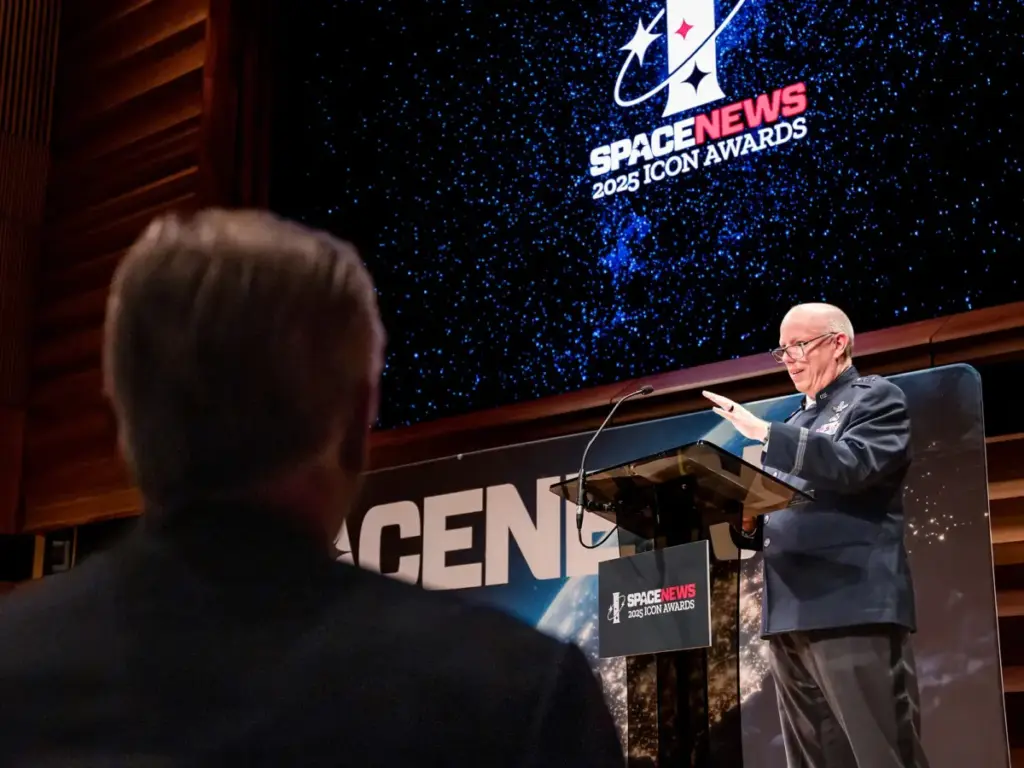
The SpaceNews Icon Awards return to celebrate the defining achievements that continue to shape the trajectory of the modern space industry. Today marks the official announcement of the shortlist for 2026, featuring a distinguished selection of individuals, organizations, and landmark missions that exemplify the highest standards of innovation, exploration, and operational sustainability.
This year’s honorees reflect a rapidly maturing space economy driven by unprecedented ambition and creativity. From historic milestones like returning astronauts to the vicinity of the moon for the first time in over half a century to expanding the capacity to run high-performance artificial intelligence directly on orbit, the finalists capture a sector in full acceleration. Other prominent themes among the nominees include the rapid realization of complex on-orbit servicing, the scaling of operations through strategic partnerships, and transformative mergers and acquisitions that are redefining the competitive landscape of commercial and national security space.
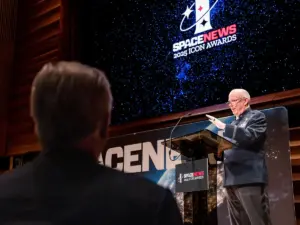
The ultimate winners across all categories will be announced live at the 2026 SpaceNews Icon Awards ceremony on December 1 in Washington, D.C. The premier event will bring together leaders from across the global space enterprise to celebrate these exceptional contributions and share the behind-the-scenes stories of their successes. Tickets for the ceremony are available now, with an early bird registration rate open through October 31.
Lifetime Achievement
The lifetime achievement category honors individuals whose visionary leadership and decades of dedication have left a permanent, transformative mark on the global space industry, shaping exploration, national security, and commercial growth for generations to come.
Mark Dankberg is recognized as a true satellite communications pioneer. As the co-founder of Viasat, he has spent decades advancing high-capacity satellite broadband technology, fundamentally reshaping how consumers, governments, and enterprise businesses connect across the globe.
Jean-Yves Le Gall stands as one of Europe’s most influential space leaders. His decades of leadership at both CNES and Arianespace played a pivotal role in strengthening Europe’s independent launch capabilities, fostering international partnerships, and cementing the continent’s competitive position in the global space economy.
Chris Scolese concludes a distinguished career spanning NASA and national security space, most recently serving for nearly seven years as the director of the National Reconnaissance Office. During his tenure, he oversaw a dramatic transformation of the agency’s architecture and spearheaded the growing integration of commercial capabilities. Previously, Scolese served as NASA’s chief engineer and director of the Goddard Space Flight Center.
Karen St. Germain has profoundly shaped NASA’s Earth science enterprise through senior leadership roles overseeing complex missions, groundbreaking research, and the expanded use of satellite observations to better understand Earth’s changing climate and environment.
Coyote Smith is recognized as a longtime military space leader and educator whose career has critically informed modern thinking regarding spacepower, national security space strategy, and the education and professional development of the next generation of space operators and strategists.
International Collaboration
This category recognizes partnerships that successfully bridge organizational and national divides to advance the frontiers of space exploration, fundamental science, and commercial enterprise.
Clay Mowry, currently serving as the chief executive of the American Institute of Aeronautics and Astronautics (AIAA), has continuously worked across industry, government, and professional organizations to build resilient connections within an increasingly international and multidisciplinary space community.
The Loft Orbital and Marlan Space partnership represents a major international initiative combining U.S., French, and Emirati capabilities, highlighted by plans for the 50-satellite Altair-Next Gen constellation that integrates Earth observation, onboard computing, and artificial intelligence.
The pairing of K2 Space and SES has brought together K2 Space’s high-power satellite platforms with SES’s software-defined payloads for meoSphere, a next-generation Medium Earth Orbit network beginning with 28 spacecraft designed to serve both commercial and defense customers.
The Nancy Grace Roman Space Telescope successfully brought together NASA, ESA, JAXA, France’s CNES, Germany’s Max Planck Institute for Astronomy, and institutions across the global scientific community to develop a next-generation observatory dedicated to studying dark energy, exoplanets, and the evolution of the universe. The telescope launched on August 30, opening an exciting new chapter in international space science.
The Solar wind Magnetosphere Ionosphere Link Explorer (SMILE) mission successfully united the European Space Agency and the Chinese Academy of Sciences for the first space science mission jointly designed, implemented, launched, and operated by Europe and China. The spacecraft launched on May 19 to study the complex interactions between the solar wind and Earth’s magnetosphere.
Emerging Space Company
The emerging space company category highlights new or rapidly expanding enterprises that are injecting fresh innovation into the market and opening entirely new commercial sectors within the space economy.
Benoît Deper and Aerospacelab have built the company into a rapidly expanding European satellite manufacturer and operator, pursuing a strategy of vertically integrated spacecraft production and constellation development spanning both Europe and the United States.
Lux Aeterna emerged from stealth mode with ambitious plans to develop reusable satellites capable of returning payloads safely to Earth. The company successfully raised $10 million in 2026 as it works steadily toward its upcoming reentry demonstration mission.
Katalyst Space Technologies pushed commercial satellite servicing into unchartered territory with LINK, a rapidly developed robotic spacecraft dispatched to attempt the rescue of NASA’s aging Swift observatory, while simultaneously expanding its operations into Geostationary Earth Orbit servicing, spacecraft deorbiting, and broader robotic space operations.
Skyroot Aerospace significantly advanced India’s burgeoning private launch sector with the development of Vikram-1, marking India’s first privately developed orbital-class launch vehicle.
Innovative Technology
This category acknowledges foundational technologies that successfully push the boundaries of aerospace engineering and unlock brand-new operational capabilities in orbit and on the ground.
Cailabs advanced laser communications from individual optical ground stations toward a shared global infrastructure by launching an innovative optical-ground-station-as-a-service model, backed by plans to establish an international network of approximately 15 stations.
D-Orbit continued to expand the functional capabilities of its ION orbital transfer vehicle, pushing far beyond standard satellite deployment into hosted payloads, advanced orbital transportation, distributed cloud computing, and other specialized in-space logistics services.
Xona Space Systems advanced a viable commercial alternative to traditional GPS with Pulsar, a Low Earth Orbit positioning, navigation, and timing architecture engineered to deliver vastly more precise and resilient navigation services utilizing a brand-new generation of satellites.
Individual Achievement
Recognizing dynamic individual leaders whose personal vision, drive, and innovation have set new benchmarks for industry excellence and inspired ongoing progress across the broader space community.
Steve Altemus of Intuitive Machines has continued to successfully expand the company from a lunar transportation specialist into a comprehensive space infrastructure provider, a transition highlighted by an $800 million acquisition of Lanteris Space Systems and heavy investments in orbital communications, navigation, and data services.
Ian Cinnamon of Apex helped establish a transformative new manufacturing model for the satellite industry, emphasizing standardized spacecraft platforms, dramatically accelerated production timelines, and an overall approach designed to bring mass-production economics to satellite fabrication.
Rafal Modrzewski of ICEYE led the continued global expansion of the world’s largest commercial synthetic aperture radar satellite fleet, seamlessly combining high-performance commercial services with increasingly vital sovereign intelligence and reconnaissance capabilities for governments around the world.
Shey Sabripour of CesiumAstro built the company around advanced active phased-array communications technology, helping move high-throughput, software-defined connectivity from a promising laboratory concept toward fully operational space systems.
Deal of the Year
The deal of the year category highlights major financial transactions and strategic investments that fundamentally reshape market dynamics, create formidable new competitors, or alter the long-term trajectory of the aerospace industry.
AE Industrial Partners agreed to acquire a controlling interest in L3Harris’ Space Propulsion and Power Systems business, successfully reviving the historic Rocketdyne name for an enterprise whose propulsion heritage stretches back more than six decades.
EQT reached an agreement to acquire Exolaunch, providing the previously self-funded German launch integration and deployment company with substantial outside investment and the financial resources required to accelerate international expansion and develop advanced new services.
Intuitive Machines completed its landmark $800 million acquisition of the former Maxar Space Systems, acquiring decades of invaluable satellite manufacturing experience in its bid to become a fully vertically integrated space prime contractor.
NASA turned to Katalyst Space Technologies for an unusually rapid commercial servicing mission designed to rendezvous with and raise the orbit of the agency’s Swift observatory, testing an innovative new model for procuring time-sensitive in-space technical services.
SpaceX’s long-anticipated public offering brought one of the most valuable private companies in the world onto public stock markets in a truly historic financial transaction for the commercial space sector.
Space AI Breakthrough
This category honors pioneering advances that successfully harness artificial intelligence and high-performance computing to fundamentally transform spacecraft design, space data processing, and orbital operations.
Aethero successfully launched its Phobos spacecraft equipped with an NVIDIA-powered edge-computing module, demonstrating a robust platform designed specifically for continuous onboard data processing and compute-as-a-service applications in orbit.
Alex Greenberg of Loft Orbital played a central role in driving the company’s aggressive push to bring artificial intelligence and high-performance computing directly into orbit, enabling satellites to process massive volumes of raw data locally before transmitting actionable intelligence down to the ground.
Starcloud advanced the rapidly emerging concept of space-based data centers by developing high-performance orbital computing infrastructure specifically engineered to run increasingly demanding artificial intelligence workloads directly in space.
Commercial Space Achievement
Celebrating commercial enterprises and specific missions that have measurably advanced commercial space capabilities and contributed to the ongoing economic growth of the broader space sector.
ICEYE successfully expanded its synthetic aperture radar network while simultaneously deploying an advanced new generation of spacecraft capable of capturing imagery down to 16-centimeter resolution, supporting an expanding roster of commercial and sovereign missions worldwide.
Impulse Space and Starfish Space successfully demonstrated autonomous rendezvous and proximity operations utilizing Impulse Space’s Mira spacecraft paired with Starfish Space technology, advancing the critical commercial capabilities required for future satellite servicing and complex in-space operations.
SEOPS and Exolaunch expanded their launch integration and rideshare services during a period of surging demand in the commercial launch market, helping a diverse array of satellite operators secure reliable access to orbit across a broader selection of launch vehicles.
Sustainability and Environmental Impact
This category acknowledges exceptional leadership in utilizing space-based technology to protect Earth’s environment while actively advancing more sustainable, responsible operations in orbit.
Hydrosat expanded the operational use of thermal infrared satellite data for water resource management, agriculture, and climate monitoring, while simultaneously unveiling Osiris, a next-generation constellation designed to combine 25-meter thermal imagery with broad-area coverage and daily revisit capabilities.
The Space Data Association continued its vital work bringing commercial and civil satellite operators together to share operational tracking data, promote active collision avoidance, and champion responsible operations within increasingly congested orbital environments.
The Vera C. Rubin Observatory began issuing real-time scientific alerts in February, establishing an automated system expected to eventually generate millions of notifications each night concerning transient celestial objects and events ranging from near-Earth asteroids to distant supernovae.
Civil Space Achievement
Celebrating extraordinary breakthroughs in deep space exploration, scientific discovery, and high-profile public-sector space missions.
The Artemis 2 Team successfully carried out a mission that returned astronauts to the vicinity of the moon for the first time in more than half a century, carrying NASA astronauts Reid Wiseman, Victor Glover, and Christina Koch alongside Canadian astronaut Jeremy Hansen on a nearly 10-day flight around the moon aboard the Orion spacecraft. The successful April mission brought together NASA, international space agency partners, and a vast industrial manufacturing team supporting Orion, the Space Launch System, and associated ground systems.
The Copernicus Sentinel-1D Team brought the Sentinel-1D satellite into full operational status in May, successfully restoring and significantly strengthening Europe’s flagship radar Earth observation capability and continuing more than a decade of uninterrupted global environmental monitoring through the Copernicus program.
The Nancy Grace Roman Space Telescope Team successfully launched NASA’s next flagship astrophysics observatory on August 30, initiating a mission designed to survey the universe significantly faster than Hubble while investigating the mysteries of dark energy, exoplanets, and fundamental astrophysical questions.
Military Space Achievement
Recognizing the individuals, organizations, and missions making critical contributions to the evolution of national security space capabilities and defense readiness.
Gurpartap “GP” Sandhoo assumed leadership of the Space Development Agency while also taking on the role of the Space Force’s portfolio acquisition executive for missile warning and tracking, overseeing the continued rapid deployment of the Proliferated Warfighter Space Architecture and its growing constellation of military satellites.
Impulse Space significantly expanded its national security portfolio by securing a $28 million Space Force contract for a future space domain awareness mission utilizing its highly maneuverable Mira spacecraft operating in Low Earth Orbit.
SpaceWERX continued to leverage the Space Force’s small-business innovation programs to transition emerging commercial technologies effectively toward military applications, broadening the active pool of companies contributing to national security space objectives.
The VICTUS HAZE Team successfully demonstrated the Space Force’s most advanced tactically responsive space mission to date, with spacecraft provided by Rocket Lab and True Anomaly supporting realistic rendezvous, proximity operations, and space domain awareness scenarios following a highly compressed, rapid-response launch campaign.
Join the industry for the 2026 SpaceNews Icon Awards in Washington, D.C., on December 1. Learn more and register for tickets by visiting the official event page. For any questions, please reach out to [email protected].