











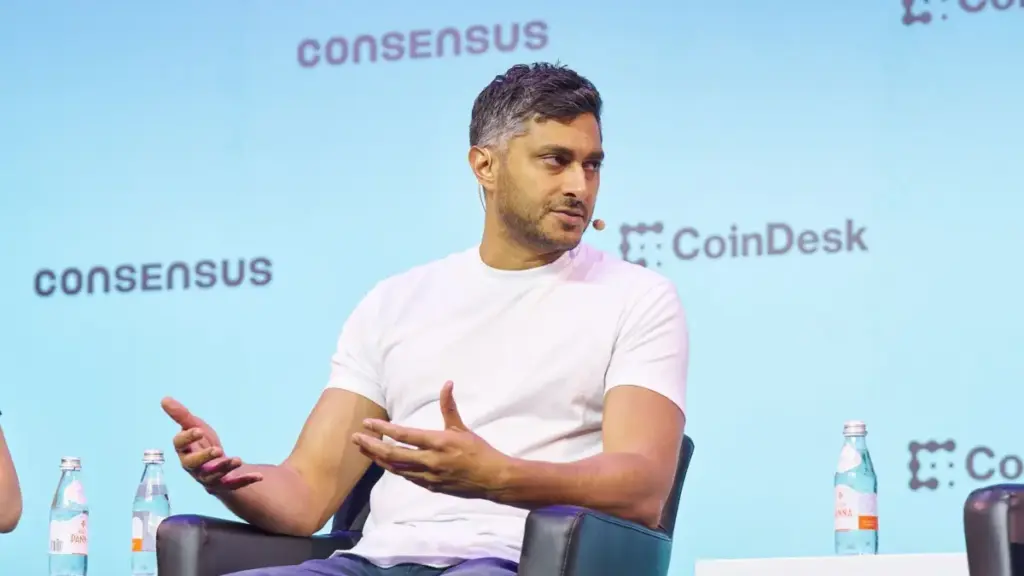
For the past 15 years, Kraken has been synonymous with the crypto exchange industry, serving as a primary gateway for digital asset trading. However, as the industry matures, the company’s parent entity, Payward, is signaling a definitive shift in strategy. Rather than continuing to focus solely on the retail exchange experience, the Wyoming-based firm is betting billions of dollars on a transformation that aims to reposition it as a core component of the global financial infrastructure. Under the leadership of co-CEO Arjun Sethi, Payward is consolidating its diverse portfolio of trading, payments, asset management, and institutional services onto a singular, unified technological foundation.
This evolution marks a departure from the traditional model of a crypto exchange. Sethi characterizes the new approach as a cohesive integration of services that eliminates the fragmentation often seen in legacy systems. “We’re not a holding company,” Sethi stated in an interview. “It’s one platform, one balance sheet, one regulatory stack.” The central component of this strategy is what Sethi describes as a “one ledger” architecture. This system is designed to allow money and digital assets to move seamlessly between products, effectively bypassing the inefficient patchwork of intermediaries—such as clearing houses, custodians, and separate record-keepers—that have historically defined and constrained traditional finance.
A Departure from the “Everything Exchange” Model
Payward’s ambition places it in a competitive landscape alongside other industry giants like Coinbase and Binance, both of which are pursuing their own variations of a consolidated financial platform. Coinbase has focused on building an “Everything Exchange” that bridges crypto, stocks, derivatives, and prediction markets, while Binance has integrated trading, payments, and yield-bearing products into a single user ecosystem.

However, industry analysts at Architect Partners suggest that Payward is carving out a distinct path. While competitors are largely focusing on aggregating consumer-facing services under a single branded umbrella, Payward appears to be prioritizing the development of a regulated, high-performance infrastructure stack. This model is intended not only to support Kraken’s own brands but also to serve as the backbone for outside financial institutions. By focusing on the “Everything Financial Infrastructure” model, Payward is positioning itself to power financial products across multiple brands, distinct customer segments, and diverse partner channels, potentially turning the company into a utility provider for the broader financial services sector.
This strategic pivot comes as Kraken maintains a significant, though specialized, position in the market. While it remains a major player, it operates with a different scale compared to global giants like Binance, which commanded 38.7% of top-10 centralized-exchange spot volume in the second quarter of 2026. Kraken’s focus on building a robust, institutional-grade infrastructure is an attempt to capture long-term value that transcends mere trading volume.
The Problem with Legacy Finance
The fundamental thesis driving Payward’s expansion is the observation that the legacy financial system is hindered by aging technology and cumbersome market conventions. In the traditional world, securities trading often involves lengthy settlement cycles, markets are limited by operating hours, and various entities—including banks, brokers, and clearing houses—maintain disparate records that must be laboriously reconciled. Each of these boundaries adds layers of complexity, cost, and delays.
Sethi believes that blockchain-based systems offer a superior alternative. By enabling assets to function as programmable instruments on a shared, immutable infrastructure, Payward aims to streamline these processes. The company has organized this vision into four core pillars: the Kraken exchange for trading, a dedicated banking division, a sophisticated asset management arm, and “Payward Services,” a B2B division that sells infrastructure solutions to other firms.
Kraken currently holds between $40 billion and $50 billion in assets across roughly 6.6 million funded accounts globally. To maximize the utility of these accounts, Payward is aggressively rolling out a suite of complementary services, including card programs, lending facilities, derivatives, and tokenized equities. These features are designed to allow customers to leverage their holdings for collateral, borrowing, or deployment into decentralized finance (DeFi) applications, all while remaining within the Payward ecosystem.
Scaling Through Strategic Acquisitions and Partnerships
Payward’s growth strategy is a blend of internal development, high-stakes acquisitions, and collaborative partnerships. The company’s approach to acquisitions is highly disciplined, relying on a quantitative framework to identify infrastructure gaps. Rather than soliciting pitches from bankers, the company targets specific technologies or regulatory permissions that would be prohibitively expensive or time-consuming to build from scratch.
A prime example of this strategy is the $1.5 billion acquisition of NinjaTrader, which provided Payward with a U.S. futures brokerage, complete with the necessary technology and regulatory standing. This was followed by the $550 million acquisition of Bitnomial, a move that secured additional derivatives infrastructure, including a regulated exchange and clearinghouse. Furthermore, the company is actively expanding its banking capabilities, with plans to acquire a bank in Europe to bolster its international footprint.
However, Payward recognizes that some elements of the financial system cannot be acquired. In these instances, the company is opting for collaboration with established incumbents. A notable example is the recent $100 million investment from Nasdaq into Payward. This partnership will see the two firms work together on Nasdaq Equity Tokens and advanced market surveillance technology, with a planned launch in the second quarter of 2027. Similarly, the London Stock Exchange is working with Payward to explore the tokenization of public equities, aiming to list “xStocks” on the LSE 24 venue in 2027.
These relationships highlight a shift in philosophy: rather than attempting to displace traditional institutions, Payward is positioning itself as a partner that can enhance their capabilities. As Sethi noted, “Trust is their currency,” and by providing the technological infrastructure to support these legacy players, Payward is finding a way to integrate its blockchain-native solutions into the heart of global finance.
Infrastructure as a Service
A key revenue driver for the future is Payward Services, the division responsible for packaging the company’s internal infrastructure for external clients. By providing a common set of APIs, Payward is enabling banks, fintech startups, and other brokerage firms to leverage its custody, liquidity, compliance, risk management, and settlement capabilities.
This move effectively transforms Payward into an infrastructure provider, allowing its technology to power products that carry other companies’ brands. According to Architect Partners, this model is particularly potent because it allows Payward to succeed even when the end customer never directly interacts with the Kraken brand. With at least 25 companies currently building on this infrastructure—including platforms like Hyperliquid—the business-to-business segment represents a significant diversification of Payward’s revenue streams.
Asset Management and the Future of Value
Parallel to its infrastructure play, Payward is formalizing its asset management division. Having offered custody and staking services for years, the company is now building a platform that can accommodate diverse investment managers, complex strategies, and various asset classes. The objective is to provide a seamless execution and distribution layer, allowing clients to access structured products, tokenized equities, and credit strategies.
By moving these products onto its own “on-chain” rails, Payward aims to drastically reduce the costs and counterparty risks typically associated with traditional asset management. The firm has already begun testing this approach through a partnership with Bitwise, and it plans to scale the platform by onboarding additional managers who want to benefit from the efficiency of tokenized, programmable financial instruments.
A Measured Approach to Going Public
Despite its rapid expansion and multi-billion-dollar investments, Payward remains cautious regarding its public market debut. While the company filed confidentially for an IPO in November 2025, it has since pushed back that timeline to at least the second quarter of 2027. Sethi emphasizes that the company is under no pressure to rush the process, noting that Payward is currently profitable and experiencing consistent revenue growth.
The company has maintained this momentum without relying on public markets for funding, opting instead to use its own balance sheet and strategic capital raises from partners like Nasdaq and Citadel Securities to fuel its growth. For Sethi, the regulatory environment is not a deterrent; he views the current lack of comprehensive U.S. crypto legislation as a temporary hurdle that does not diminish the utility of the technology. “Bitcoin has been around for 17 years without a market-structure bill,” he remarked. “Rights come first, and laws come later and legislation comes downstream.”
As Payward looks toward the future, its ultimate goal remains the democratization of financial infrastructure. By enabling individuals to access the same sophisticated tools and rails used by top-tier trading firms, the company is attempting to bridge the gap between traditional finance and the decentralized future. As Sethi succinctly put it, the company’s guiding principle is simple: “Fix money, fix the world.” With its multi-pronged approach to infrastructure, banking, and global partnerships, Payward is clearly betting that the path to this future lies in becoming the invisible foundation upon which the next generation of financial markets will be built.