







The tooling ecosystem surrounding large language models has expanded at a velocity that outpaces even the most dedicated practitioners. In nearly every conversation about enterprise AI application development, two primary names consistently dominate the discourse: LangChain and LlamaIndex. Both ecosystems promise to dramatically reduce the friction inherent in building production-ready applications powered by large language models. Both command massive, highly active developer communities, enjoy robust institutional backing, and receive near-reflexive recommendations the moment a developer or engineering team asks how to break into the space.
Yet, as engineering teams move past the initial prototyping phase and face the realities of production deployment, a critical realization is emerging: neither framework serves as a universal panacea for every project, team, or developmental stage. Increasingly, a third, more deliberate path is earning serious consideration across the industry. Rather than relying on heavy abstractions, a growing number of engineering organizations are opting to build directly from scratch, utilizing nothing more than base application programming interfaces and their own custom-tailored abstractions.
This shifting landscape requires a careful examination of what each approach actually offers, where each path inevitably introduces friction, and how technical leaders can determine which strategy aligns with their specific organizational needs. The overarching goal within the artificial intelligence community is no longer to crown a single reigning framework, but rather to help practitioners make deliberate architectural choices rather than defaulting to whichever repository happens to command the highest number of GitHub stars.
Understanding the Core Orchestration Challenge
To accurately evaluate the ongoing debate between pre-built frameworks and custom architectures, developers must first understand the specific technical problem these tools are designed to solve. In their raw, unassisted state, large language models function fundamentally as stateless text predictors. They ingest an isolated prompt, compute a completion, and retain zero memory of previous interactions once the cycle concludes.
Constructing practical, utility-driven applications on top of these models—ranging from document question-answering systems and multi-step autonomous agents to sophisticated retrieval pipelines and conversational user interfaces—demands an extensive orchestration layer. Developers must actively manage context windows, dynamically route execution flows between various tools, retrieve relevant external information, handle session memory, and chain disparate operations together in a logical sequence.
Both LangChain and LlamaIndex provide this vital orchestration layer out of the box, abstracting away the complex plumbing so that software engineers can theoretically focus on core application logic rather than low-level infrastructure. Conversely, building from scratch means taking full ownership of that plumbing, writing the necessary connection logic, and managing the application state directly through native client libraries.
LangChain: Broad Ecosystem Integration and Its Complexities
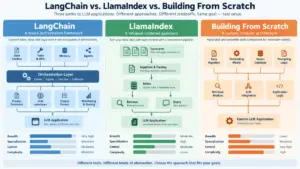
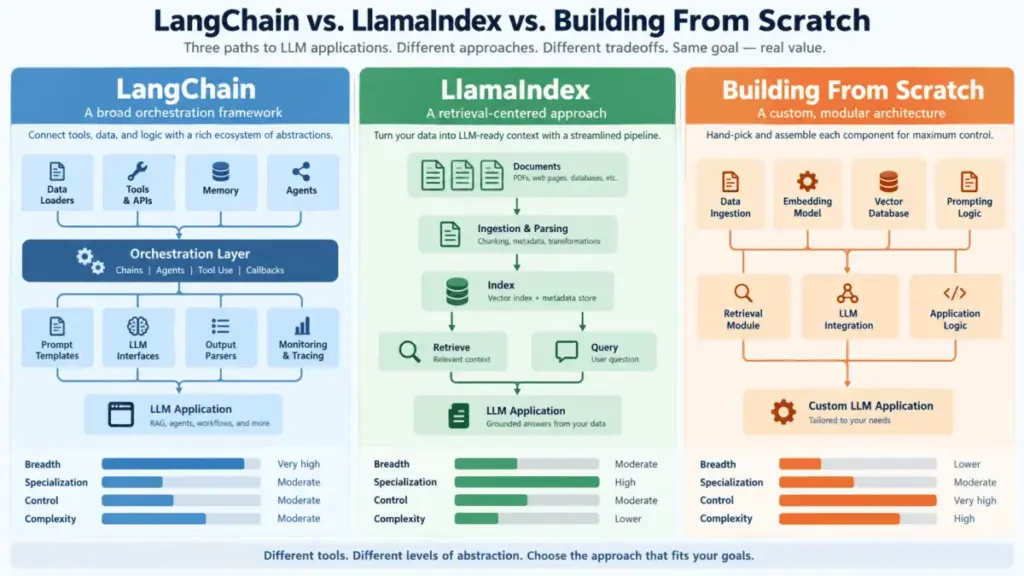
LangChain emerged early in the generative artificial intelligence boom, rapidly expanding its footprint to encompass an enormous surface area. Its primary distinguishing strength lies in its remarkable breadth. The framework provides structured abstractions for chains, autonomous agents, conversational memory, external tools, document retrievers, output parsers, and prompt templates, alongside dozens of pre-built integrations with external services, enterprise databases, and third-party APIs.
For engineering teams tasked with connecting large language models to a wide, eclectic variety of external tools and data sources, LangChain’s expansive integration library proves genuinely useful. It covers an impressive range of technical providers, spanning vector databases, web search engines, and custom enterprise APIs, supported by extensive documentation and community-contributed examples for standard architectural patterns.
Furthermore, LangChain handles multi-step agentic workflows with reasonable proficiency. When an application requires a language model to autonomously evaluate and select between multiple tools, loop iteratively on intermediate results, or execute a sequential plan of action based on dynamic outputs, LangChain’s agent abstractions provide an immediate starting point without forcing developers to write the underlying decision-making loops from the ground up.
However, the very breadth that makes LangChain so appealing for initial exploration also introduces significant complexity during long-term maintenance. The abstraction layers sit deeply nested within the library, and when an execution pipeline fails, tracing the root cause across multiple layers of wrapped classes can prove non-trivial. Many production developers report that while LangChain’s abstractions accelerate initial prototyping phases, they subsequently create substantial drag during the debugging and deep customization phases.
Additionally, the framework has evolved at a blistering pace. This rapid iteration cycle means that official documentation occasionally lags behind current API implementations, older community tutorials frequently reference deprecated patterns, and routine framework upgrades can introduce breaking changes. For enterprise systems where stability, predictability, and long-term maintainability are paramount, this persistent architectural churn represents a tangible operational cost. Consequently, LangChain typically performs best during rapid prototyping phases, exploratory projects, or scenarios where broad integration coverage outweighs the need for tight, granular control over implementation details.
LlamaIndex: Specialized Focus on Retrieval-Augmented Generation
Originally launched under the moniker GPT Index, LlamaIndex adopted a much narrower, highly focused scope from its inception: streamlining the construction of retrieval-augmented generation systems. That foundational focus remains the defining characteristic of the platform and influences every aspect of its design philosophy.
When an application’s primary objective revolves around extracting precise information from large volumes of unstructured documents and providing that data as accurate context to a language model, LlamaIndex proves exceptionally well-suited to the task. Its specialized data connectors, indexing strategies, and query engines are purpose-built for document-centric retrieval, resulting in architectural abstractions that are generally more coherent and unified than those found in broader frameworks.
Moreover, LlamaIndex delivers robust native tooling for advanced retrieval-augmented generation patterns, including document re-ranking, hybrid search mechanisms, hierarchical retrieval structures, and intelligent query routing. Engineering teams tasked with building enterprise-grade document question-answering systems, internal knowledge base assistants, or specialized corporate search engines routinely discover that LlamaIndex successfully handles the intricate edge cases that simpler, ad-hoc retrieval pipelines frequently overlook.
The project has also invested meaningfully in evaluation tooling, an aspect of artificial intelligence development whose importance cannot be overstated. Accurately determining whether a retrieval system consistently returns genuinely useful context—and verifying that performance before modifications negatively impact end users—remains one of the most persistent hurdles in modern software engineering.
Despite these distinct advantages, LlamaIndex is less ideal for applications that extend far beyond document retrieval. If a project requires rich agentic behaviors, complex tool utilization, or operational workflows that do not center on document databases, developers may find themselves continuously fighting the framework’s core assumptions rather than leveraging them. Furthermore, much like its broader counterpart, LlamaIndex carries inherent abstraction overhead. The more assumptions a framework bakes into its underlying architecture, the more difficult it becomes for engineers to deviate from those predefined patterns when unique business requirements emerge.
The Pragmatic Viability of Building From Scratch
Choosing to build an artificial intelligence application from scratch does not imply engineering a foundational language model from the ground up. Rather, the term describes the practice of calling model provider application programming interfaces directly, implementing custom retrieval algorithms, and constructing only the specific abstractions required by the application at hand.
This approach has grown increasingly accessible as base application programming interfaces have matured across the industry. Major providers such as OpenAI, Anthropic, and Google now offer exceptionally well-documented APIs paired with robust, stable client libraries. Concurrently, specialized vector database providers including Pinecone, Weaviate, and Qdrant maintain their own dedicated software development kits. The underlying infrastructure is already fully realized; choosing to build from scratch simply means assembling those components independently rather than relying on a heavy third-party framework.
Opting for a custom, scratch-built architecture grants developers complete visibility into system operations at every stage of execution. There are no hidden prompt injections embedded within framework templates, no unexpected retry loops operating outside developer awareness, and no opaque abstraction layers intercepting network requests. When unexpected behavior occurs in production, engineering teams know precisely where to inspect the codebase.
This level of granular control becomes especially critical as applications mature through the software development lifecycle. Engineering teams that have guided large language model applications from inception to full production deployment frequently note that framework constraints grow increasingly burdensome as functional requirements evolve. Custom retrieval logic, specialized context management, domain-specific prompt engineering, and rigorous performance optimization are universally simpler to implement when the team maintains absolute ownership of the underlying codebase.
Furthermore, building from scratch introduces a subtle, highly valuable psychological benefit: it forces absolute clarity regarding what an application actually requires to function. Heavy frameworks can inadvertently encourage systemic over-engineering by making complex architectural patterns deceptively easy to invoke. When developers implement retrieval logic manually, they naturally construct precisely what the specific use case demands—incorporating no unnecessary complexity and leaving no redundant code behind.
Naturally, this path is not without its challenges. The upfront time and engineering investment are genuine. Teams pursuing this route must write significantly more boilerplate code initially, make architectural decisions explicitly, and spend additional cycles establishing infrastructure that frameworks might otherwise handle automatically. For organizations still exploring whether a proposed artificial intelligence application is commercially or technically viable, this initial investment can potentially delay foundational learning.
Additionally, building a robust retrieval-augmented generation pipeline from scratch requires a firm foundational understanding of embedding models, vector mathematical similarity, optimal document chunking strategies, and context window management. While frameworks can sometimes obscure knowledge gaps, scratch-built systems will immediately expose any misunderstandings regarding these underlying mathematical and computational principles.
Evaluating Strategic Approaches for Modern Engineering Teams
Selecting the appropriate architectural path depends heavily on three core variables: the current stage of the project, the collective technical expertise of the engineering team, and the fundamental nature of the application being developed.
For organizations in the earliest phases of exploration and proof-of-concept development, utilizing an established framework often makes pragmatic sense. Both LangChain and LlamaIndex enable teams to test core hypotheses significantly faster than writing a custom architecture from the ground up. Abstraction overhead matters far less when the primary objective is rapid learning rather than immediate production stability. Within this exploratory context, LangChain generally serves as the superior choice if the long-term functional requirements of the application remain uncertain, while LlamaIndex proves more appropriate if document retrieval is definitively central to the product vision.
Conversely, for teams constructing retrieval-heavy systems destined for immediate production environments, LlamaIndex warrants serious consideration. Its focused scope ensures that its structural abstractions closely align with document-centric requirements, while its built-in evaluation utilities provide immediate utility as the application scales toward users.
When an organization possesses clear, highly specific requirements backed by a team with strong engineering foundations, building from scratch frequently represents the superior long-term investment. The initial overhead required to establish custom connections pays substantial dividends later in the product lifecycle through enhanced debuggability, superior performance optimization, and unfettered architectural flexibility as business requirements inevitably shift.
Furthermore, these architectural choices are rarely permanent commitments. A common, highly sensible developmental pattern involves prototyping initial concepts using a framework like LangChain, gaining a granular understanding of what the eventual production system requires, and subsequently rewriting the core retrieval and orchestration logic from scratch while selectively retaining framework integrations for peripheral components.
Ultimately, LangChain, LlamaIndex, and custom-built architectures are not mutually exclusive philosophies. They represent distinct tools with unique operational tradeoffs, each ideally suited to different operational contexts. Engineering teams that encounter friction in their artificial intelligence initiatives are frequently those that selected an architectural tool before thoroughly understanding their underlying problem well enough to evaluate those tradeoffs effectively.
By carefully analyzing application requirements—identifying where complexity truly resides, determining the precise degree of control required, and balancing speed-to-prototype against long-term maintainability—technical leaders can chart a course toward robust, sustainable software architecture that outlasts the rapid evolution of industry frameworks.
Vinod Chugani serves as an artificial intelligence and data science educator who bridges the gap between emerging artificial intelligence technologies and practical application for working professionals. His core focus areas include agentic artificial intelligence, machine learning applications, and workflow automation. Through his work as a technical mentor and instructor, Vinod has supported data professionals through skill development and career transitions, bringing analytical expertise derived from quantitative finance to his hands-on teaching methodology. His educational content consistently emphasizes actionable strategies and frameworks that professionals can apply immediately within their organizations.