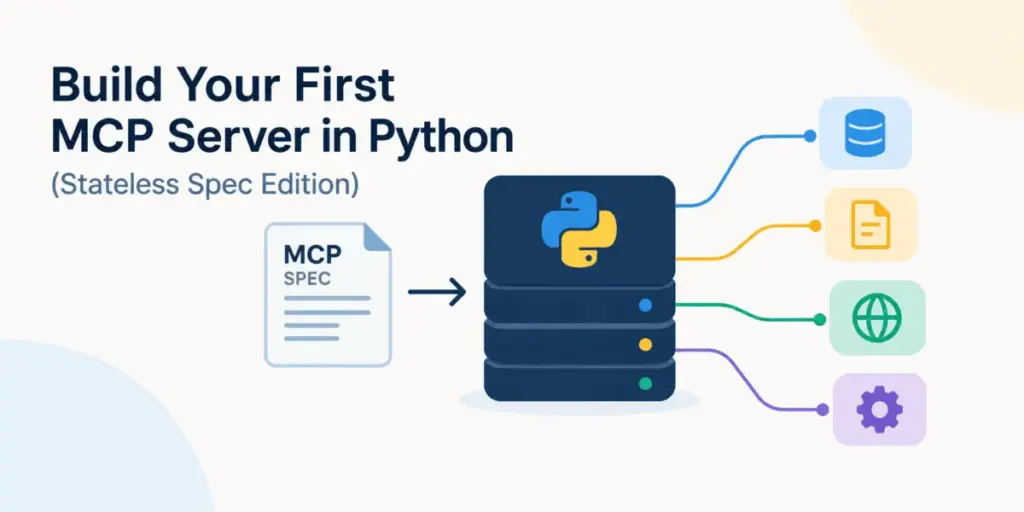
The Model Context Protocol (MCP) underwent a significant architectural transformation this summer, pivoting away from complex connection states to embrace a streamlined, scalable design. The introduction of the 2026-07-28 MCP specification redefined the protocol core as entirely stateless, marking a departure from older operational models. Under this updated framework, modern clients no longer need to establish a dedicated protocol session before executing requests, and backend servers are relieved from relying on session identifiers for routine operations. This engineering shift makes MCP servers substantially easier to deploy, manage, and scale behind standard HTTP infrastructure without the overhead of sticky routing or specialized session management.
Concurrently, the official Python SDK has advanced to version 2 as its primary stable line, introducing a high-level server interface designed to simplify how developers expose tools, resources, and prompts using standard Python functions. Rather than dealing with low-level protocol plumbing or manual JSON schema definitions, developers can leverage native Python type hints and decorators to build robust, network-accessible AI components. This evolution bridges the gap between traditional application development and modern LLM orchestration, offering a clean path for integrating AI capabilities into existing enterprise codebases.
To understand how this stateless architecture functions in practice, developers are examining implementation models that showcase the core primitives of the updated SDK. A representative developer knowledge-base server illustrates this approach by exposing specific endpoints without retaining any user session state. Every incoming request contains all the necessary data required for processing, embodying the core philosophy of the modern stateless MCP model. In this setup, an LLM host communicates directly with the Python server via standard protocol requests, querying knowledge bases, reading resources, and generating context-aware prompts dynamically.
Setting up this environment requires modern tooling, with the current Python SDK demanding Python 3.10 or newer alongside the official command-line interface extensions for development and inspection workflows. Using modern package managers like uv or traditional package installers such as pip, developers can initialize projects without boilerplate frameworks. The project structure remains remarkably minimal, typically consisting of a server implementation file and a corresponding client script. This simplicity allows engineering teams to prototype and test MCP capabilities rapidly without navigating heavy configuration files or complex build pipelines.
At the core of the Python v2 SDK is the high-level server API, which allows developers to instantiate a server instance complete with custom instructions that guide how connected models utilize the exposed tools. While the SDK retains a lower-level server class for advanced scenarios requiring exact control over schemas and protocol metadata, the higher-level API serves as the standard choice for most applications. By attaching structured data collections—such as articles detailing virtual environment creation, password resets, or application programming interface rate limits—developers can instantly transform static information into interactive resources for AI agents.
The true strength of the framework becomes apparent when exposing Python functions as MCP tools, which act as executable actions that an artificial intelligence model can invoke autonomously. By simply applying a decorator to a function and providing clear type hints and docstrings, the SDK automatically derives the required input schemas and parameter descriptions. Developers are no longer required to write manual JSON schemas, construct tool manifests, or build custom argument parsers. The function signature itself serves as the interface definition, making the development process feel remarkably close to writing standard application logic. Optional parameters and default values are seamlessly translated into the generated schema, ensuring that the model understands how to interact with the function accurately.
In addition to actionable tools, the protocol distinguishes between actions and static or semi-static data through the use of resources. While tools function similarly to action-oriented processing requests, resources expose information that host applications can read and load directly into context without invoking computational logic. By mapping Uniform Resource Identifiers to specific functions, developers can enable clients to retrieve data collections directly. This clear separation of concerns provides a clean architectural boundary, aligning resource retrieval with read operations and tool execution with functional work.
The SDK also accommodates reusable prompt templates through dedicated decorators, allowing developers to standardize how instructions and context are presented to language models. These prompts are typically initiated by users or host applications rather than being invoked autonomously by the model, providing a reliable way to guide interactions, enforce support policies, and maintain consistent output formats across different queries. Because tools, resources, and prompts are all managed through the same decorator-oriented interface, the resulting application code remains clean, readable, and easy to maintain.
Running these applications in a development environment is streamlined through dedicated command-line utilities that launch the server alongside an interactive inspection interface. This graphical workspace allows developers to view available tools, inspect generated schemas, and test function calls with custom parameters in real time, forming an efficient feedback loop during the development phase. Once validated locally, the application can transition seamlessly to production deployment over Streamable HTTP, exposing a standardized endpoint that handles incoming requests without relying on persistent connection states.
For deployments requiring deeper integration into existing web architectures, the server can also be configured as a standard asynchronous server gateway interface application. By exposing a compatible web application object, developers can integrate their MCP endpoints directly into larger web frameworks like FastAPI or Starlette, allowing AI capabilities to coexist alongside traditional web routes and application logic. This flexibility ensures that organizations can adopt the Model Context Protocol without overhauling their existing technology stacks or changing their preferred deployment pipelines.
The underlying architectural shift brought by the stateless protocol update resolves several historical scaling challenges associated with AI tooling. Under older specifications, maintaining a continuous session required multi-instance deployments to rely on sticky routing or shared memory caches to ensure requests reached the correct worker process. The transition to a self-contained request-response model means that individual requests can be routed to any available worker instance in a clustered environment without losing context or failing. This compatibility with standard load balancing infrastructure makes horizontal scaling straightforward, enabling high-availability deployments that can handle fluctuating workloads efficiently.
Critics of stateless architectures often raise concerns regarding application-level state, such as shopping carts, user sessions, or ongoing multi-turn workflows. However, the protocol maintainers clarify that a stateless protocol core does not prevent applications from managing state; rather, it shifts the responsibility of state ownership from the protocol layer to the application layer. By employing explicit handles—such as generating unique identifiers that are passed back and forth between the model and the server—applications can maintain complex transactional states without hiding them inside protocol sessions. When a model needs to modify a resource, it includes the explicit identifier in the request, allowing any backend worker to process the operation accurately.
Verifying the functionality of these servers can be accomplished using native client libraries that connect directly to the HTTP endpoints. By establishing an asynchronous connection, client applications can inspect negotiated protocol versions, list available tools, and execute remote functions programmatically. This decoupling of client and server allows development teams to build specialized microservices that expose domain-specific intelligence, which can then be consumed by various AI-powered applications across an enterprise network.
Ultimately, the refinement of the Python SDK and the maturation of the stateless protocol specification represent a significant step forward for developers building AI-driven systems. By reducing boilerplate, eliminating session management overhead, and aligning MCP development with standard web paradigms, the updated tooling allows engineering teams to focus on building valuable business logic rather than wrestling with complex protocol mechanics. As organizations continue to integrate large language models into their operational workflows, these scalable, lightweight patterns provide a sustainable foundation for the next generation of intelligent software infrastructure.