








In a significant advancement for cloud-native database management, Amazon Web Services has announced a new capability for Amazon Aurora PostgreSQL that promises to fundamentally change how organizations interact with their data. By embedding the high-performance analytical engine DuckDB directly into the Aurora environment, AWS is enabling users to query operational data stored in Aurora alongside massive datasets residing in data lakes—specifically those formatted in Apache Iceberg and Apache Parquet—using standard PostgreSQL syntax.
This integration marks a departure from traditional data architecture, which has long relied on complex Extract, Transform, and Load (ETL) pipelines to move information between storage layers. By eliminating these bottlenecks, AWS is aiming to reduce operational complexity, lower infrastructure overhead, and accelerate the development cycle for data-driven applications.
Bridging the Gap Between Operational and Analytical Data
For years, the standard approach to building modern data applications involved a rigid separation of concerns. Developers would maintain a relational database, such as Aurora PostgreSQL, for high-frequency transactional data, while offloading historical or voluminous records to an Amazon S3 data lake. When an application needed a comprehensive view—such as a real-time dashboard or an AI-driven agent requiring both current and historical context—it had to rely on "reverse ETL" or batch processing jobs to synchronize these environments.
These pipelines were not only expensive to maintain but often introduced significant latency, as data had to be moved, transformed, and indexed before it could be queried. Furthermore, as organizations increasingly look to integrate Generative AI and intelligent agents into their workflows, the limitations of these pipelines have become more pronounced. Predicting exactly which datasets an AI agent might need in advance is virtually impossible, leading to either massive over-replication of data or, conversely, agents that lack the necessary historical context to make informed decisions.

The new functionality in Aurora PostgreSQL solves this by treating the data lake as an extension of the database itself. By leveraging the efficiency of the DuckDB project—the team behind which recently joined Amazon—AWS has embedded the engine directly into the database kernel. This allows users to perform cross-platform joins in a single query without the need for additional network hops or data duplication. Whether it is Apache Iceberg tables managed through the AWS Glue Data Catalog or raw Parquet files residing directly in Amazon S3 or S3 Tables, the data is now accessible through a unified interface.
Engineering Efficiency Through DuckDB Integration
The decision to integrate DuckDB is a strategic move aimed at performance and scalability. DuckDB is widely recognized in the data engineering community for its ability to execute complex analytical queries with minimal overhead. By bringing this technology inside the Aurora PostgreSQL ecosystem, AWS ensures that analytical workloads can benefit from the speed of the engine while remaining within the familiar security and management frameworks of Amazon RDS.
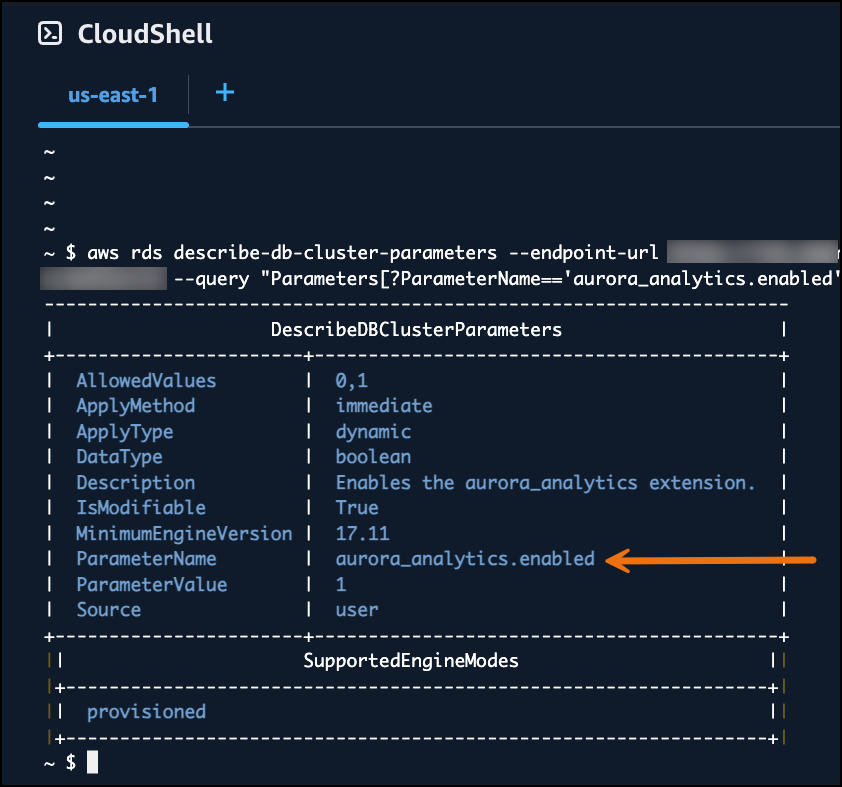
The integration supports Aurora PostgreSQL major versions 17 (starting with 17.11) and 18 (starting with 18.6). To initiate this functionality, users must enable the aurora_analytics extension and attach an IAM role with the AuroraAnalytics feature. This role grants the database the necessary permissions to interact with S3 and the AWS Glue Data Catalog. From there, users can create foreign tables that act as pointers to the data lake, allowing them to query external files as if they were native database tables.
One of the most notable features of this implementation is its ability to handle schema inference. In many previous iterations of federated query systems, developers were required to manually define the structure of every external table. With this new capability, Aurora can automatically read the metadata from Parquet files or Iceberg tables, significantly reducing the administrative burden. For those managing large numbers of tables, a single IMPORT FOREIGN SCHEMA statement can bulk-create these foreign table definitions, inferring schemas across an entire Glue database instantly.

Performance Optimizations and Unified Access
The system is designed to be intelligent regarding resource usage. It employs advanced optimization techniques such as predicate pushdown and column pruning, ensuring that the engine only reads the specific data required for a given query rather than scanning entire datasets. This is crucial for managing costs and maintaining high performance as data volumes grow into the petabyte scale.
Furthermore, the system includes a caching mechanism for frequently accessed data, which significantly accelerates subsequent queries. To provide transparency, AWS has introduced the aurora_analytics_stat_statements() function. This diagnostic tool allows database administrators to inspect query performance in detail, providing metrics such as total rows scanned, the number of bytes retrieved from S3, and the effectiveness of the local cache.
This unified approach extends to external catalogs as well. Through AWS Glue Data Catalog federation, organizations can register external Iceberg REST Catalog (IRC)-compatible catalogs. This enables a single, cohesive query to join data stored in an Aurora instance with Iceberg tables spread across multiple disparate catalogs. For the application layer, this creates a seamless experience where the location and format of the data are abstracted away, allowing developers to focus on logic rather than plumbing.
Practical Applications and Future-Proofing
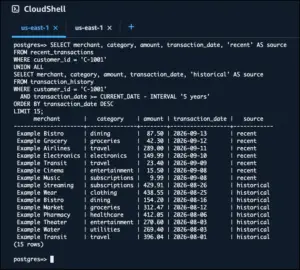
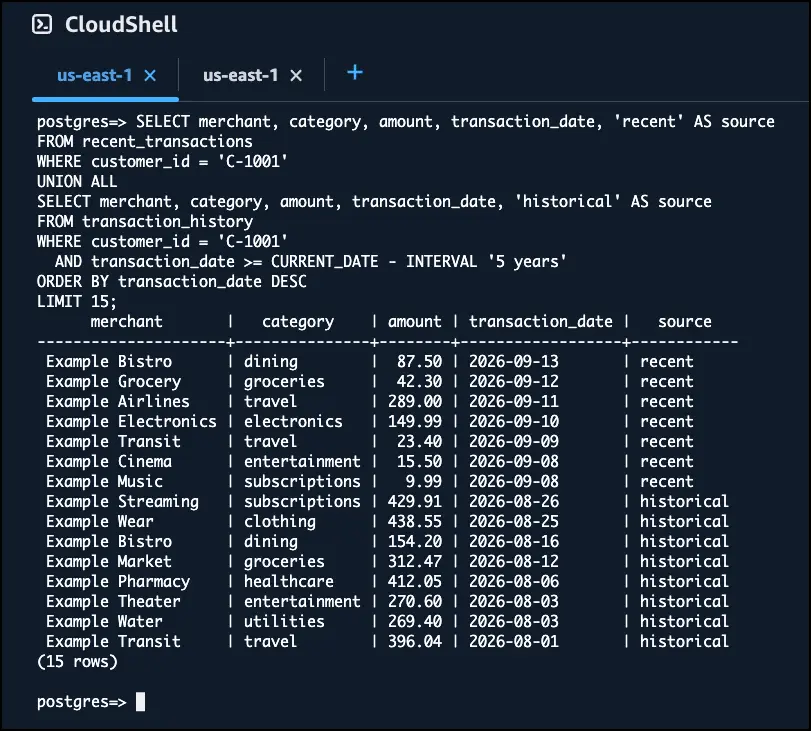
The practical implications of this development are extensive. Consider a financial services application that tracks customer transactions. Previously, a bank might store the last week of transactions in Aurora for immediate access and the previous five years of records in a data lake. Running a query to show a customer their full transaction history would require a complex application-level merge. Now, that same result can be achieved with a standard UNION ALL query, where the database engine manages the heavy lifting of pulling the "hot" data from the transactional table and the "cold" data from the S3 storage.
For scenarios where single-digit-millisecond latency is a hard requirement, the system also supports data materialization. Using standard commands like CREATE TABLE AS SELECT or MERGE INTO, users can move specific datasets from the data lake into native Aurora tables. This provides a path to high-performance storage for the most critical "hot" data while still allowing the rest of the historical record to remain in the cost-effective data lake. Because these queries can run on any read replica, organizations can effectively offload intensive analytical scans from their primary writer instances, protecting the performance of their core operational applications.
As AWS continues to refine this integration, the choice of building around the open-source DuckDB engine suggests that future performance and functionality improvements will be ported back into the Aurora service. This ensures that as the underlying analytical engine evolves, AWS users will benefit from those advancements without needing to re-engineer their infrastructure.
This new capability is currently available across all commercial AWS Regions and AWS GovCloud (US) Regions. There is no additional charge for the feature itself; customers are only responsible for the incremental compute costs incurred during query execution and the standard S3 request costs associated with reading their data lake files. By removing the barriers between operational databases and analytical data lakes, Amazon Aurora is positioning itself as a more versatile tool for modern, AI-integrated application development.