









For over half a century, Charles Schulz’s Peanuts has occupied a unique space in the cultural consciousness. To the casual observer, the comic strip is a tapestry of philosophical musings, childhood anxieties, and the occasional baseball game gone wrong. Among the vast library of strips published between 1950 and 2000, scholars and fans alike have categorized the work into three distinct lanes: the purely funny, the profoundly sweet, and those rare, masterful moments that manage to balance both. While the "boring" strips—as even the most dedicated enthusiasts might concede—certainly exist in the archives, it is the comedic brilliance of Schulz’s observations that kept the world reading for decades.
When one considers the role of Snoopy within this framework, the conversation often drifts toward his elaborate daydreams. We think of the World War I Flying Ace perched atop his doghouse, or the suave, sunglasses-wearing persona of Joe Cool. These are iconic, certainly, but they are also departures from the character’s roots as a suburban beagle. To truly appreciate the foundational genius of Schulz, one must strip away the high-concept roleplay and look at the strips where Snoopy is simply a dog—where the humor is derived from the mundane, often baffling, and deeply relatable nature of the canine experience.

The challenge of isolating the "funniest" dog-centric strips is a daunting one, precisely because the line between human behavior and canine instinct is so blurred in the world of Peanuts. Yet, if we narrow the scope to strips that highlight the dog’s perspective—the quiet, hungry, and occasionally mischievous reality of life on a leash—we uncover a masterclass in comic timing and observational humor. These selections focus on Schulz’s ability to find the comedy in the simplest of interactions, reminding us that while Snoopy may dream of being a pilot, he remains, at heart, a creature of habit.

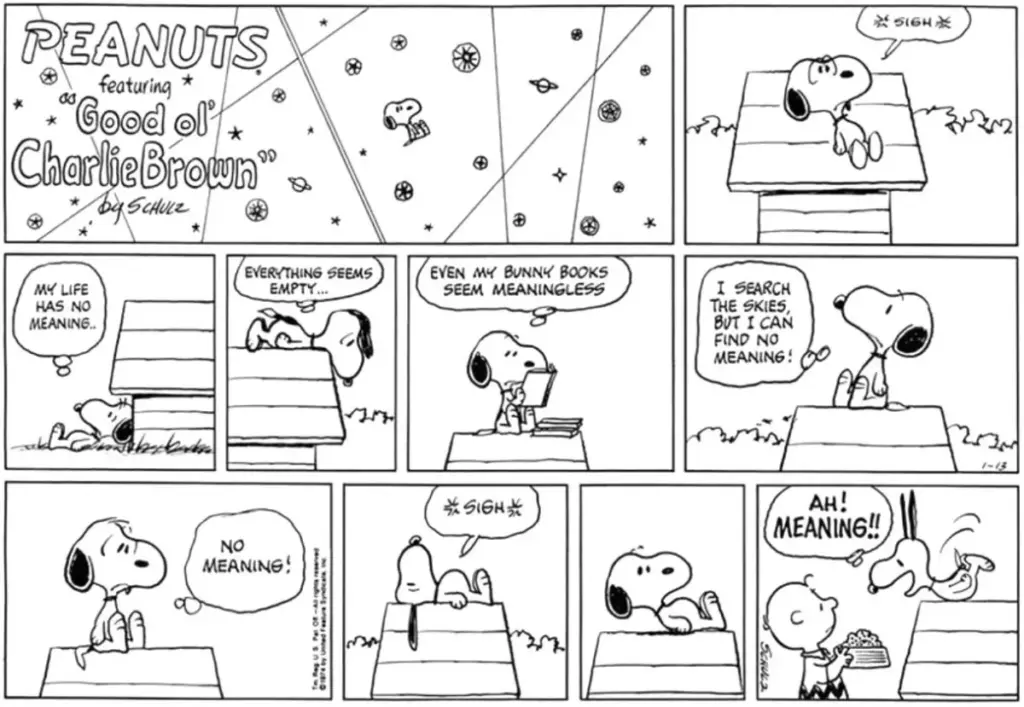
One of the most poignant, albeit humorous, observations Schulz made was about the sheer, unadulterated luxury of the canine lifestyle. In a particularly memorable strip, Snoopy reflects on the nature of his existence compared to that of his human companions. Humans, burdened by the weight of school, jobs, and social expectations, often view the family pet with a mixture of affection and intense envy. They watch the dog sleep, eat, and play, and they wonder what it would be like to exist without a care in the world.

In this specific strip, Snoopy leans into this jealousy, effectively validating the human perception that his life is, quite frankly, better. There is a comedic arrogance in his acknowledgment that he has no job, no responsibilities, and a guaranteed food supply. By articulating this—or rather, by having his body language communicate it—Schulz captures the universal human desire to trade one’s own complicated adult life for the simple, fulfilling pleasure of having a stick thrown in the park. It is a moment of meta-commentary that manages to be both self-aware and bitingly funny, reminding readers that while Snoopy is a beloved pet, he is also a master of his own effortless domain.
The humor in Peanuts was not always centered on the introspective, however. Sometimes, it was rooted in the early, more chaotic energy of the strip’s debut era. To look back at the Sunday strip from January 6, 1952, is to see a different version of Snoopy entirely. By this point, the strip had been running for roughly a year and a half, having moved from its daily format to the larger, more expansive Sunday canvas. In these early years, Snoopy was not the verbose dreamer we would later recognize; he was a rambunctious, occasionally troublesome animal.
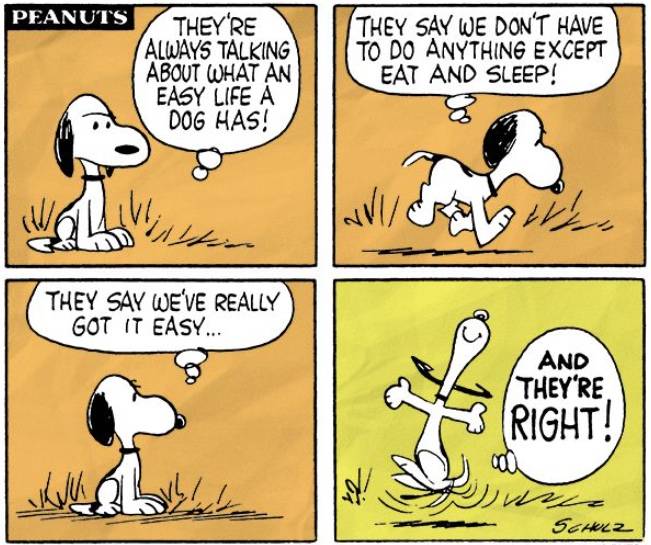
In this particular classic, we see a game of tag among the neighborhood children. The scene captures the frantic, kinetic energy of childhood play, but with a twist: the dog is participating. When the tag reaches Snoopy, the result is not a light touch, but a literal bite to the seat of Charlie Brown’s trousers. The subsequent panel, showing an indignant, pants-less Charlie Brown and a perfectly innocent-looking Snoopy, serves as a masterclass in visual comedy. The inclusion of the original Patty—distinct from the later, more famous Peppermint Patty—providing the justification that "that’s just his way of tagging" adds a layer of absurdity that highlights how far the character had yet to evolve. It is a jarring, hilarious reminder that before Snoopy was a writer or a pilot, he was a dog who didn’t quite understand the rules of the games he was playing.
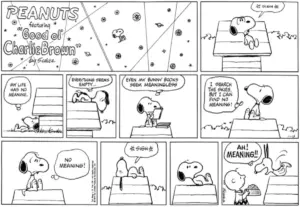
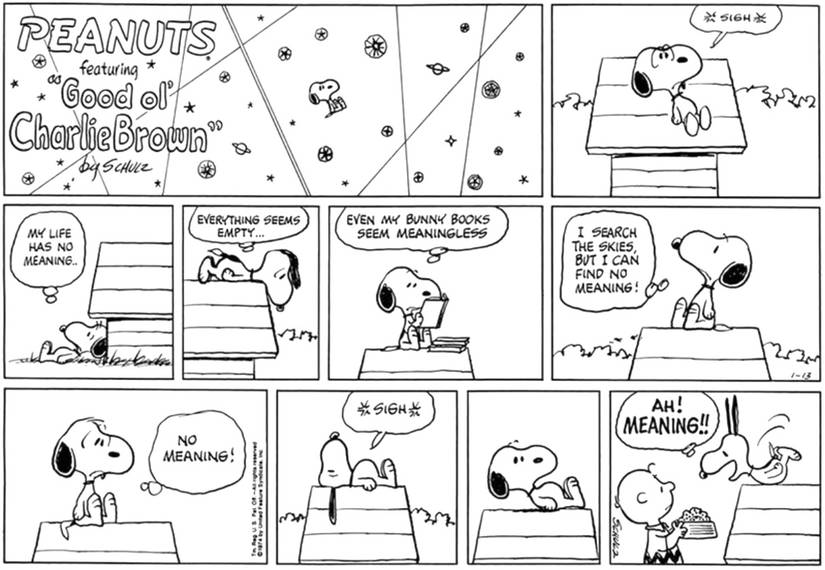
Schulz’s genius was perhaps most evident when he used these "dog moments" to explore existential themes. In a strip that dives into the concept of the "meaning of life," we find a despondent Snoopy wandering through a period of deep, almost human-like malaise. For the reader, this is a moment of genuine emotional investment. We worry for him; we wonder what could be bothering such a central character. He acts, in every way, like a man suffering from a mid-life crisis. The tension builds through several panels of quiet, heavy atmospheric dread.
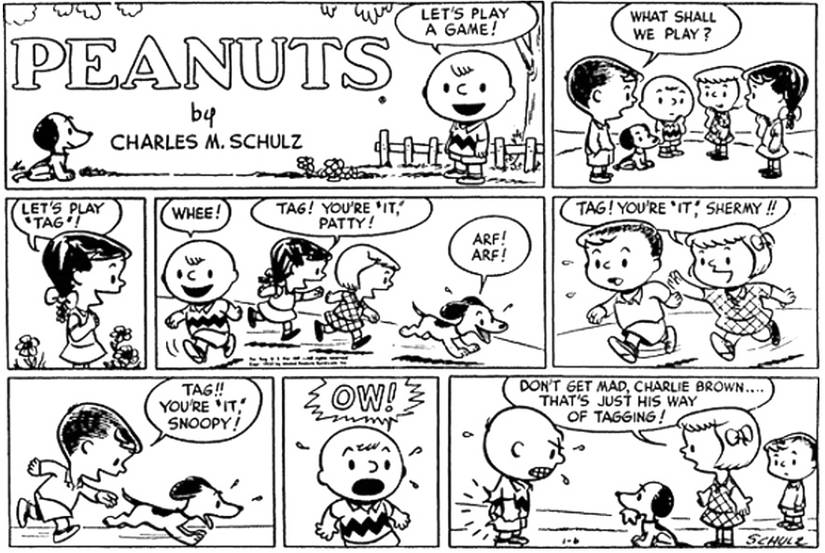
Then, the punchline arrives: the sound of a food bowl being filled. The transition from existential despair to pure, instinctual joy is instantaneous. It is a brilliant subversion of the reader’s expectations. We expect a deep, philosophical revelation, but instead, we receive a sharp reminder that, for all his human-like behavior, Snoopy is still governed by the basic biological imperatives of his species. The comedy here lies in the fragility of his "human" persona; it takes only a few kibbles to collapse his entire philosophical struggle.
This theme of food-driven behavior resurfaces in moments of genuine canine frustration. There are few things as relatable to dog owners as the sight of an empty food bowl. In one of the most expressive strips of the era, we see a visibly annoyed Snoopy reacting to his lack of sustenance. It is a rare, refreshing glimpse of genuine anger from a character who is usually portrayed as happy-go-lucky. By treating the empty bowl with the gravity of a major life crisis, Schulz taps into the universal language of pets. It is funny precisely because it is so petty; Snoopy’s indignation is both dramatic and entirely justified from his narrow, food-focused perspective.
Finally, we arrive at the tension between comedy and sentimentality. In a strip dedicated to the nature of dog sleeping habits, we find Lucy providing a quasi-scientific explanation for why dogs behave the way they do. The humor is sharp, but it is tempered by the visual of a sleepy, content Snoopy curled up on top of Linus’s head. It is a moment that flirts with the line between being "too sweet" and being genuinely funny.
Ultimately, this struggle to define the strips as purely "funny" versus "sweet" is perhaps the most important takeaway of the Peanuts legacy. Schulz rarely allowed his characters to exist in one box for long. Even in the funniest, most cynical moments, there is an inherent warmth that makes the punchline land with more impact. Whether he is biting Charlie Brown’s pants, mourning the lack of dinner, or simply finding peace atop a friend’s head, Snoopy remains a character who defies simple categorization. By focusing on his life as a dog, Charles Schulz didn’t just write funny comics; he captured the essential, often hilarious, and always endearing truth of what it means to share a life with an animal.