







For the past several years, the technology sector has operated under a sweeping, largely unchallenged assumption: that humanity is collectively holding its breath for the next wave of artificial intelligence. Tech leaders, venture capitalists, and corporate boardrooms routinely project a future where every workflow, personal habit, and digital interaction is supercharged, automated, or replaced by generative tools. The narrative suggests that people are starving for new AI features, products, and agents that will magically sweep away legacy processes and broken organizational habits.
Yet, a mounting body of real-world evidence, user research, and workplace studies suggests a completely different reality. Most people do not want more artificial intelligence—at least not in the intrusive, disruptive ways corporate leaders currently envision it. Despite billions of dollars in infrastructure spending and aggressive product rollouts, many high-profile AI features suffer from remarkably low adoption and user retention rates. Meanwhile, they carry exorbitant delivery costs and pose genuine risks to corporate reputation and employee morale.
The core disconnect lies in a fundamental misunderstanding of what artificial intelligence actually represents to the end user. Corporate leadership frequently falls into the trap of treating "Powered by AI" as a standalone value proposition. In reality, customers and employees do not view technology through the lens of its underlying algorithms; they judge features by their reliability, predictability, and utility compared to existing tools. When an AI-powered feature fails or produces hallucinations, the cognitive burden of verifying its output often outweighs any perceived time savings. Rather than magically creating happy, engaged users, standalone AI bolt-ons frequently take people completely out of their established, efficient workflows.
The AI People Don’t Need
Organizations routinely look to artificial intelligence as a silver bullet for long-standing structural issues. However, AI is exceptionally good at amplifying existing shortcuts and organizational shortcomings rather than fixing them. It cannot magically heal years of accumulated technical debt, poor data quality, broken corporate cultures, or toxic internal politics. Instead, these underlying inconsistencies are exacerbated by automated tools and handed directly to users, who are left to untangle the resulting mess.
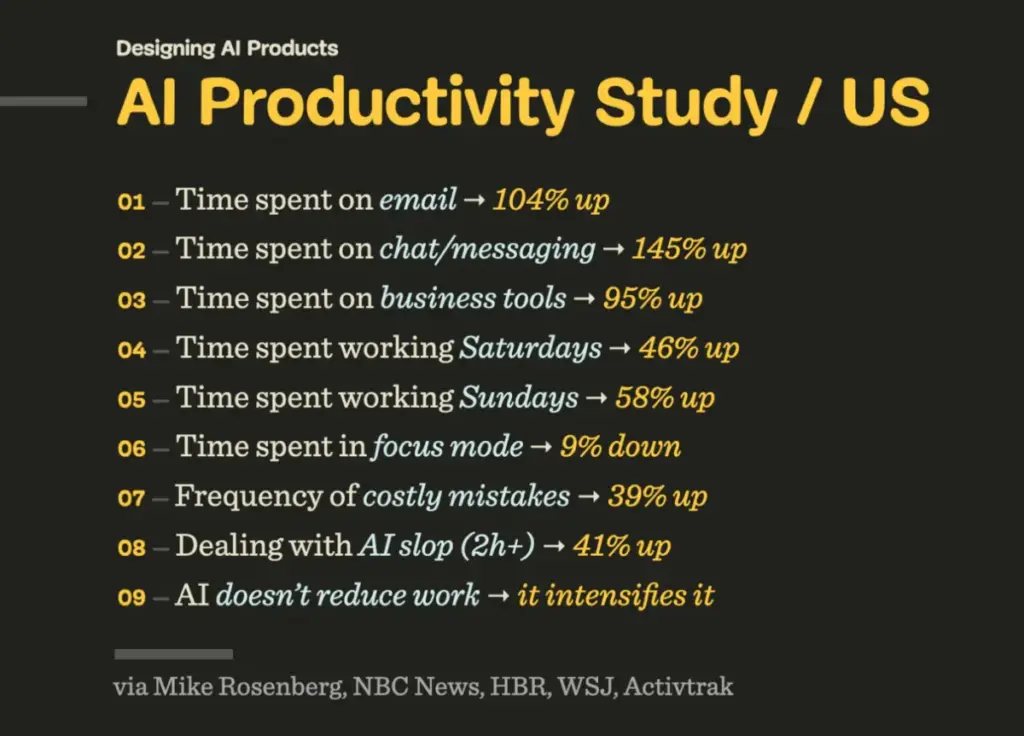
In most modern enterprises, workers already spend their days hopping between fragmented, disconnected systems. Introducing a new, standalone AI tool often means adding yet another layer of complexity that employees must navigate. Studies tracking workplace productivity following the integration of widespread AI tools indicate a paradoxical result: rather than reducing workload, AI often intensifies it. Metrics show significant spikes in time spent managing communications, handling digital clutter, and cleaning up AI-generated artifacts, accompanied by a measurable drop in deep focus time and an increase in weekend work.
Furthermore, the psychological toll of this forced technological shift cannot be ignored. For many workers, AI does not feel like a tool they have proactively chosen to explore; it arrives uninvited, dictated from the top down at an unrelenting pace. Coupled with persistent public narratives warning of widespread job displacement, it is little wonder that the prevailing sentiment among many workers is not enthusiastic adoption, but resistance to change and deep-seated anxiety about their future.

At its best, AI is met with silent compliance or passive acceptance. At its worst, it generates skepticism, caution, and a perception of liability. Unlike traditional software features, generative AI is inherently probabilistic, making it unpredictable and unreliable. Consumers are increasingly questioning the necessity of forcing artificial intelligence into every facet of modern life—from autonomous customer service bots and AI-generated art to smart appliances and synthetic companions. The average person is not dreaming of managing a swarm of unsupervised AI agents roaming through their bank accounts or speaking endlessly into a magical chatbot box.
The AI People Actually Need
The ongoing debate surrounding AI deployment frequently misses the mark by comparing machine reliability to human fallibility. End users do not evaluate software by comparing it to other people; they compare feature to feature. If a software tool works flawlessly while an AI-powered alternative produces erratic errors, users will bypass the AI every single time. Success is determined by what works consistently and reliably, regardless of the underlying technology stack.
Conversations in the tech industry often prioritize the sheer speed of delivery above all else. Yet, for many professionals, accelerating output is secondary to doing meaningful work well, with adequate time for critical thinking and sound decision-making. There is a deep sense of professional satisfaction and human achievement that risks being eroded in an environment dominated by rushed, automated workflows.

Human preferences have remained remarkably consistent over time. People want tools that are fast, accessible, reliable, predictable, and useful on a daily basis. Rather than systems designed to replace entire workflows, users prefer technologies that augment their capabilities and quietly take over mundane, repetitive, and exhausting administrative burdens. Many roles exposed to automation still contain vital creative and intuitive components that require genuine human taste and perspective. When AI successfully absorbs the tedious aspects of a job, it enhances productivity and restores a sense of joy to daily life.
To achieve this, AI must not feel like an awkward bolt-on. It needs to be deeply integrated into existing workflows, matching mental models that professionals have spent years or decades refining. The technology should adapt to how humans naturally think and make decisions, rather than forcing people to restructure their thinking around the software. Whether these features are explicitly branded as artificial intelligence or simply introduced as smart automation is secondary to whether they genuinely serve the user.
Ultimately, the most successful tools are not "AI-first," but rather "AI-second." They operate subtly, calmly, and ambiently in the background, offering supportive assistance for tasks that are otherwise dull and unnecessary. As corporate strategist Bo Young Lee eloquently noted, most people do not want synthetic books, AI-generated paintings, automated therapy, or machine-driven medical diagnoses. Instead, they want technology to shoulder the heavy physical and mental labor that drains their energy, leaving them free to engage with human art, literature, and genuine human connection.

As the industry continues to grapple with the realities of deployment and user adoption, the path forward requires a renewed focus on human-centric design. True innovation is not measured by the sheer volume of AI features deployed across an enterprise, but by how effectively technology serves to give people more time, headspace, and freedom to focus on the things they truly value.