









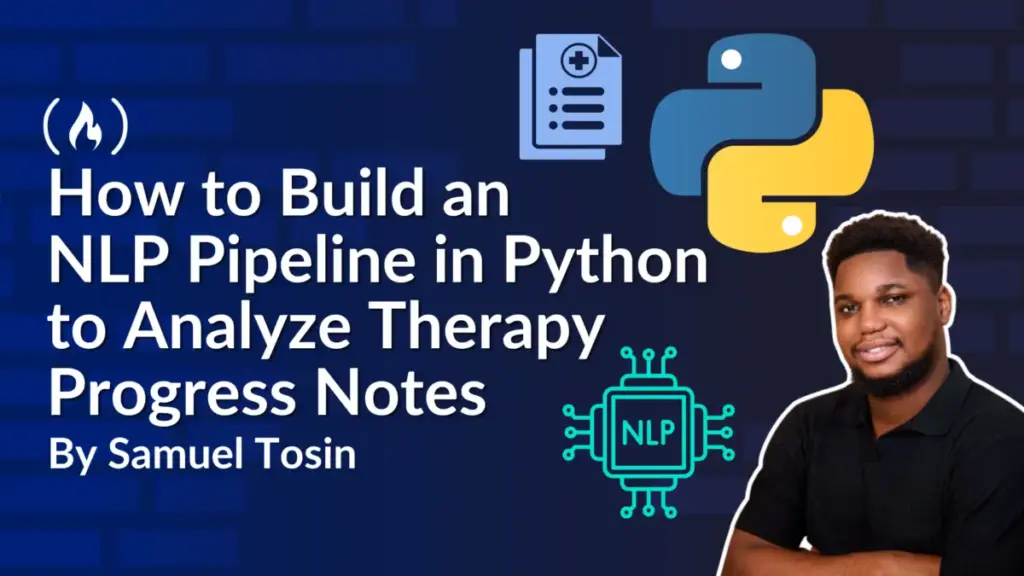
As text analytics continue to expand into complex domains, researchers and developers are increasingly exploring how Natural Language Processing (NLP) can be applied to clinical narratives and therapeutic records. A new open-source Python project demonstrates how developers can use modern NLP libraries, including spaCy and Hugging Face Transformers, to process fictional therapy progress notes, evaluate sentiment shifts, and track linguistic patterns across multiple sessions.
The project, which is publicly available on GitHub, bridges text processing and data visualization. However, its creators emphasize that the framework is strictly designed for educational exploration using synthetic data rather than clinical deployment.
Understanding the Scope and Limitations of NLP in Clinical Contexts
Therapy progress notes document what occurs during a session, capturing therapist observations, client statements, discussed topics, and plans for future meetings. Over time, these records accumulate significant volumes of text. While reading a single note provides context for an individual session, text analysis offers a method for examining how language evolves across a series of meetings.
Natural Language Processing allows computers to parse human language, break text down into sentences, extract grammatical features, and classify sentiment or emotion. Despite these technical capabilities, the project’s developers issue a firm reminder: NLP tools cannot determine whether therapy is effective, identify relational dynamics, or replace a trained professional.
General-domain models are trained on everyday text, such as social media posts or crowdsourced corpora, rather than clinical records. Consequently, automated sentiment scores or emotion classifications reflect statistical language patterns rather than a client’s true psychological state or therapeutic progress.
Architecture of the Open-Source Python Pipeline
The project utilizes a modular design powered by Python, connecting specialized libraries to handle distinct stages of data processing. spaCy serves as the foundational text-processing engine, leveraging the small English language model en_core_web_sm to tokenize sentences, assign part-of-speech tags, identify base lemma forms, and flag named entities.
Rather than relying on manual text cleaning that might strip out crucial context, the pipeline passes intact sentences directly to two pretrained Hugging Face transformer models. The first model, DistilBERT fine-tuned on the Stanford Sentiment Treebank (SST-2), classifies sentences into positive and negative categories. The second model, a DistilRoBERTa checkpoint trained by Jochen Hartmann, evaluates text across seven distinct emotion categories: anger, disgust, fear, joy, neutral, sadness, and surprise.
To manage data organization and output generation, the pipeline incorporates pandas and Matplotlib. pandas structures the session data into analytical dataframes, while Matplotlib compiles the results into comprehensive visual dashboards that chart sentiment trajectories, dominant emotions, pronoun ratios, and hedging phrase frequencies over time. A testing suite powered by pytest ensures code reliability using mocked classifier outputs, allowing developers to run tests without downloading heavy model weights.
Examining Linguistic Features and Session Timelines
Beyond standard sentiment and emotion detection, the Python workflow extracts specific linguistic markers, including pronoun ratios and hedging phrases. By tracking words that indicate uncertainty—such as "maybe," "perhaps," "sort of," and "I guess"—alongside first-person versus third-person pronoun distributions, the project demonstrates how developers can quantify surface-level text characteristics.
The resulting session timeline aggregates these metrics into a chronological overview. By comparing averaged scores across the first and second halves of a session series, the project provides a descriptive look at numerical shifts within the model outputs. However, analysts reiterate that these metrics remain statistical descriptions of text rather than diagnostic measurements or indicators of psychological change.
Ethical Considerations and Future Directions
The release of the project highlights broader ethical considerations regarding data privacy, algorithmic bias, and the interpretation of automated outputs. Processing clinical records requires strict adherence to healthcare privacy regulations, such as HIPAA in the United States or equivalent international frameworks. Simple text sanitization or anonymization is insufficient for real-world clinical data, and processing genuine patient notes without explicit legal authorization, proper security safeguards, and informed consent poses significant ethical and legal risks.
Furthermore, general-domain language models often underperform when encountering formal medical writing, non-native English speakers, or culturally diverse modes of expression. Misinterpreting automated sentiment indices as clinical outcomes can lead to flawed conclusions.
The project’s developers hope the open-source repository will serve as a starting point for developers interested in health technology, Python data science, and applied NLP. By understanding both the technical implementation and the inherent limitations of language models, practitioners can better navigate the responsible use of AI tools in text-heavy domains.