










For Angela Sant’Albano, the transition into the world of high-stakes video game development was a baptism by fire. Before stepping onto the set of Resident Evil Requiem, she had never performed for a game, nor had she ever donned a motion-capture suit. Yet, after spending months immersing herself in the harrowing narrative of Grace Ashcroft, the newcomer has found herself in the spotlight, earning a coveted nomination at the 2026 Game Awards. As the industry reflects on her standout performance, Sant’Albano is opening up about the unique physical and emotional demands of bringing a new face to the iconic Resident Evil franchise.
"I honestly couldn’t have been luckier to be in Resident Evil," Sant’Albano told Polygon just weeks before the 2026 Game Awards nominations were revealed. "I still pinch myself."
While the leap from traditional screen acting to the digital realm of motion capture can be daunting for any performer, Sant’Albano discovered that the medium was surprisingly intuitive. Rather than feeling alienated by the technology, she found that the process offered a rare synthesis of two distinct performance arts: the intimacy of television and the unbridled freedom of live theater.

"Imagine you’re doing theater in the round," she explains. "You have the audience 360 degrees around you, but then you have the intimacy of television and screen because you have a camera right here with you. You can have an incredibly internal dialogue while also having the freedom of the body."
That freedom of the body was not just a theoretical concept during the production of Resident Evil Requiem; it was a mandatory requirement. The game’s cutscenes were captured in their entirety at London’s renowned Imaginarium Studios, a facility known for its commitment to authentic movement. Under the direction of the production team, the actors were expected to perform their own stunts and movements, often in a darkened studio environment designed to strip away the distractions of a typical film set.
To capture the genuine desperation of Grace Ashcroft, a character constantly teetering on the edge of survival, Sant’Albano had to push her own physical boundaries. Scenes that required Grace to be gasping for breath or paralyzed by fear were not merely acted; they were physically lived in the studio.
"I would just run around, run around, do push-ups, do jumping jacks, do whatever I could to keep my heart rate up," Sant’Albano shares. "Grace is a very anxious person. And yeah, sort of doing that when you kind of mimic anxiety in your body and mimic that breath, you then inevitably feel a bit anxious."
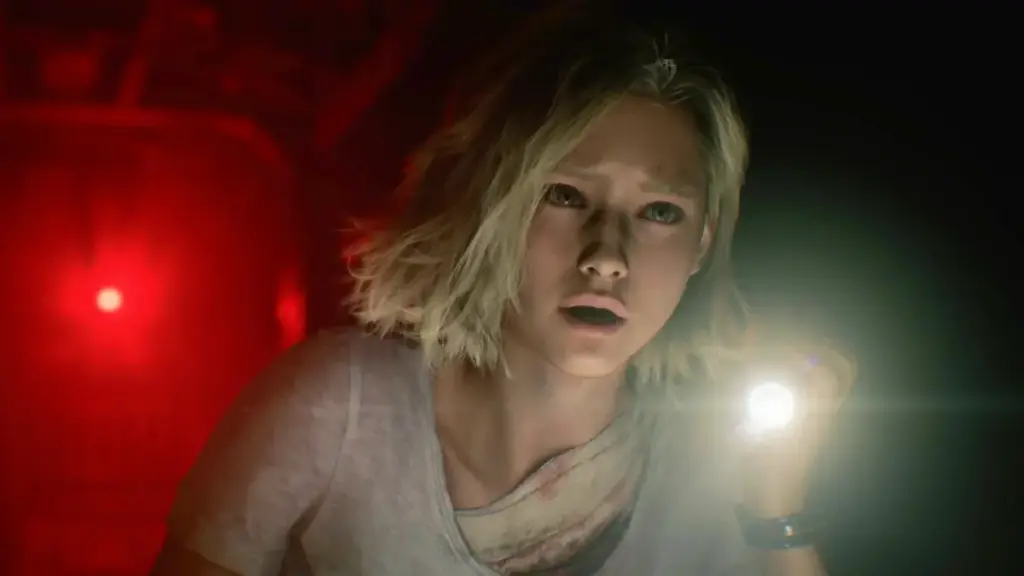
The production went to great lengths to ensure that this physical reality translated to the screen. In one early, memorable sequence where Grace wakes up chained to a gurney, the production team didn’t rely on camera tricks or digital augmentation. Instead, they tilted the physical rig while Sant’Albano was strapped into it, forcing her to endure the sensation of being upside down. When the narrative called for her character to be dragged across the floor, the production ensured that the actor was physically pulled as well, grounding the digital horror in a tactile, visceral experience.
"I really believe that that is why the performances came across as so truthful," she says. "Because we put ourselves in a lot of those situations."
This commitment to authenticity extended beyond the high-intensity action sequences to the subtler, human moments that define Grace as a character. During the rehearsal process, Sant’Albano and the creative team experimented with the limits of Grace’s personality, testing how far they could push her awkwardness and her vulnerability before pulling it back to maintain the character’s core essence.

One of the most notable collaborative efforts involved the character’s internal monologue and how she expressed her mounting frustration. Sant’Albano, considering the character’s age and the extreme circumstances she faces, felt that a certain level of raw, unfiltered language was necessary to make Grace feel like a real person in her mid-20s.
"I just remember thinking, like, Grace is a 25, 27-year-old girl. She’s gonna swear," Sant’Albano recalls. "How would Angela react in a lot of these situations? And I was like, she would say ‘fuck.’"
The team at Capcom agreed, and the inclusion of more grounded, realistic dialogue became a signature element of Grace’s interactions throughout the game.
Finding the voice of Grace Ashcroft was a meticulous process that went deeper than just vocal performance. Sant’Albano invested significant time in researching the mechanics of stuttering, seeking to understand the psychological and physiological triggers that exacerbate it. By constructing the character from the ground up—starting with her traumatic history, her complex and strained relationship with her mother, and her persistent feeling of being an outsider within the ranks of the FBI—Sant’Albano was able to find the character’s unique posture and cadence.
"I sort of just dived into her backstory in order to find her," she says. "And then through that, like her voice and her posture… it all kind of came weirdly naturally."
With Resident Evil Requiem now in the hands of players and the accolades beginning to mount, the question of Grace’s future has become a primary topic of conversation among fans of the series. Grace successfully survives the events of the game, leaving her story wide open for future chapters. Sant’Albano is clearly invested in the character’s trajectory, citing the unresolved mysteries surrounding her mother’s professional life, her complicated dynamic with Emily, and her burgeoning, fragile bond with series stalwart Leon Kennedy as potential narrative threads that deserve further exploration.
"I do hope that Grace will come back," Sant’Albano says. "I think her story is definitely not over."
However, should Grace return, fans should not expect a sudden transformation into an action-hero archetype. Sant’Albano is protective of the vulnerability that makes Grace distinct, noting that her strength lies in her humanity rather than her combat prowess. She is not a soldier in the traditional sense, and that is precisely what makes her survival so compelling.
"She’s never gonna be Leon," Sant’Albano concludes. "And I think that’s what makes her special."
As the 2026 Game Awards approach, the industry is watching to see if Sant’Albano’s breakout performance will be rewarded. Regardless of the outcome, her work in Requiem has already left an indelible mark on the franchise, proving that even within a world of monsters and bioterrorism, the most powerful elements are often the human ones. For now, the audience can only wait to see if the haunting echoes of Grace Ashcroft’s first outing will indeed lead to a broader, more terrifying story in the years to come.