










For platform engineering teams, managing containerized applications at scale on Amazon Elastic Container Service (Amazon ECS) has long involved a complex, repetitive dance of infrastructure provisioning. While ECS excels at orchestrating the lifecycle of containers, the peripheral networking requirements—configuring Application Load Balancers (ALBs), managing AWS Certificate Manager (ACM) certificates, setting up AWS WAF web access control lists (web ACLs), and fine-tuning security groups—often create a significant operational bottleneck. Every time a new microservice is deployed, teams must manually or through custom automation provision these resources and keep them synchronized as the service scales or undergoes updates. This per-service overhead not only slows down deployment velocity but also introduces the risk of configuration drift, where subtle inconsistencies across environments can lead to hard-to-diagnose networking issues.
Recognizing these challenges, AWS has announced the launch of Amazon ECS Gateway, a new account-level resource designed to fundamentally simplify ingress networking for containerized workloads. By shifting the burden of infrastructure management from the developer to the platform, ECS Gateway allows teams to move faster while maintaining robust security and networking standards. The new service functions by dynamically provisioning and managing the necessary ingress infrastructure on the user’s behalf, with all resources created directly within the customer’s AWS account. This ensures that while the heavy lifting is automated, the user retains full visibility and control over their underlying cloud resources.

The introduction of ECS Gateway marks a shift in how organizations can structure the division of labor between platform teams and application development teams. By providing a centralized mechanism for ingress, platform engineers can define the networking guardrails once, and application developers can simply hook their services into these pre-configured gateways. This architecture allows for host-based routing using ALBs, enabling up to 25 services to share a single load balancer. This capability is particularly significant for cost optimization, as it allows organizations to maximize the utility of their infrastructure without the need to provision a dedicated load balancer for every individual microservice, which is often inefficient for smaller or low-traffic services.

Under the hood, ECS manages the full lifecycle of this underlying infrastructure. The system is designed to be intelligent and responsive: it provisions the first ALB automatically when the initial service connects to the gateway, and it continues to add more load balancers as the capacity of existing ones is reached. Conversely, as services are decommissioned or scaled down, the gateway gracefully removes unnecessary resources, ensuring that the infrastructure footprint remains lean. Each service integrated into the gateway receives a unique DNS hostname, providing developers with a ready-to-use, production-grade endpoint the moment the provisioning process concludes.

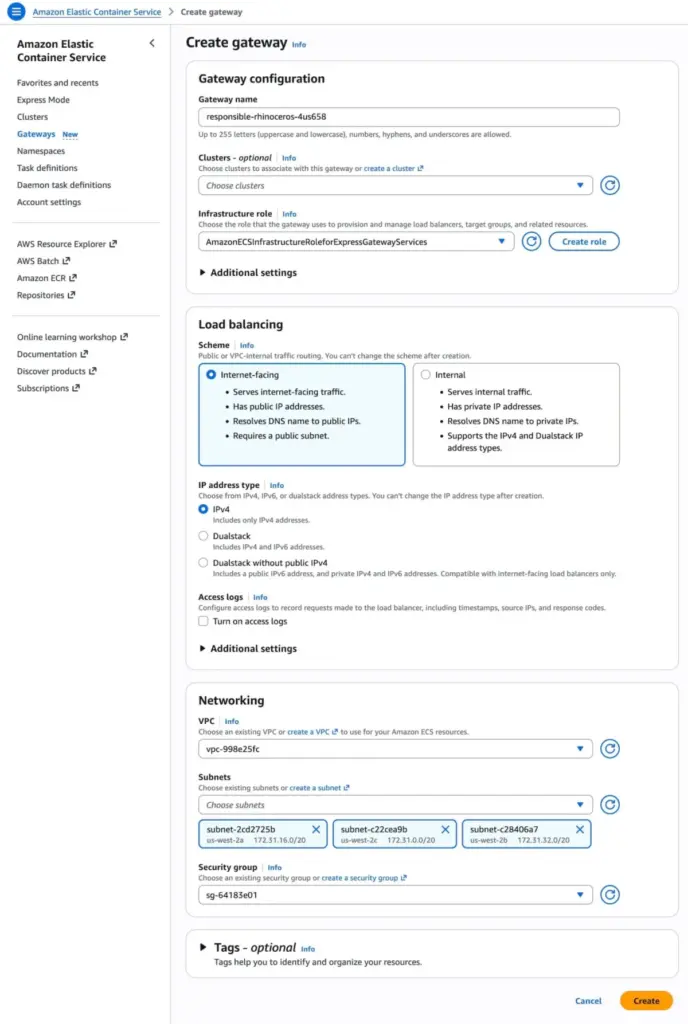
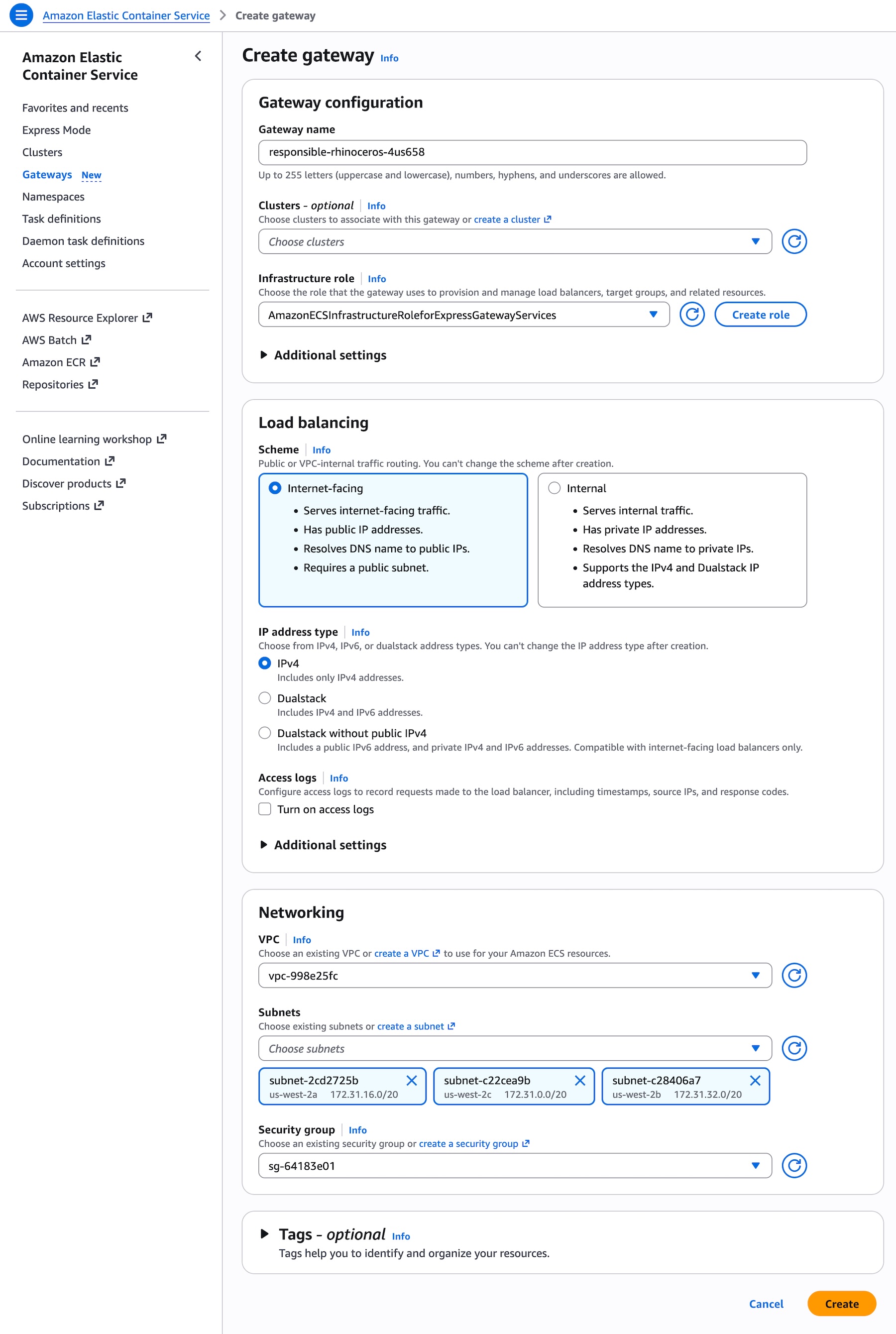
Getting started with ECS Gateway is designed to be intuitive for those already familiar with the ECS console or the AWS Command Line Interface (AWS CLI). Within the console, platform teams can define a new gateway by providing a name and selecting an infrastructure role. This role is a critical component of the security model, as it is the IAM identity that ECS assumes to provision and manage the networking stack, including ALBs, security groups, and SSL/TLS certificates. During the creation process, users can associate the gateway with one or more ECS clusters, choosing between a public-facing load balancing scheme or a VPC-internal routing configuration. Advanced settings, such as listener ports, web ACL associations for security, and the maximum number of load balancers the gateway is permitted to scale to, can also be configured at this stage.
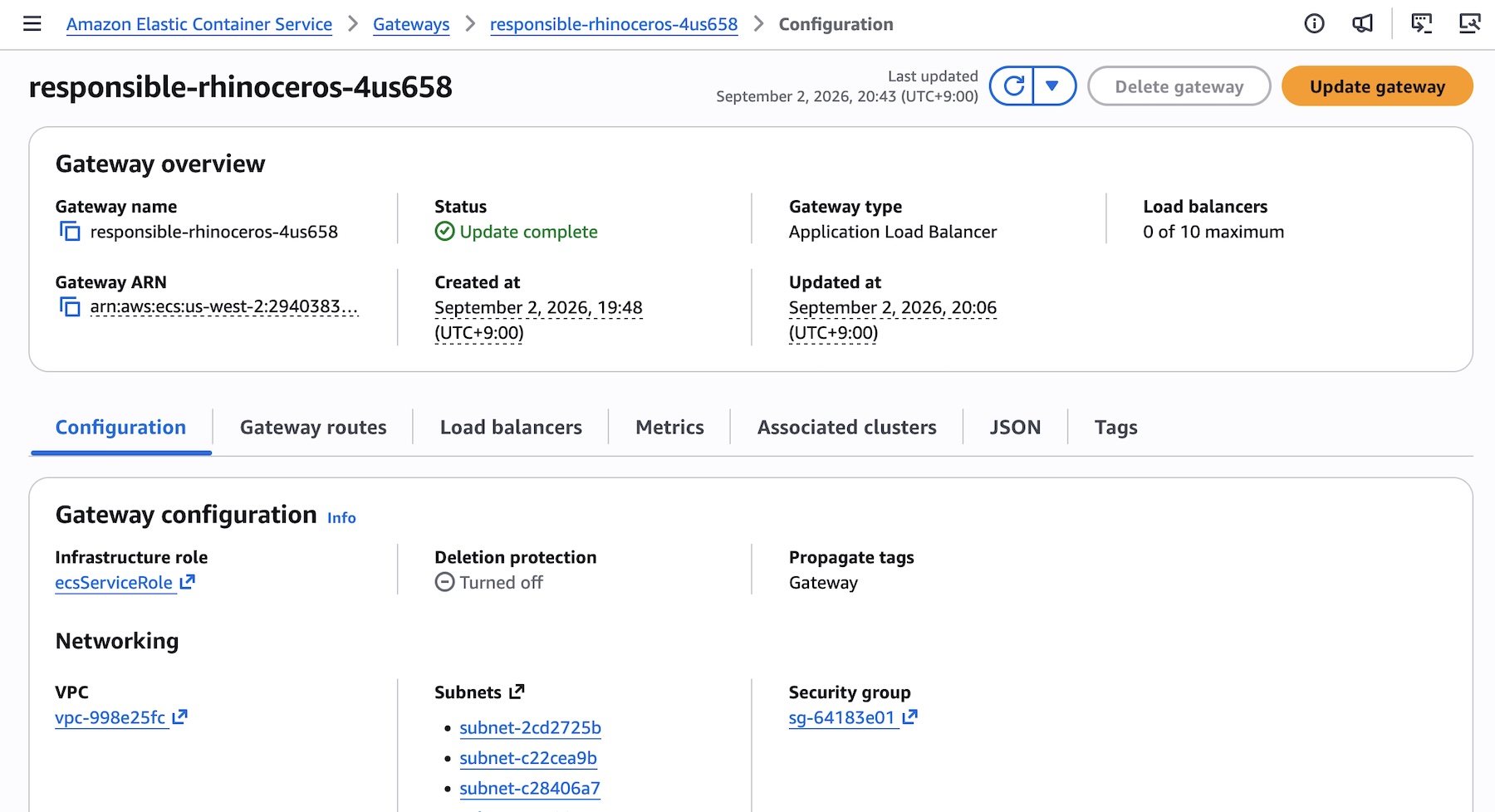
It is important to note that certain foundational settings, such as the gateway’s name, the VPC and subnet configuration, and the listener protocol, are immutable after creation. This design choice emphasizes the importance of planning the gateway’s role within the broader network architecture. For teams that prefer infrastructure-as-code or automated pipelines, the AWS CLI provides a straightforward way to create these gateways via the CreateGateway command. Once the gateway is live, it remains dormant in terms of infrastructure footprint until a service actually connects to it, ensuring that no unnecessary resources are billed or provisioned until they are strictly required.
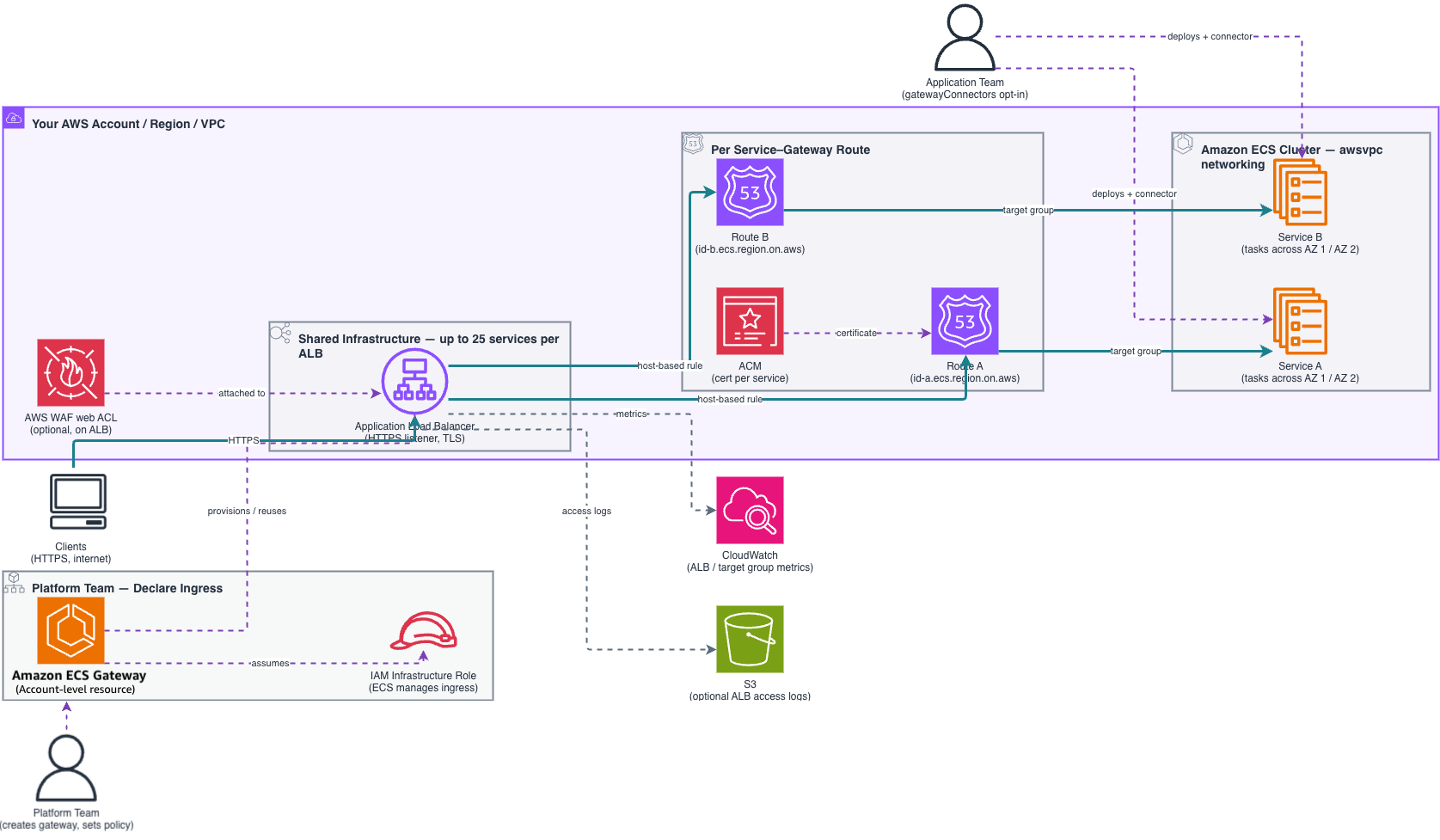
The versatility of ECS Gateway is further demonstrated by its flexible association model. A single gateway can be associated with up to 10,000 clusters, while a single cluster can support up to five different gateway associations. This many-to-many relationship provides platform teams with immense flexibility, allowing them to segment traffic by environment, security zone, or organizational unit. For example, a team might deploy one gateway dedicated to public-facing traffic and another restricted to internal VPC traffic, then associate both with a specific set of clusters. This ensures that application teams can easily route their services to the appropriate ingress point simply by choosing the correct gateway.
When it comes to adoption, ECS Gateway is designed to integrate into existing workflows without requiring a complete rewrite of service definitions. Application teams add a "gateway connector" to their service definitions during the CreateService or UpdateService API calls. For organizations with existing services already using traditional load balancers, the transition can be handled incrementally. Because both the old ingress path and the new ECS Gateway path can coexist, teams can validate their new connections and ensure traffic is flowing correctly before decommissioning their legacy load balancer configurations.
When an update is triggered, Amazon ECS evaluates the gateways associated with the cluster and connects the service to every compatible gateway. Compatibility is determined by several factors: the access type must match the service’s connector filter, the gateway must reside within the same VPC as the service, and the gateway must provide coverage for all the Availability Zones utilized by the service’s subnets. Once a connection is established, ECS handles the heavy lifting: it assigns the service to an ALB with available capacity, provisions the necessary ACM certificate, sets up the unique DNS hostname, configures the listener rule to route traffic to the correct target group, and adjusts security groups to ensure that only the ALB can communicate with the service.
The system is also built to be self-healing and operationally resilient. ECS Gateway automatically manages common operational scenarios, such as the rotation of certificates, the maintenance of security group rules, and the rebalancing of services across ALBs as load fluctuates. By centralizing these tasks, the platform team reduces the surface area for human error and ensures that security patches and configuration updates are applied consistently across the entire container fleet.
For developers and operators who rely on modern tooling, the integration of ECS Gateway extends to the latest AI-driven workflows. The service is fully supported by the AWS MCP Server and various plugins, allowing teams to manage their gateway configurations programmatically using AI coding assistants. This aligns with the broader industry trend of using natural language and advanced automation to manage cloud-native infrastructure, further lowering the barrier to entry for complex networking tasks.
The rollout of Amazon ECS Gateway represents a significant step forward for the AWS container ecosystem, addressing one of the most common pain points for platform engineers. By abstracting the complexities of ALB management, certificate lifecycle, and security group synchronization, AWS is enabling organizations to focus more on their application logic and less on the plumbing of their cloud network. The service is currently available in all commercial AWS Regions where Amazon ECS is supported, and it carries no additional service fee. Customers pay only for the underlying infrastructure—such as the ALBs, data transfer, and ACM certificates—that is provisioned in their account. This transparent pricing model, combined with the operational efficiency gains, makes ECS Gateway a compelling option for teams looking to standardize and scale their containerized ingress strategy. As teams begin to adopt this new capability, the ability to rapidly deploy services with secure, pre-configured networking will likely become a cornerstone of efficient, modern cloud operations.