The rapid evolution of artificial intelligence is fundamentally reshaping how defense, intelligence, and commercial organizations collect, process, and exploit satellite imagery. As the global volume of Earth observation data continues to expand exponentially, traditional manual analysis methods are no longer sufficient to keep pace with operational demands. Today, AI has transitioned from an experimental capability to an absolute operational necessity, proving essential for identifying complex patterns, detecting subtle anomalies, and delivering actionable intelligence at the speed of modern conflict and decision-making.
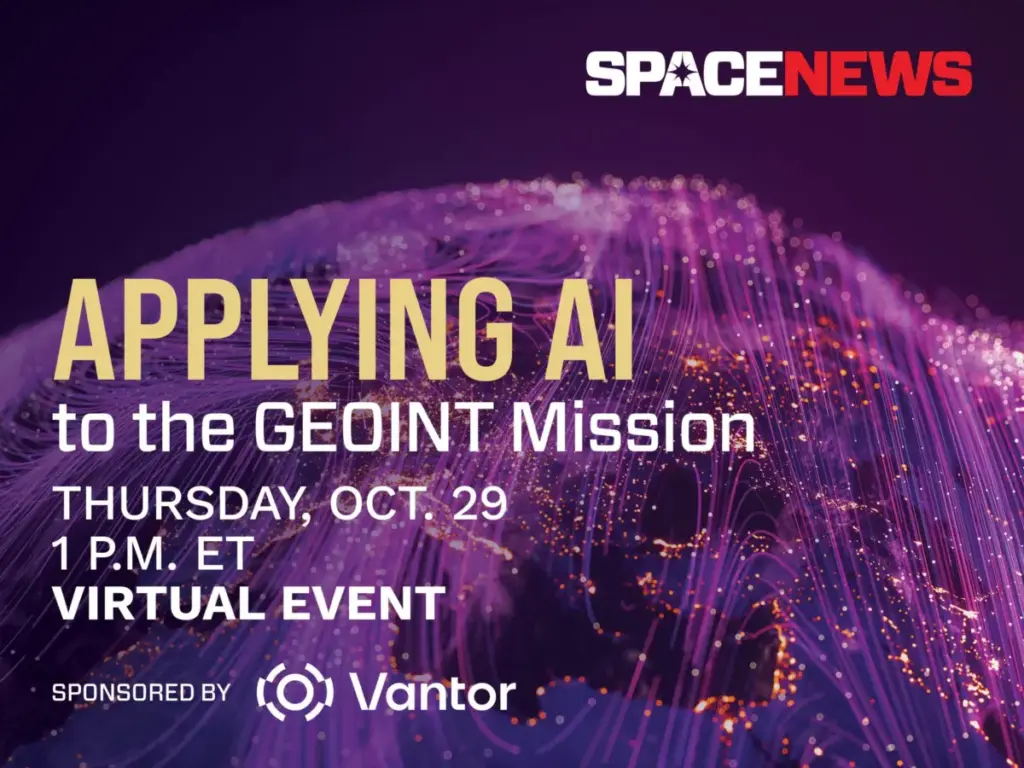
To examine these transformative developments, SpaceNews is partnering with Vantor to host an exclusive virtual event exploring the integration of machine learning into geospatial intelligence (GEOINT). Scheduled for Thursday, October 29, from 1:00 p.m. to 1:45 p.m. Eastern Time, the virtual briefing will bring together industry and defense perspectives to analyze how modern automation is redefining the intelligence lifecycle. The session will be broadcast via Zoom, with registration open to professionals across the aerospace, defense, and technology sectors.
The modern intelligence landscape is defined by an unprecedented influx of multi-source data. Commercial and government constellations now capture high-resolution imagery across optical, radar, and infrared spectrums on a continuous global scale. Without advanced computing architectures, intelligence agencies risk drowning in data while starving for actionable insights. Machine learning algorithms and neural networks now serve as the critical filter, processing massive streams of raw pixel data to highlight what truly matters to commanders, analysts, and national security decision-makers.

During the upcoming October 29 event, featured speakers will dive deep into the specific technological breakthroughs driving this transition. Conversations will center on advances in automated target recognition, which allows systems to autonomously identify military hardware, infrastructure changes, and maritime vessels with minimal human intervention. Additionally, the panel will explore sophisticated change-detection methodologies, multimodal data fusion—which combines imagery with signals intelligence and open-source data—and the integration of large language models to streamline reporting and database queries.
Yet, as the capabilities of machine learning expand, organizations face persistent and complex challenges. One of the foremost hurdles discussed in the defense technology community is the rigorous validation of AI outputs. In high-stakes intelligence operations, false positives or algorithmic hallucinations carry severe operational consequences. Ensuring that automated systems are reliable, transparent, and resilient against spoofing or adversarial manipulation remains a top priority for developers and end-users alike.
Maintaining analyst trust is another critical theme of the virtual forum. Analysts must understand how an algorithm reached a specific conclusion before they can confidently brief senior leaders or stake tactical actions on machine-generated insights. The dialogue will carefully weigh where artificial intelligence delivers its greatest operational value through sheer speed and scale, versus where human cognitive capabilities, contextual judgment, and ethical oversight remain entirely indispensable. Furthermore, the discussion will address how intelligence organizations must structurally adapt to manage persistent, data-driven surveillance without overwhelming their workforce.
The event is sponsored by Vantor, a company operating at the forefront of spatial intelligence to build an autonomous and interoperable global framework. Vantor provides decision-makers and frontline operators with the tools necessary to construct a unified intelligence picture, offering the operational clarity required to navigate current geopolitical developments and anticipate future challenges. The company fuses data from its advanced orbital constellation—featuring some of the most capable imaging satellites currently in orbit—with real-time sensor feeds gathered across space, air, and ground domains.

By integrating these diverse streams, Vantor constructs an AI-ready digital twin of the Earth. Its spatial intelligence platform is designed to automate every phase of the intelligence cycle, spanning from initial tasking and collection to final data production, allowing the digital foundation to update and be analyzed at the relentless pace of real-world change. These commercial products are engineered to drive deeper mission-critical insights and connect the next generation of autonomous systems across defense, intelligence, and commercial markets.
The virtual event will take place via Zoom on Thursday, October 29, from 1:00 to 1:45 p.m. ET. Interested participants can secure their attendance through the registration portal provided by SpaceNews. Upon completion of registration, attendees will receive a unique access link via email. For those unable to attend the live broadcast, a full video recording of the session will be published on the SpaceNews platform shortly after the event concludes.