







For as long as modern software development has existed, the ritual of the craft has remained remarkably consistent. It is a world defined by the "setup": the hum of the terminal, the glow of the browser, the rhythmic clatter of a mechanical keyboard, and an overwhelming forest of open tabs—each a promise of a solution or a piece of documentation that might be needed later. For generations of developers, success was measured by how well they could master these tools, memorize arcane terminal commands, and adapt their own cognitive processes to the rigid logic of the machine. The developer served the environment, molding their workflow to fit the limitations of the editor and the command line.
Today, that relationship is undergoing a profound and irreversible shift. As artificial intelligence moves from simple code completion to sophisticated, agentic workflows, the fundamental nature of programming is changing. We are no longer merely operating tools; we are expressing intent.
The Shift from Execution to Intent
The revolution isn’t found in the ability to generate a few lines of boilerplate code via a prompt. Rather, the true transformation lies in the emergence of systems capable of true agency. Modern AI systems can now ingest an entire repository, comprehend its architecture, select the appropriate model for a specific task, plan a multi-step execution strategy, and navigate the complexities of dependencies. More importantly, they can perform these actions within the safety boundaries defined by the developer.

This capability effectively compresses the traditional development lifecycle. Where a developer once had to manually open files, inspect symbols, run individual tests, and debug failures, they can now describe an intended outcome to an agent. Tools like GitHub Copilot have evolved to gather necessary context, edit code, execute tests, and iterate on the implementation until it aligns with the goal. In agent mode, this becomes a collaborative loop: the developer provides the high-level direction, and the agent navigates the mechanics of the codebase.
The significance of this cannot be overstated. When a coding agent can take an issue, work within an isolated GitHub Actions environment, and return a polished pull request for review, the role of the developer shifts from the "typist" of logic to the "architect" of intent. The developer remains firmly in control of the outcome, but the daily experience of work becomes less about the manual friction of implementation and more about setting constraints, defining parameters, and exercising judgment.
The Rising Value of Human Judgment and Taste
In an era where an AI agent can generate three potential implementations for a feature before a developer has finished their morning coffee, the nature of "productivity" is being redefined. When mechanics are delegated to the machine, the value of the developer’s time shifts toward higher-order cognitive tasks.
This environment places a premium on qualities that were previously secondary to raw coding speed: human judgment, design taste, and strategic foresight. The machine can offer options, but the developer must be the one to decide if a particular abstraction is appropriate for the long-term health of the codebase. They must discern whether a database migration is truly safe, whether the test suite provides meaningful coverage, and whether the proposed solution actually addresses the underlying user need.
This is the most critical evolution in the craft: as we delegate more of the "how" to AI, the human responsibility for the "why" and the "what" becomes more essential than ever. Accountability cannot be automated. The developer is, and will remain, the ultimate steward of the software’s quality and intent.
Integrating Intelligence into the Workflow
As the industry looks toward the future of developer workflows, the goal is not to create a separate "AI layer" that sits beside the workspace, but rather to embed intelligence directly into the environment. We are moving toward a paradigm of ambient intelligence—a state where the tools are aware of the developer’s context and ready to assist without the need for constant, deliberate invocation.
This transition requires a new technical architecture. It demands portable context, where information flows seamlessly between the agent and the developer’s tools. Standards like the Model Context Protocol (MCP) are vital here, as they connect agents to diverse tools and services, allowing them to operate within the specific conventions of a given project. When repository instructions and project-specific skills are encoded into the system, and when hooks are in place to enforce policy and validate output, the AI stops being a generic assistant and starts becoming a teammate that understands the specific "language" of the organization.
The ideal architecture for this new era consists of three distinct layers. First, a modality layer that accurately captures the developer’s intent, whether through text, voice, or other interfaces. Second, a harness layer that plans and executes the work, managing the interaction with the codebase. Third, a control plane that provides the developer with the ability to inspect, redirect, and approve the agent’s work in real-time. The most successful products will be those that integrate these three layers into a single, cohesive experience without ever forcing the developer to surrender their oversight.
The Resurgence of Physical Controls
As development moves beyond the keyboard and the terminal, we are seeing a surprising return to physical interfaces. In the maker community, there is a growing trend of experimenting with ambient control devices—everything from simple, hackable picture frames to ESP32-based hardware. This shift recognizes that when a developer is deeply immersed in an agentic workflow, the standard keyboard-and-mouse setup can sometimes feel restrictive.
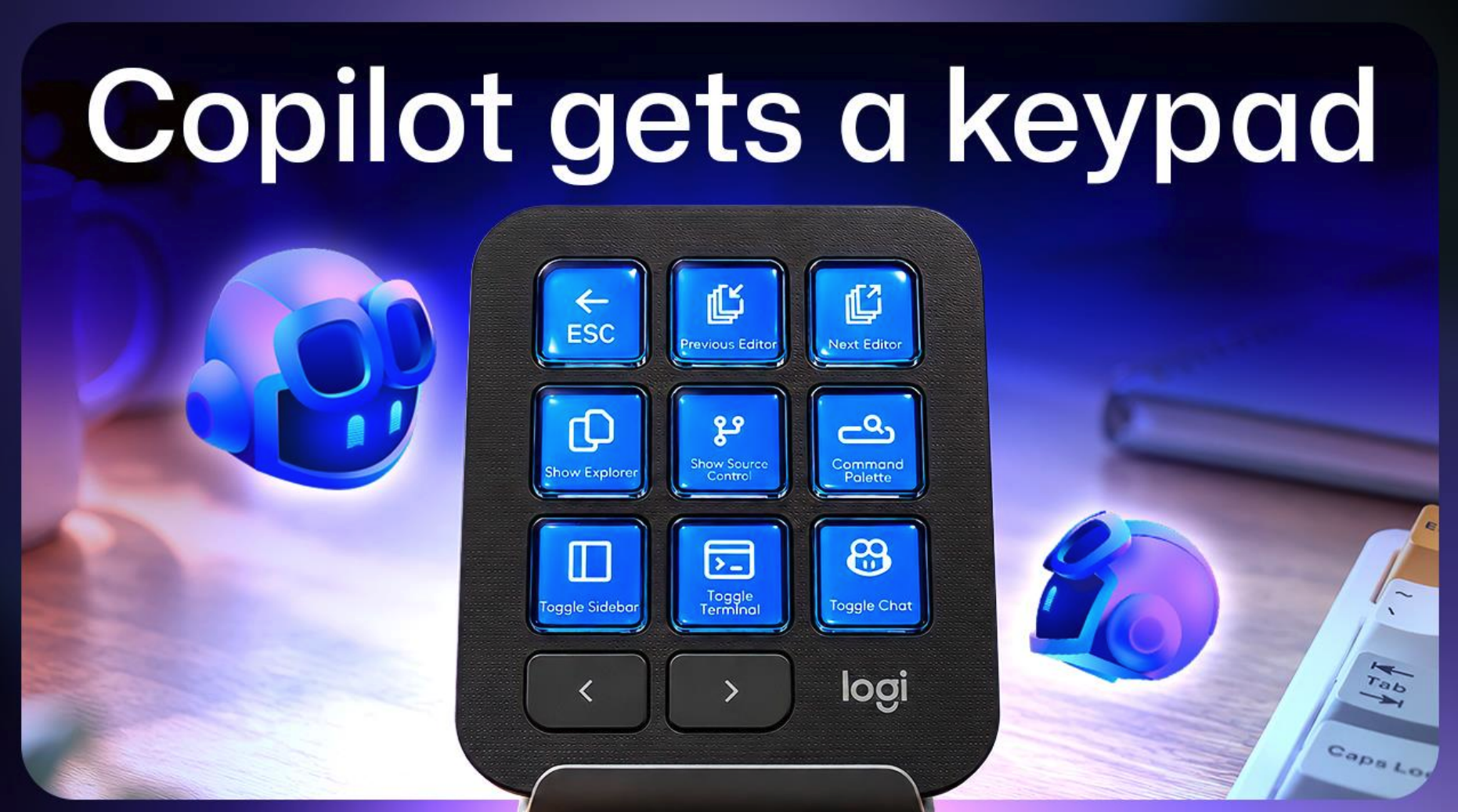
In collaboration with Logitech, GitHub has spent the last 18 months exploring how specialized hardware, specifically the Logitech MX Keypad, can bridge this gap. The goal is to turn familiar, repetitive developer actions into programmable inputs that are deeply contextual to the work at hand.
For many, the physical keypad acts as a bridge to the GitHub Copilot experience. A single button press can submit a complex, parameterized prompt, resume a paused session, invoke a specific IDE command, or trigger a multi-step sequence that would otherwise require navigating multiple menus. Hardware earns its place in the modern developer’s toolkit only when it removes enough friction to preserve the "flow state"—the delicate mental focus that is so easily broken by mundane interruptions.
Not every developer needs extra hardware, and not every action warrants a physical key. However, the true value of these interfaces lies in the developer’s ability to choose what earns a shortcut. By mapping high-frequency tasks to physical controls, developers can reclaim a portion of their cognitive load, letting the hardware handle the interface while they maintain focus on the problem-solving. This is the next stage in the evolution of computing: GUIs made software visual, the mouse made navigation fluid, the web made it connected, and mobile made it tactile. Now, agents are adding intent, and the interface is evolving to include ambient control.
The Future of the Interface
Looking ahead, the central challenge for the industry is no longer about raw performance, but about engineering the human-machine interface. As we continue to integrate tools like the MX Keypad with the GitHub Copilot app, the focus remains on the foundational questions of modern engineering: How much context should an agent retain? How do we safely manage secrets and credentials within automated workflows? How can multiple agents coordinate their efforts without creating conflicting results?
For decades, developers were forced to learn how to "speak computer." They memorized syntax, internal APIs, and the obscure incantations found in old forum posts. Today, the computer is finally getting better at meeting us halfway. The ultimate goal of these advancements is not to replace the developer, but to strip away the friction that surrounds the work.
The most effective interfaces of the future will not be defined by the number of panels, buttons, or flashy AI features they offer. Instead, they will be defined by their ability to understand the context of the work, provide the developer with meaningful control, and then effectively get out of the way. By removing the friction of the process, we enable developers to return to what they have always done best: building software that truly matters. For those looking to experiment with this new, frictionless workflow, early integrations like the Logitech MX Keypad and GitHub Copilot Pro+ offer a concrete way to test how ambient control can preserve focus and accelerate the pace of creation.