








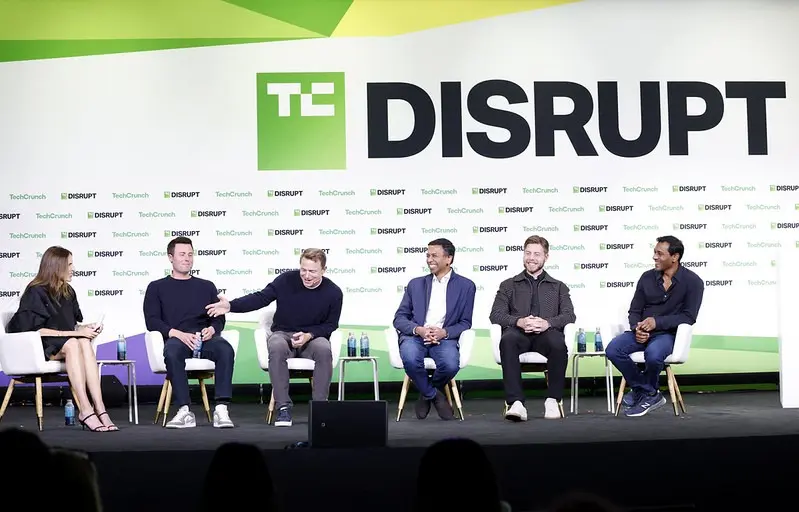
The landscape of venture capital is defined by constant motion. Partners depart, strategies pivot, and capital commitments swell to accommodate the shifting ambitions of the tech sector. Yet, for Benchmark, the storied firm that has anchored the Silicon Valley ecosystem for over three decades, the objective remains curiously, and perhaps defiantly, static. At this year’s TechCrunch Disrupt, the firm’s five general partners took the stage to offer a rare glimpse into a partnership that prides itself on being immune to the "pedal to the metal" mentality currently gripping their rivals.
Benchmark’s evolution is undeniable. This summer, the firm announced a $2 billion capital injection across two distinct funds, marking only the second time in its 31-year history that it has significantly deviated from its traditional, smaller-vehicle strategy. However, to hear the partners tell it, this shift is not an abandonment of their core philosophy, but rather a necessary recalibration for a more expensive, more complex global economy.
The Evolution of the Craft
For Peter Fenton, one of Benchmark’s long-standing pillars, the essence of the firm’s work remains tethered to the early-stage "craft." Despite the rise of AI and the massive capital requirements of modern startups, the fundamental commitment—working shoulder-to-shoulder with founders at the very beginning of their journey—has not changed. "It’s usually a 10-to-15-year commitment," Fenton noted during the panel. "And that doesn’t scale."
Fenton admitted that for twenty years, the firm’s core $500 million fund remained stagnant, a tactical error that failed to account for the creeping inflation of the broader economy. By expanding, the firm is simply adjusting its scale to match the reality of today’s market. The introduction of a dedicated growth fund is similarly framed as an "expansion of mandate." According to Fenton, the firm had previously missed out on significant opportunities that would have yielded astronomical returns simply because they were constricted by a rigid, early-stage focus. This new structure allows them to capture the "agony and ecstasy" of a more concentrated portfolio—a high-stakes approach where a handful of winners generate the vast majority of the fund’s returns.
The Power of a Small Partnership
The firm’s internal culture is anchored by its deliberate, intimate size. For newcomers like Ev Randall, who joined the firm late last year following tenures at Founders Fund, Bond, and Kleiner Perkins, the appeal of Benchmark lies in the absence of bureaucratic friction. Randall observed that while many firms operate through hierarchical, federated structures, Benchmark functions more like a professional sports team.
"Every firm is ultimately a collection of the people within the firm and how they work together," Randall explained. Small partnerships, he argued, allow for a higher level of "throughput and fidelity" in conversations. When the team is small, decisions aren’t filtered through the Byzantine corporate structures that define larger investment firms. It is a group characterized by mutual admiration—a rarity in the high-pressure world of venture capital.
Jack Altman, who joined the firm in February after a successful stint as an individual investor, echoed this sentiment. Despite having previously raised his own fund, Altman found himself drawn to the collective intelligence of the Benchmark team. "So much in this industry gets tied up in money and status," Altman noted. "What I felt from the Benchmark team… is it’s a group that really cares about founders and helping companies." For Altman, the decision to join was driven by a desire to learn within a concentrated, high-conviction group rather than navigating a volatile market in isolation.
No Agenda, No Rules
Perhaps the most unconventional aspect of Benchmark’s operation is its weekly Monday partner meeting, which notably lacks a formal agenda. While newcomers like Altman have occasionally attempted to introduce structure, the seasoned partners maintain that the lack of rigor is, in fact, an asset.
Eric Vishria described the meetings as an "ongoing conversation" rather than a board-level check-in. In a period of rapid technological change, the team uses this time to discuss emerging possibilities, light-bending innovations, and the nuances of their existing board engagements. Because the team is limited to five people, they can afford to remain reactive, ensuring they are always at the disposal of their founders when critical needs arise, such as executive hiring or strategic partnerships.
The firm’s decision-making process is equally fluid. When asked if a single partner could veto a deal, the response was one of genuine uncertainty. "Nobody knows. We don’t have rules around it," said Chethan Puttagunta. This lack of a formal, "Shark Tank-style" voting process is possible only because of the firm’s low volume of deals. Without the pressure to churn out hundreds of investments a year, the partners can prioritize deep alignment. As Fenton put it, "If someone in the room doesn’t like you, we’re not a great partner."
Navigating the AI Era
The conversation inevitably turned to the current "AI funding frenzy" and the ethical dilemmas surrounding VCs backing competing companies. As startups pivot and expand, the lines between competitors often blur. Vishria acknowledged that while conflicts are a "harsh reality" of the current dynamic, the firm maintains a strict ethos of commitment to its founders. While they have been fortunate to avoid the public, acrimonious conflicts seen elsewhere in the industry, the partners recognize that the ambition of the AI era—where the cost of coding new products approaches zero—makes overlapping territory increasingly common.
When discussing the volatility of the public markets, particularly regarding AI-focused companies like Cerebras, the partners emphasized the need for a "stomach of titanium." Vishria noted that the volatility seen in modern tech stocks is often a product of an "hyperactive X echo chamber" rather than fundamental business health. He argued that the market is currently prone to wild swings based on unverified information and anonymous estimates.
Regarding the geographic concentration of talent, the partners acknowledged that while great companies can be built anywhere, San Francisco remains the gravitational center of the current AI boom. "Iron sharpens iron," Randall observed, noting that even non-SF based founders frequently find themselves gravitating toward the city to tap into the unique ecosystem of peers, talent, and capital.
Ultimately, Benchmark’s strategy remains a commitment to the unorthodox. Whether it is investing in "heretical" hardware companies like Cerebras or refusing to systematize their internal meetings, the firm continues to prioritize intuition and long-term relationships over the rapid, automated consensus-seeking that defines much of the industry. In a world that is moving faster than ever, Benchmark is betting that the best way to keep up is to stay small, stay focused, and keep the conversation going.