










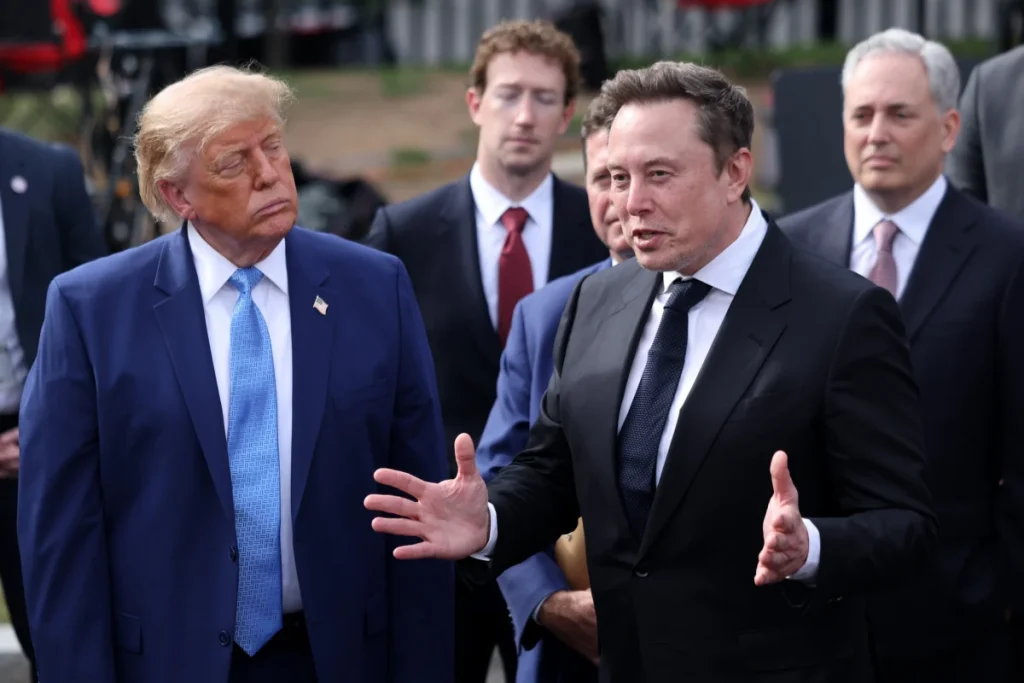
In a move that has sent ripples through the technology sector and Washington alike, President Donald Trump recently hosted a delegation of the most influential figures in the artificial intelligence industry for a summit at the White House. The gathering, which brought together leaders from the nation’s top tech firms, was ostensibly designed to establish a new framework for the development and deployment of advanced technologies. However, the most immediate and perhaps lasting takeaway from the event was a top-down mandate from the administration: the government is moving to replace the term "artificial intelligence" with a new, preferred nomenclature—"super intelligence."
This linguistic shift, now formalized through an executive order, requires all official U.S. representatives and government agencies to adopt the new terminology. The rebranding effort appears to be part of a broader, more strategic initiative by the Trump administration to shift the narrative surrounding the rapid advancement of machine learning and large language models.
The implications of this summit and the resulting "Joint Commitment on Frontier Responsibilities" were the subject of a deep dive on the latest episode of TechCrunch’s Equity podcast. Hosts Kirsten Korosec, Sean O’Kane, and Anthony Ha dissected the meeting, questioning the true motivation behind the event and its long-term impact on the industry. The consensus among the panelists was one of profound skepticism, particularly regarding the substance of the agreement signed by the tech executives.

As O’Kane pointed out during the discussion, the document is, from a legal perspective, "deeply non-binding." Despite the administration’s rhetoric, the pact lacks the enforcement mechanisms typically associated with federal regulations. President Trump himself characterized the commitment as "morally binding," a phrasing that observers noted is remarkably abstract and unprecedented in the context of federal technology policy.
The event, which saw the likes of Meta CEO Mark Zuckerberg, Amazon’s Jeff Bezos, Tesla and xAI leader Elon Musk, and Anthropic’s Dario Amodei in attendance, seemed to materialize with significant speed. This rapid assembly is all the more notable given President Trump’s recent public stance on the industry. Only weeks prior to the meeting, the president had been vocal about his desire to avoid any federal constraints on AI, even going so far as to suggest that those raising concerns about the dangers of the technology were essentially acting as proxies for foreign or political interests.
This pivot from a stance of hands-off deregulation to a high-profile summit on "frontier responsibilities" has left many in the policy world puzzled. Kirsten Korosec suggested that the meeting’s real significance lies not in the text of the agreement itself, but as a sophisticated branding exercise. By steering the conversation away from the anxieties surrounding "artificial intelligence"—a term often associated with job displacement, existential risk, and societal disruption—and toward "super intelligence," the administration is attempting to change the public perception of the technology.
"The big message was: AI is going to kill us, it’s scary, it is going to take jobs—but super intelligence is not," Korosec observed during the podcast. This rebranding strategy continued in the days following the summit with the formal announcement of a new "Super Intelligence Force," signaling that the administration intends to fully integrate this new terminology into the federal lexicon.
The atmosphere at the White House was particularly notable given the recent, volatile relationship between the administration and Anthropic. Just days before the summit, reports indicated that Anthropic was viewed with deep suspicion by certain factions within the federal government, particularly the Department of Defense. The company had been labeled by some as a national security risk, with critics publicly attacking its corporate culture and its restrictive approach to technology usage.
The thaw in this relationship appears to have been facilitated by a direct, late-night meeting between Dario Amodei and the president. This 10:00 p.m. dinner seemingly paved the way for Amodei’s inclusion in the high-level luncheon, placing him alongside the most powerful names in Silicon Valley. However, analysts are quick to note that the tensions have not necessarily vanished. While the Treasury Department has reportedly been a staunch supporter of Anthropic’s involvement, the Defense Department remains deeply skeptical. This suggests that the administration is not a monolith; rather, it is a collection of competing interests where some departments are eager to harness the power of private-sector AI, while others remain wary of the conditions companies like Anthropic place on their technology.
The execution of the summit itself also raised questions about the level of coordination behind the scenes. Observers were quick to notice that the official document signed by the executives and the president contained a glaring error: "United States" was misspelled. For a policy event of such magnitude, the error served as a potent symbol for the critics who argued that the entire affair was a rushed performance rather than a well-considered policy breakthrough.
Anthony Ha noted that while the agreement itself may be toothless, the fact that the meeting occurred at all is a significant data point. The effort required to get the industry’s most competitive and often adversarial CEOs into the same room, all agreeing to a singular, if vague, set of principles, suggests that the administration felt a powerful need to demonstrate control over the sector.
The event also provided plenty of fodder for public speculation, with images and footage from the post-summit press conference circulating widely on social media. The interaction between the tech titans—men who command some of the world’s most valuable companies—as they navigated the protocol of a White House event created a surreal tableau that was widely memed by observers.
Ultimately, the question remains: what does this mean for the future of AI development in the United States? While the administration is pushing for a shift in how we talk about these systems, the practical reality of regulation remains elusive. The "Joint Commitment" does not change the fact that the industry is moving at a pace that far outstrips the current federal capacity to oversee it. Whether the rebranding of AI to "super intelligence" will succeed in assuaging public concerns or simply serve as a temporary exercise in political messaging remains to be seen.
As it stands, the industry continues to move forward, driven by competitive pressures that remain largely unaffected by voluntary, non-binding agreements. The White House, by inserting itself into the conversation, has signaled its intent to be a central player in the narrative, even if it has yet to propose a concrete framework that can effectively address the risks and opportunities presented by the next generation of computing. For now, the administration appears content to focus on the power of the name, hoping that by changing the label, they can control the perception of one of the most transformative technological shifts of the century.