







Consumers and enterprise teams alike interact with cloud services multiple times a day. Whether checking an inbox via webmail, joining a synchronized video conference, or messaging colleagues across dedicated enterprise workspaces, users rely heavily on cloud-hosted software. Behind these seamless digital experiences lies a complex web of infrastructure, though the end-user never has to manage the physical servers or maintain the underlying hardware. Users simply sign in and get straight to work, an operational paradigm known as Software as a Service (SaaS).
While SaaS remains the most visible face of modern computing, it represents only one of three primary cloud service models. The broader cloud computing ecosystem also encompasses Infrastructure as a Service (IaaS) and Platform as a Service (PaaS). Each model offers a distinct degree of control over underlying infrastructure and application development environments. Comprehending the differences among these architectures is essential for navigating contemporary cloud engineering and selecting the most appropriate framework for upcoming technology projects.
What Is Cloud Computing?
Cloud computing fundamentally reshaped the technology sector by delivering on-demand computing resources—ranging from raw processing servers and scalable storage to complex networking components—over the internet on a pay-as-you-go pricing model. Rather than purchasing and maintaining physical hardware, organizations rent these resources from major cloud service providers (CSPs), most notably Amazon Web Services (AWS), Microsoft Azure, and Google Cloud Platform.
To fully appreciate the shift to cloud architectures, it helps to examine traditional on-premises models. Before the widespread adoption of cloud infrastructure, organizations built and maintained their own computing environments. This meant housing physical servers in dedicated on-site rooms or rented facilities, and hiring specialized internal staff to manage them. Organizations assumed total responsibility for the entire technology stack, including procuring hardware, configuring local networks, installing operating systems, applying software patches, and paying for continuous power and climate control.
If a growing retail business, for instance, wanted to expand its digital storefront, it had to purchase additional physical servers, configure the software stack manually, and absorb the capital expenditure. If traffic surged unexpectedly, scaling up required weeks of procurement and hardware installation. The cloud alleviates this burden by shifting physical responsibilities to the provider. While the underlying servers and data centers still exist, the cloud provider owns and maintains them, allowing organizations to provision and scale capacity instantly.
The Shared Responsibility Model and Computing Layers
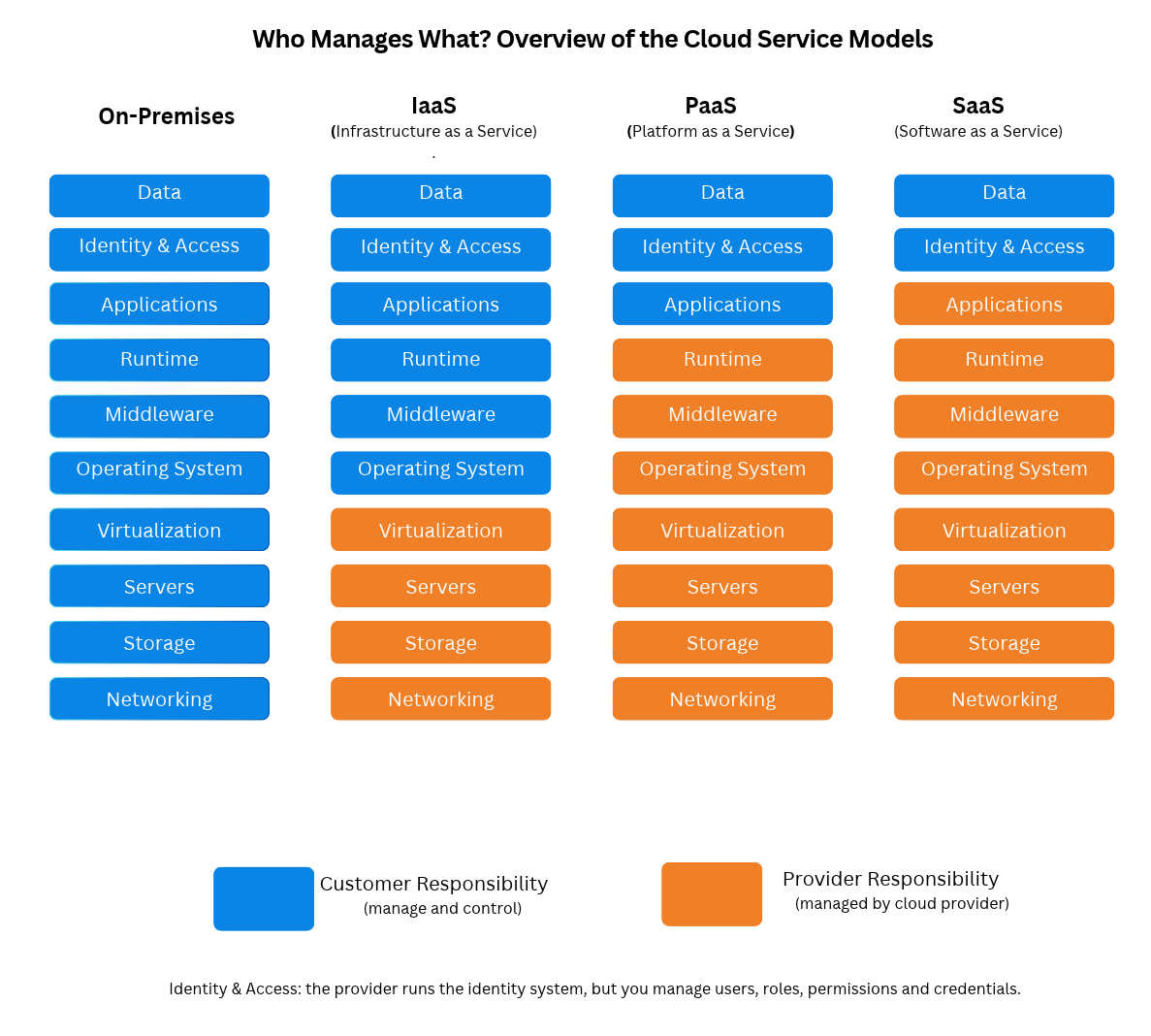
The primary differentiator among various cloud services is the division of labor between the customer and the provider. This operational split is formally governed by the shared responsibility model, which dictates which segments of a running application stack are managed by the cloud vendor and which remain under the control of the customer.
A standard computing stack consists of several interdependent layers. From the bottom up, the stack starts with physical facilities, hardware, and the virtualization layer, moving upward through operating systems, runtime environments, middleware, and application code, and culminating in user data and access management.
Major cloud providers often categorize this division as security "of" the cloud versus security "in" the cloud. The provider takes charge of security of the cloud, which encompasses the physical data centers, host hardware, network infrastructure, and virtualization controls. Conversely, security in the cloud remains the customer’s obligation. This includes protecting stored data, managing user identities and granular permissions, and correctly configuring deployed services.
Infrastructure as a Service (IaaS)
Infrastructure as a Service represents the foundational cloud model, providing organizations with basic, scalable computing building blocks such as virtual servers, raw storage volumes, and virtualized networking components.
When deploying an IaaS solution, an administrator requests a virtual machine from the cloud provider, specifying the desired CPU allocation, memory capacity, operating system, and network routing configurations. Within minutes, the virtual machine initializes and becomes accessible over the network. From that moment onward, the administration of the server falls entirely to the customer. The user must install required software, apply security patches to the operating system, configure firewalls, and monitor application performance.
While IaaS removes the heavy capital expenditure associated with purchasing physical hardware, it does not eliminate the administrative burden of managing servers. Customers typically incur charges based on active server uptime, provisioned storage volumes, and outbound data transfer. Common industry examples of IaaS include Amazon Elastic Compute Cloud (EC2), Microsoft Azure Virtual Machines, and Google Compute Engine. These services operate alongside complementary infrastructure elements such as virtual block storage, object storage repositories, and private virtual networks.
Organizations generally turn to IaaS when they require absolute control over the operating system and the entire software stack. This model suits legacy applications that cannot easily run in managed environments, provides maximum flexibility during architectural migrations, and allows engineering teams to custom-build environments from the ground up. However, IaaS introduces notable tradeoffs. Customers retain full responsibility for patching, security updates, and backup management, meaning a missed security update can leave systems vulnerable. Furthermore, scaling infrastructure requires proactive planning and custom configuration, and administrators need specialized systems administration skills to maintain secure, efficient environments.
Platform as a Service (PaaS)
Platform as a Service abstracts away underlying infrastructure management by providing a ready-to-use deployment environment for application code. In this model, the cloud provider manages the physical servers, operating systems, networking, middleware, and runtime engines, while the customer focuses exclusively on developing application code and managing data.
Unlike IaaS, where engineers must manually configure operating systems, web servers, and runtime versions before launching an application, PaaS streamlines this workflow. Developers simply specify the programming language environment, push their source code via version control systems or deployment packages, and the platform automatically builds, deploys, and hosts the application at a public web address. As user traffic fluctuates, the platform automatically scales application instances based on predefined rules.
Customers retain control over application configuration, resource sizing, and deployment permissions, but they no longer need to log into remote servers to apply security patches or perform routine maintenance. Billing is typically calculated based on resource consumption, such as the size and duration of running application instances. Prominent examples of PaaS include Heroku, Google App Engine, and AWS Elastic Beanstalk. Specialized variants also exist, such as managed relational databases like Amazon RDS, which automates database engine maintenance and backups while leaving schema design and data management to the user.
PaaS is ideally suited for development teams aiming to accelerate software delivery without getting bogged down by infrastructure provisioning. It minimizes operational overhead and simplifies horizontal scaling during traffic spikes. Nevertheless, PaaS introduces certain compromises, most notably reduced operational control and potential vendor lock-in, as applications often become tightly integrated with proprietary platform features. Additionally, because billing covers convenience and managed operations, PaaS can sometimes prove more expensive at scale compared to raw IaaS instances.
Software as a Service (SaaS)
Software as a Service delivers fully functional, ready-to-use applications over the internet, accessible via standard web browsers or client applications. In this model, the provider manages every technical layer of the application stack, from the underlying infrastructure and platform down to the software itself.
Historically, deploying enterprise software required purchasing physical licenses, installing applications onto individual workstation computers, and manually applying patches for every subsequent software update. SaaS entirely eliminates this friction by hosting the application centrally. Providers roll out continuous feature updates and security patches globally, ensuring all users simultaneously access the most current version. Customers do not manage code or servers; instead, their responsibilities shift to administrative configuration, such as managing user accounts, establishing permission hierarchies, and configuring sharing policies. SaaS is typically billed via recurring subscription models, such as per-user monthly or annual fees structured around tiered feature sets.
Widely adopted examples of SaaS include Google Workspace, Microsoft 365, Slack, Salesforce, and Zoom. Organizations lean toward SaaS when they require standard business tooling without maintaining dedicated internal IT or development teams. For instance, a small enterprise requiring secure professional email, collaborative document editing, and video conferencing can deploy a complete SaaS suite within hours, leaving server maintenance, uptime monitoring, and spam filtering entirely to the vendor.
The primary disadvantage of SaaS is the loss of granular control. Organizations must accept the feature sets provided by the vendor, offering limited room for deep customization. Furthermore, because corporate data resides on third-party servers, organizations must rigorously vet provider security policies and data portability terms. Reliance on continuous internet connectivity is another critical dependency, as network outages can render essential business tools temporarily inaccessible.
Beyond the Core Models: CaaS, FaaS, and Serverless Computing
While IaaS, PaaS, and SaaS form the foundational pillars of cloud computing, modern cloud architectures also incorporate specialized models including Containers as a Service (CaaS) and Functions as a Service (FaaS).
Containers package an application alongside its complete set of dependencies, runtime libraries, and configuration files, ensuring the software executes identically across any environment. CaaS platforms manage these containerized workloads at scale. Administrators submit container images, and the platform automates deployment, health monitoring, and load balancing across server clusters using orchestration tools like Kubernetes. CaaS bridges the gap between IaaS and PaaS, granting engineers deeper control over container contents while offloading cluster management to the provider. Examples include Amazon Elastic Container Service (ECS) and Google Kubernetes Engine (GKE).
Functions as a Service, commonly known as serverless computing, takes abstraction a step further by allowing developers to deploy granular pieces of code, or functions, that execute exclusively in response to specific events. An incoming web request, a file upload to cloud storage, or a scheduled timer can trigger execution. The cloud provider dynamically provisions compute resources for the duration of the execution and scales them down to zero immediately afterward. Organizations pay purely for the milliseconds of active execution time, eliminating costs associated with idle capacity. Examples include AWS Lambda and Google Cloud Run.
The term "serverless" broadly describes cloud operational models where users never provision, configure, or manage servers, and scaling occurs automatically based on demand. While FaaS is fundamentally serverless, the designation also applies to managed data storage services, object repositories, and specialized container execution environments.
Selecting the Appropriate Cloud Model
Choosing the optimal cloud service model requires evaluating project requirements, team expertise, budgetary constraints, and the desired degree of operational control. Organizations typically evaluate their needs by starting at the highest level of abstraction—such as SaaS or PaaS—and dropping down to more granular infrastructure models only when specific technical requirements demand it. Many production environments ultimately combine multiple cloud models, utilizing SaaS for internal business operations, PaaS for application development, and IaaS or CaaS for legacy workloads that require specialized configuration.
Ultimately, every cloud service model establishes a different boundary for shared responsibility between the organization and the cloud provider. Whether deploying raw virtual machines, managing managed application platforms, or utilizing fully realized software applications, organizations retain ultimate accountability for their proprietary data and access security.