








Moving a web application from the controlled environment of a local development machine to a live, secure production server is often regarded as one of the most intimidating hurdles for software developers. While writing code and building features are core components of software engineering, understanding how that code actually operates in the wild—facing real network traffic, security threats, and scaling demands—requires an entirely different set of operational skills. To bridge this knowledge gap, freeCodeCamp.org has released a comprehensive, 11-hour masterclass on its YouTube channel designed to demystify full-stack deployment, server security, and automation from the ground up.
Developed and instructed by software engineer Imad Saddik, the course takes a deliberately hands-on approach to modern infrastructure. Rather than jumping straight into automated tools that obscure how underlying systems communicate, the curriculum encourages learners to execute the deployment process manually first. By building and configuring everything themselves before introducing Continuous Integration and Continuous Deployment (CI/CD) automation, students gain a deep, foundational understanding of how complex, multi-tier web systems are hosted, hardened, and maintained in production environments.
The modern software landscape increasingly demands that developers possess at least a working knowledge of DevOps principles. In many modern development teams, the traditional barrier separating software developers from systems administrators has dissolved. Developers are frequently expected to manage their own cloud instances, configure web servers, handle SSL certificates, and troubleshoot environment-specific bugs. However, educational bootcamps and computer science curricula often focus heavily on algorithmic problem-solving and application-layer programming, leaving infrastructure management as an afterthought. This new course aims to rectify that imbalance by providing a practical roadmap for taking a complete, full-stack application and preparing it for real-world usage.
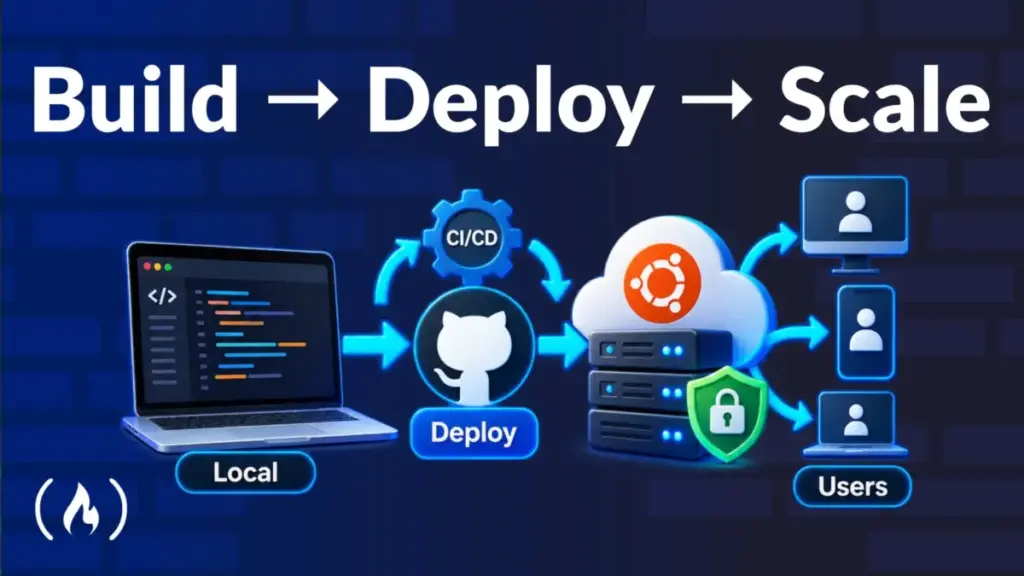
At the core of the curriculum is a practical demonstration using a modern technology stack. Throughout the 11-hour runtime, Saddik guides learners through the complete lifecycle of a Vue.js and FastAPI application. Vue.js serves as the dynamic, reactive frontend framework, while FastAPI provides a high-performance, asynchronous Python backend for handling server-side logic and API requests. Using this specific stack allows the course to address the unique challenges associated with deploying decoupled architectures, where the client-side application and the server-side API must be configured, secured, and connected independently yet harmoniously.
The journey begins long before any code is pushed to a remote server. The initial stages of the course focus on provisioning and configuring a raw cloud server instance. Learners are introduced to fundamental Linux system administration concepts, including user management, file permissions, firewall configuration, and package management. Understanding how to navigate a terminal on a remote virtual private server is an essential prerequisite for any developer looking to manage production infrastructure, and the course ensures that students feel comfortable operating outside the safety net of their local development environments.
Once the foundational server environment is established, the curriculum delves into the complexities of configuring web servers and reverse proxies. Deploying a modern full-stack application typically requires setting up environments where static frontend assets can be served efficiently while API requests are routed securely to the backend application server. The course explores how to configure production-grade web servers to handle these responsibilities, manage domain names, and establish secure communication channels using Transport Layer Security and SSL certificates. Security is treated as a continuous priority throughout the lessons, touching upon common vulnerabilities, environment variable management, and the hardening of server access protocols to prevent unauthorized entry.
After mastering the intricacies of manual deployment—understanding every configuration file, directory structure, and daemon required to keep the application running smoothly—the course transitions into the realm of automation. Manual deployments, while invaluable for learning how systems work under the hood, are inherently fragile and inefficient for ongoing software development lifecycles. To solve this, the curriculum introduces modern CI/CD pipelines. Students learn how to automate the build, test, and deployment phases of their software development process. By the end of this transitional phase, every code change pushed to a designated branch in a repository triggers an automated sequence that securely updates the live production server without manual intervention.
The release of this extensive resource aligns with freeCodeCamp’s broader mission to make technical education accessible to everyone around the world for free. Over the years, the open-source curriculum and educational platform have helped more than 40,000 individuals secure professional employment as software developers across the technology industry. By expanding its learning library to include advanced infrastructure and deployment strategies, the organization continues to address the evolving demands of the job market, where employers increasingly value developers who understand the entire lifecycle of a software product rather than just frontend or backend coding in isolation.
For developers, students, and hobbyists looking to bridge the gap between local coding and professional production environments, the complete 11-hour masterclass is available to watch immediately on the official freeCodeCamp.org YouTube channel. Whether viewers choose to follow along step-by-step with their own cloud instances or use the comprehensive video as a conceptual reference guide, the course offers a transparent look at the mechanics that power the modern web.