









Replacing complex JavaScript logic with modern native CSS features is often celebrated as an immediate win during code reviews. Developers frequently swap out heavy utilities like ResizeObserver for elegant container queries, watching lines of code vanish into a sea of red deletions in pull requests. However, a growing discussion within the frontend community highlights a hidden tradeoff: while a specific code snippet becomes simpler, the broader application can become significantly harder
to reason about.
Gabriel Shoyombo, exploring the intersection of modern CSS capabilities and existing codebases, notes that these shifts often split logic unexpectedly between JavaScript and styles. The core issue is not that modern CSS capabilities are inherently flawed, but rather that introducing a new feature without fully understanding its interaction with legacy code, layout rules, the cascade, and rendering engines can introduce systemic complexity.


When a codebase undergoes a partial migration, components frequently end up with two owners controlling their behavior. For instance, a card component might be updated to use a CSS container query to handle responsive layouts, while an old JavaScript ResizeObserver or a legacy class-toggle mechanism survives in a separate file. As long as both implementations agree on breakpoints, everything appears functional. Yet, when requirements change—such as a designer requesting an updated breakpoint—developers often update only the CSS rule they know about. This creates intermediate states that no one explicitly wrote, leaving debugging teams baffled by layout bugs that arrived alongside features designed to simplify the code.
Beyond competing behavior scripts, modern CSS features can quietly alter surrounding layouts through block formatting contexts. Declaring a property like container-type: inline-size communicates an intent to allow child elements to query width, but browsers interpret this as applying both style and inline-size containment. This single declaration can inadvertently stop margins from collapsing, alter how floats push elements aside, and cause content-sized cards to collapse to zero width if explicit dimensions are missing. In isolation, a component might appear to fill its parent container cleanly, but within a complex grid or flex layout, these containment rules disrupt the surrounding furniture arrangement of the page.
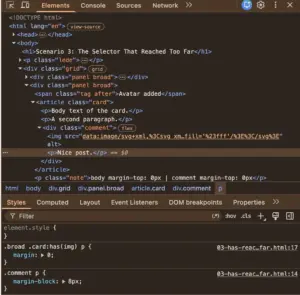
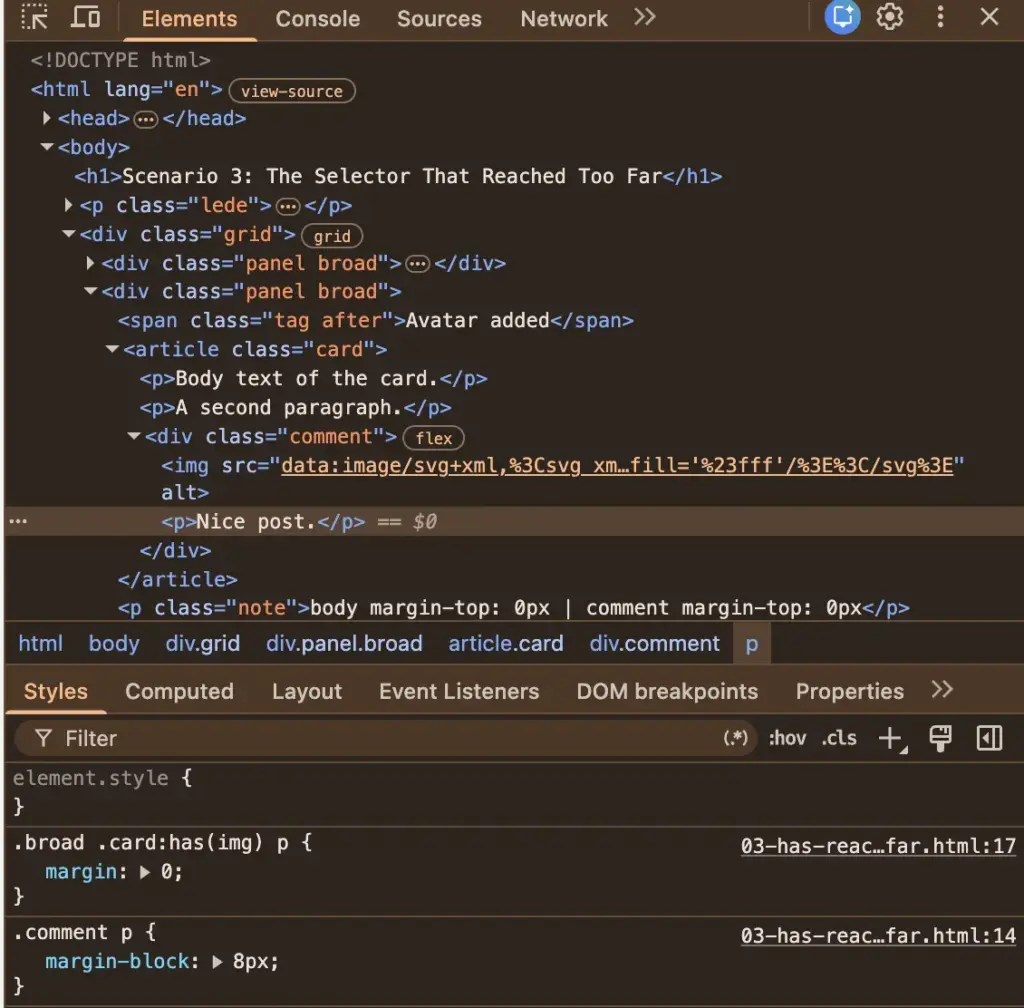
The CSS Cascade introduces further complications through selectors like :has() and native nesting. Short, powerful selectors can reach much further into a DOM tree than anticipated, stripping margins from unrelated elements or unintentionally overriding component rules. Similarly, native nesting adopts the highest specificity of its associated selector list, frequently triggering specificity wars that force developers to resort to overriding rules or wrapping selectors in :where() to neutralize unintended weight. Furthermore, cascade layers do not automatically rescue a project from these conflicts unless both legacy and modern stylesheets are fully layered. Unlayered legacy styles routinely win specificity battles against layered component rules, adding yet another ordering rule for developers to memorize.

Performance implications also challenge the assumption that moving logic from JavaScript to CSS is universally faster. While modern features offload layout calculations to the browser, complex selectors can trigger widespread restyling across thousands of elements during routine state changes. In large applications, combinations of seemingly harmless CSS rules can dramatically amplify the cost of DOM updates, creating rendering bottlenecks that are difficult to trace back to a few lines of declarative styling.
Ultimately, discussions across developer communities emphasize that most documentation and feature announcements are written from a greenfield perspective, whereas day-to-day engineering largely involves migrations. Shoyombo points out that achieving a genuinely simpler system requires ensuring that new rules have clear owners, thoroughly checked scopes, intentional cascade placements, and measurable performance validation. True code simplification involves looking beyond local line counts to understand how new features integrate with the entire application ecosystem.