








Apple has officially unveiled the latest iteration of its compact tablet, the iPad mini, introducing a series of significant internal and external upgrades. While the device has long been a favorite for those seeking high performance in a portable form factor, this year’s release marks a transformative jump in technology. However, these advancements come with a notable shift in market positioning, as the tablet moves into a higher price bracket, challenging users to weigh its new capabilities against a substantially increased cost of entry.
Apple’s update cycle for the iPad mini has never been annual, a strategic choice that allows the company to implement major leaps in silicon and hardware when they do refresh the line. The new model is powered by the 5-core, 2nm A20 Pro system-on-a-chip (SoC), a piece of engineering that Apple claims delivers up to 2.7 times the graphics performance and up to 4.5 times the speed in AI-focused workloads compared to the A17 Pro found in its predecessor.
The storage configurations remain consistent with previous generations, but the top-tier 512GB model receives a distinct performance boost, featuring an additional CPU core and a dual 16-core Neural Engine to handle the most demanding tasks. Both models are designed to support the full suite of Apple Intelligence and enhanced Siri AI features, but the A20 Pro silicon is clearly engineered to handle these on-device AI tasks with greater efficiency and speed. While Apple does not officially disclose RAM specifications for its mobile hardware, industry expectations point to the new iPad mini sporting 12GB of memory, a 50 percent increase over the 8GB found in the outgoing model. Battery life remains consistent with previous standards, though Apple has introduced faster charging capabilities, allowing the device to reach a 50 percent charge in just 30 minutes when paired with a compatible high-wattage adapter.

Despite these performance gains, the aesthetic options have been streamlined, with the color palette now limited to Midnight and Starlight. The most significant barrier to entry, however, is the price. The new iPad mini enters the market at a starting price of $699 for the 128GB model—a $200 increase over the previous generation. For power users seeking the maximum 512GB of storage, coupled with cellular connectivity and the premium nano-texture glass finish, the cost climbs to $1,249. This price point places the compact tablet firmly in the territory of the iPad Pro, forcing consumers to consider whether the portability of the mini justifies a price tag traditionally reserved for Apple’s most powerful professional-grade tablets.
The iPad Mini Embraces OLED Technology
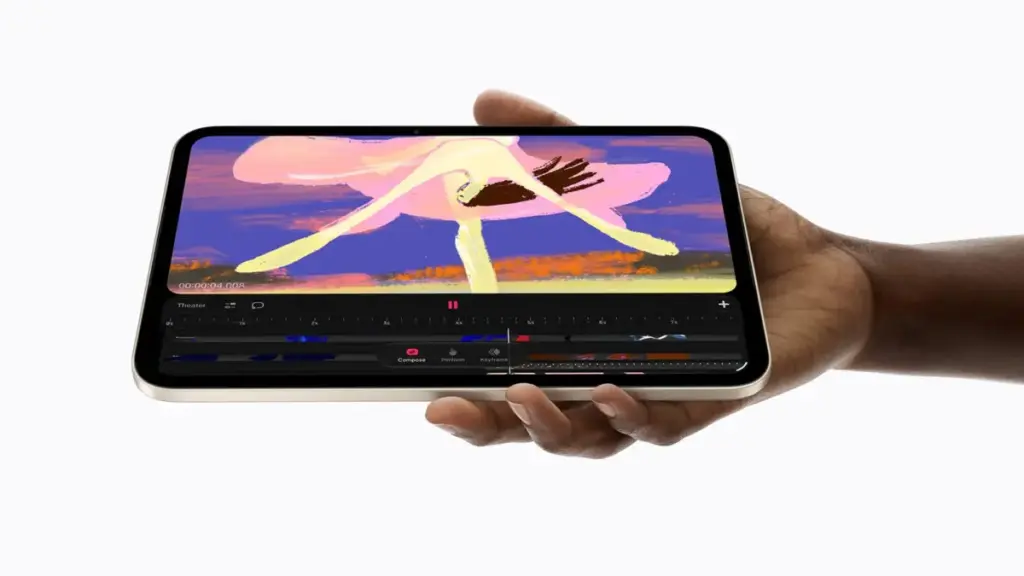
Perhaps the most anticipated change in this generation is the transition to an OLED panel. With this update, the iPad mini joins the iPad Pro as the only other device in Apple’s tablet lineup to feature OLED technology. While the resolution remains largely consistent with the previous version, the new display is significantly brighter, capable of reaching up to 1,200 nits of peak HDR brightness.
The move to OLED has also facilitated a more refined industrial design. While the footprint of the tablet remains almost identical to its predecessor, the new iPad mini is both thinner, at 5.4mm, and lighter, weighing in at 255 grams. This reduction in volume is a direct consequence of the thinner OLED display module. For context, the A17 Pro-powered model topped out at 500 nits of SDR brightness, weighed 293 grams, and measured 6.3mm in thickness.
The viewing experience is further enhanced by an expansion of the screen size to 8.5 inches, achieved by trimming the bezels by approximately 24 percent. However, the display is not without controversy. Despite the premium price, Apple has opted to retain a 60Hz refresh rate, eschewing the ProMotion technology found on its higher-end tablets. This decision has met with vocal criticism from some users, who argue that a $700 device in 2026 should offer a higher refresh rate as a standard feature.
In a recent discussion, Dave Pakula, Apple’s vice president of Hardware Engineering, addressed these concerns, suggesting that the display experience is defined by more than just a single specification. Pakula emphasized that the faster pixel response times inherent to OLED technology provide a level of visual fluidity that complements the experience, even without the higher refresh rate. For long-time iPad mini users, the jump to OLED will likely feel like a substantial upgrade, particularly for those who utilize the device for creative workflows involving color-accurate HDR content. The continued support for the Apple Pencil Pro further cements the device’s status as a specialized, compact canvas for artists and designers who value mobility alongside color fidelity.
A Handful of Other Changes
Beyond the display and the chip, Apple has introduced several subtle but meaningful engineering changes. For the first time in the product’s history, the iPad mini carries an IP67 water-resistance rating. Achieving this durability in such a compact chassis required a reimagining of the device’s audio architecture. Apple has replaced traditional speaker grilles with an Acoustic Display system, which utilizes tweeters positioned between the glass and the aluminum frame, while the woofers fire directly through the display. This setup aims to deliver deeper bass and clearer treble, offering a more immersive audio profile than previous iterations.
Connectivity has also been modernized to meet the demands of contemporary networking. The device now supports Wi-Fi 7 and Bluetooth 6, and it incorporates Apple’s new C2 cellular modem system, which the company claims will improve cellular data speeds by up to 50 percent. Security remains anchored by the Touch ID-enabled power button, a design choice that remains popular for its reliability and speed. Meanwhile, the front-facing camera has been repositioned to the longer edge of the tablet, a welcome adjustment that centers the user during video calls when the device is held in landscape orientation.
On the software front, the new iPad mini ships with iPadOS 27, which is optimized to leverage the advanced AI capabilities of the A20 Pro chip. Users can expect improved dictation accuracy and granular control over Siri’s voice, including adjustments for pace and expressiveness. While the specialized performance enhancements of the dual-core Neural Engine are exclusive to the 512GB model, the standard 5-core A20 Pro SoC still provides a significant performance buffer for all users.
This processing power is particularly relevant for the growing library of high-fidelity gaming on the platform. With titles such as Control and Death Stranding now available natively on the App Store, the new iPad mini is positioning itself as a legitimate, portable powerhouse for mobile gaming. Whether these technical refinements—the OLED display, the A20 Pro chip, and the improved durability—justify the elevated price tag will be the deciding factor for many. As it stands, the new iPad mini offers a refined, high-performance experience that manages to pack the capabilities of a desktop-class machine into a device that fits comfortably in the palm of one’s hand.