









For platform engineering teams, managing containerized applications at scale on Amazon Elastic Container Service (Amazon ECS) has long involved a delicate, often repetitive balancing act. While ECS provides a robust foundation for running high-performance container workloads, the configuration of ingress networking for individual services has frequently emerged as a significant operational bottleneck. Every time a new microservice is introduced, teams have been required to manually provision and orchestrate a complex suite of dependencies: Application Load Balancers (ALBs), AWS Certificate Manager (ACM) certificates, AWS WAF web ACLs, and intricate security group rules. Keeping these resources synchronized as services scale, undergo updates, or experience operational shifts requires constant vigilance, often leading to increased deployment friction and the persistent risk of configuration drift across the organization.
To address these challenges, Amazon Web Services has officially announced the launch of Amazon ECS Gateway, a new account-level resource designed to fundamentally simplify ingress networking for containerized workloads. By shifting the burden of infrastructure orchestration away from manual, per-service configuration, ECS Gateway enables the dynamic provisioning and management of networking resources directly within a user’s AWS account. This development marks a significant evolution in how platform teams can manage the lifecycle of their containerized traffic, providing a more streamlined, automated, and secure approach to ingress management.
Rethinking Infrastructure Responsibilities
At its core, the introduction of ECS Gateway is intended to enforce a cleaner separation of responsibilities between platform teams and application development teams. Previously, developers often had to navigate the complexities of load balancer configuration just to expose a service to the network. With the new Gateway model, platform teams define the networking standards and infrastructure roles, while application teams simply connect their services to the relevant gateway.


The mechanism behind this innovation is host-based routing. ECS Gateway enables up to 25 different services to share a single Application Load Balancer, a design choice that significantly optimizes infrastructure costs and reduces the complexity of managing large fleets of load balancers. In this new model, Amazon ECS assumes responsibility for the entire lifecycle of the underlying infrastructure. It handles the initial provisioning of the first ALB as soon as a service connects, intelligently adds more ALBs as capacity thresholds are met, and gracefully removes them when they are no longer required. As part of this automated workflow, each service is assigned a unique DNS hostname, ensuring that development teams receive a ready-to-use, functional endpoint the moment the provisioning process is complete.
Operationalizing ECS Gateway
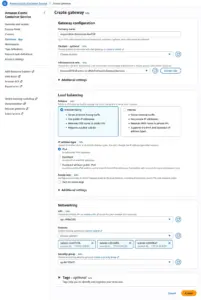
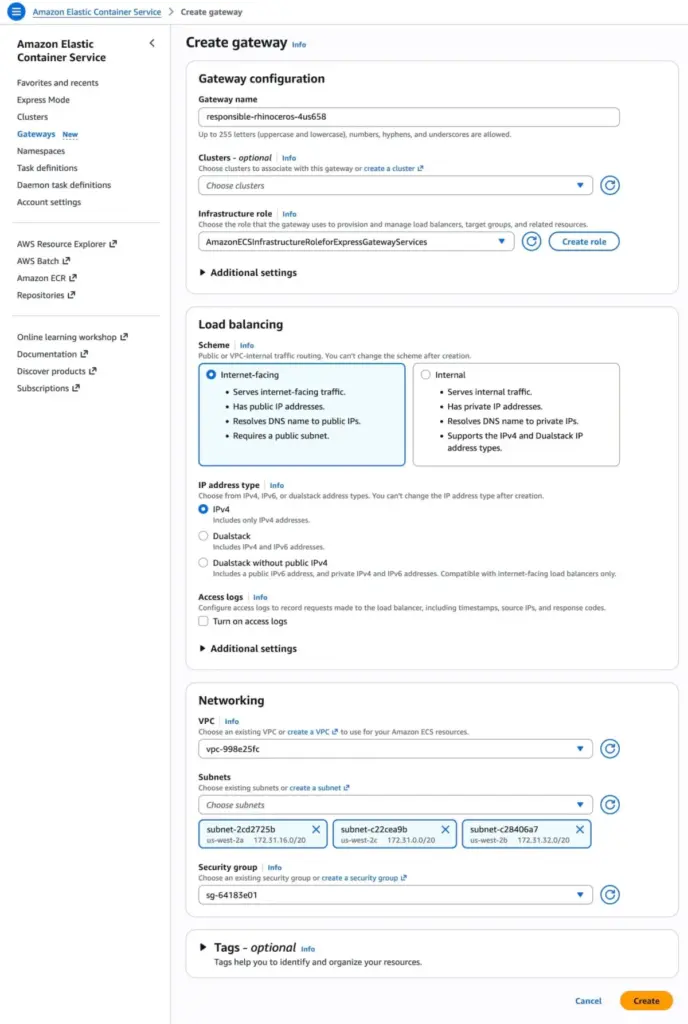
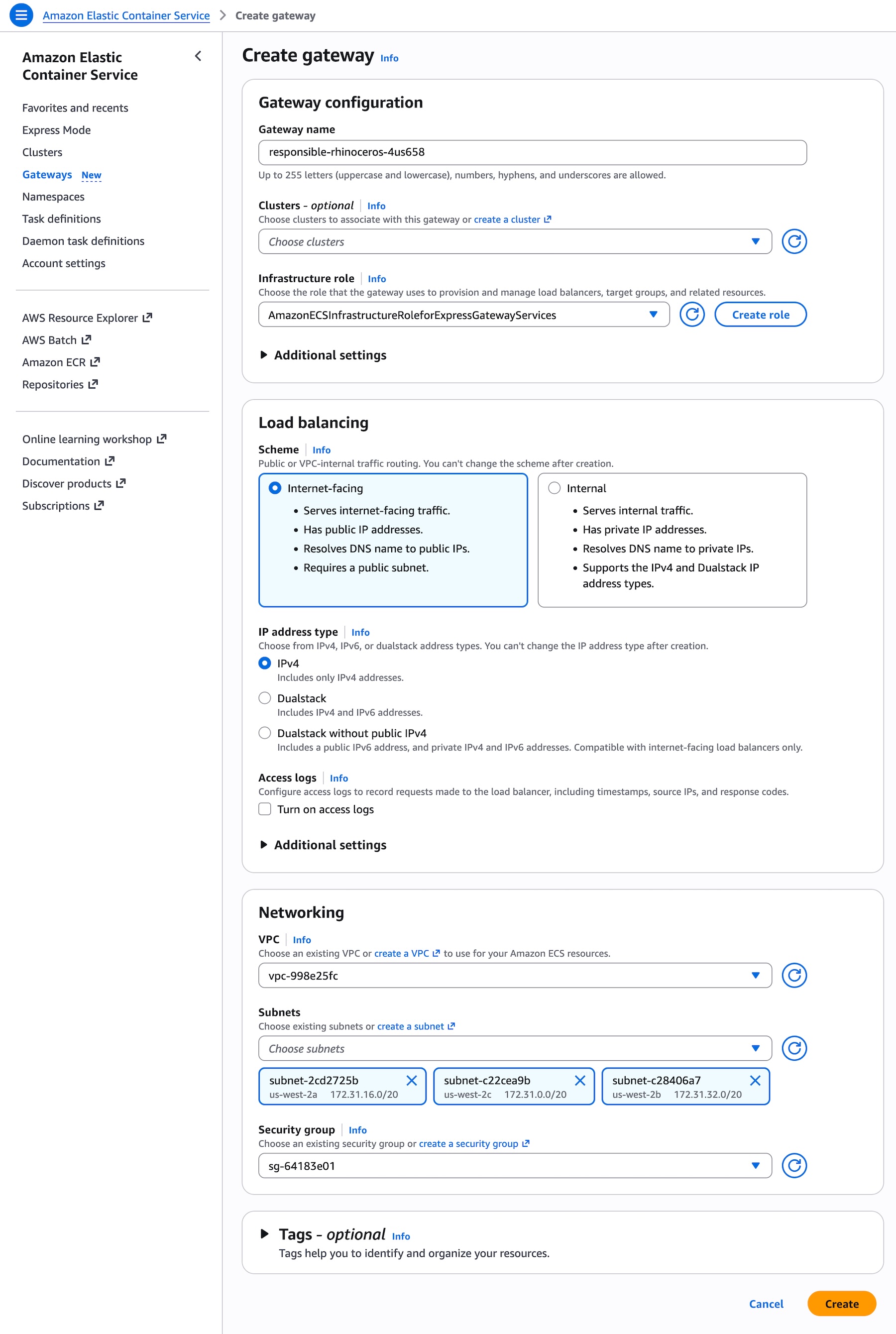
The transition to ECS Gateway begins within the Amazon ECS console, where platform administrators can define a gateway and set its core configurations. A critical component of this process is the infrastructure role—an IAM role that grants ECS the necessary permissions to provision and manage load balancers, security groups, and certificates on behalf of the user. During the creation process, administrators provide a unique gateway name and select the appropriate infrastructure role. There is also significant flexibility regarding where the gateway is deployed, as it can be associated with ECS clusters during the initial setup or integrated at a later time.
When configuring the gateway, users must choose between a public or VPC-internal traffic routing scheme. Under the advanced settings, administrators have the ability to define listeners, specify ports, set the maximum number of load balancers the gateway is permitted to scale to, and integrate AWS WAF web ACLs to ensure robust protection for their web applications. It is important to note that certain foundational settings, such as the gateway name, the VPC, subnets, IP address type, and listener protocols, are immutable once the gateway has been created, necessitating careful planning during the initial setup phase.

For organizations that prefer automation and infrastructure-as-code practices, the AWS Command Line Interface (AWS CLI) offers a straightforward path for managing these resources. By calling the CreateGateway command with a unique name, the infrastructure role ARN, and a structured configuration object, teams can define their ingress standards programmatically. Notably, the system remains dormant and consumes no additional infrastructure until a service explicitly connects to the gateway via a connector. Once the gateway is live, administrators can use the AWS console or CLI to inspect the detailed configuration, monitor gateway routes, track load balancer status, and view associated clusters.
Scaling and Integration Flexibility
The architecture of ECS Gateway is designed to support the complex, multi-environment needs of modern enterprises. A single gateway can be associated with up to 10,000 clusters, while a single cluster can support up to five distinct gateway associations. This many-to-many relationship provides platform teams with immense flexibility, allowing them to share a single gateway across different development environments or, conversely, assign multiple gateways—such as dedicated public and private gateways—to a single cluster.
Access control is maintained through careful association management; platform teams dictate which gateways are linked to which clusters, and they can further enforce security boundaries by using IAM policies to restrict who has the authority to deploy services to specific clusters.
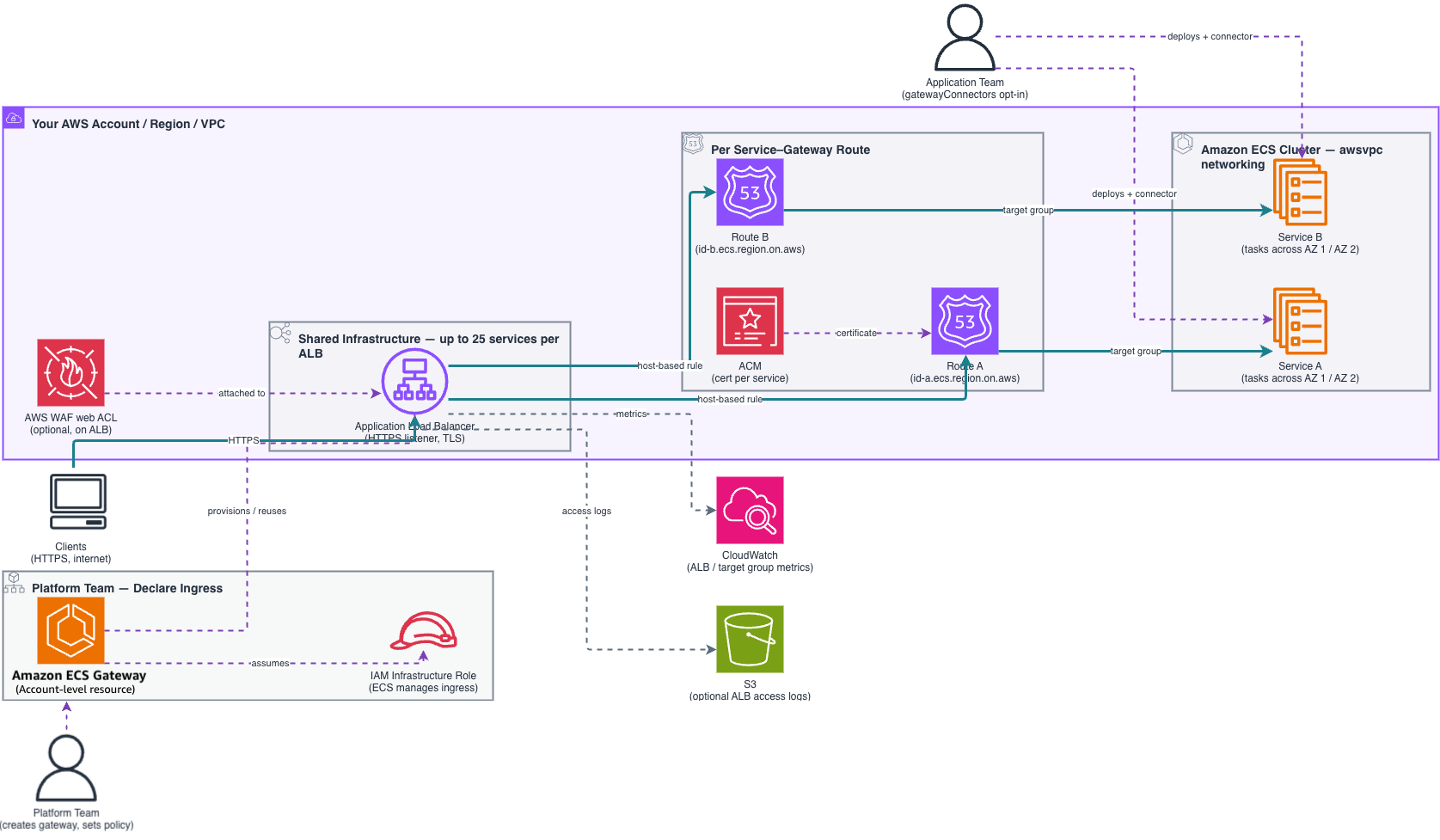
For application teams, the process of adopting this new model is remarkably intuitive. Developers simply add the gateway connector to their service definition during the CreateService or UpdateService operations. A significant benefit of this design is the ability to adopt ECS Gateway incrementally. If an existing service is already utilizing its own standalone load balancer, teams can perform a side-by-side migration. By calling UpdateService to add a gateway connector, both the legacy ingress path and the new ECS Gateway path can remain active simultaneously. This allows teams to rigorously validate the gateway connection in a production environment before safely decommissioning the old load balancer configuration, minimizing the risk of downtime during the transition.
Intelligent Traffic Management
When a deployment is initiated, Amazon ECS performs an evaluation of the gateways associated with the target cluster, automatically connecting the service to every compatible gateway. Compatibility is determined by matching the service’s connector filter with the gateway’s access type, ensuring they exist within the same VPC and that the gateway covers all Availability Zones utilized by the service’s subnets.
Once the connection is established, the automation engine takes over. ECS assigns the service to an ALB that has available capacity and then triggers the provisioning of the necessary per-service resources: an ACM certificate, a unique DNS hostname, a listener rule that directs traffic for that specific hostname to the correct target group, and a service-level security group configured to permit inbound traffic exclusively from the ALB security group. If the current load balancers reach their capacity limits, ECS automatically spins up a new ALB, provided the maxAlbCount quota has not been exceeded. The entire process concludes when the gateway route transitions to an ACTIVE status, at which point the service URL is immediately ready to accept production traffic.
Beyond initial provisioning, ECS Gateway handles the heavy lifting of day-to-day operational tasks. This includes the automated rotation of certificates, the maintenance of listener rules as services scale, and the health-based removal of services from target groups. Because the resources are created directly within the user’s account, there is no abstraction layer hiding the infrastructure, ensuring full transparency for security and compliance audits.
Considerations and Availability
While the system is designed for ease of use, there are a few important considerations for teams integrating ECS Gateway. The system currently supports a set of defined configuration parameters, and as noted, certain network-level settings are finalized at creation. Furthermore, users should be aware that while the service itself is provided at no additional charge, standard AWS pricing applies to all underlying infrastructure provisioned through the gateway. This includes costs associated with ALB usage, CloudWatch logs and metrics, ACM certificates, and standard data transfer fees.
Amazon ECS Gateway is available starting today in all commercial AWS Regions where Amazon ECS is supported. By automating the most tedious aspects of ingress networking, this new feature represents a major step forward in reducing the operational overhead for platform teams, allowing them to focus less on configuring load balancers and more on delivering high-quality, resilient containerized applications. Teams looking to get started are encouraged to experiment with their first gateway in the ECS console and share their feedback through the official AWS re:Post community or through their standard AWS support channels.