









Z.ai has officially unveiled GLM-5.4, its latest flagship artificial intelligence model, marking a significant departure from conventional design by utilizing a “Loop Transformer” architecture. This innovative approach aims to solve the industry’s ongoing struggle with “ultra-long-chain reasoning” tasks—complex processes like large-scale software engineering, cybersecurity, 3D modeling, and physical control—by increasing computational depth without the traditional reliance on stacking additional parameters.
The release represents a major step forward in Z.ai’s product evolution. Coming on the heels of the August launch of GLM-5.3, which gained notoriety for its advanced cyber capabilities—including the reported discovery of a serious vulnerability in the Cursor code editor—GLM-5.4 expands the company’s focus into the realm of “Generalized Coding.” By incorporating vision capabilities, the model is designed to apply coding logic not just to software development, but to engineering and design tasks such as mechanical design and intricate 3D modeling.
The Engineering Behind the Loop
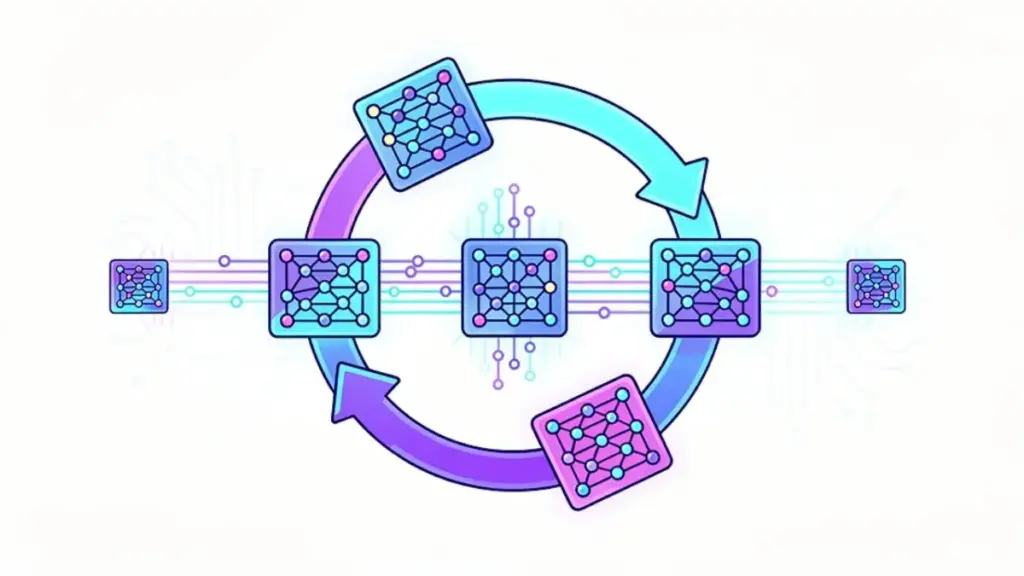
The core innovation of GLM-5.4 lies in its architecture. In a standard Transformer, each layer is processed once during a forward pass. To gain more power, developers usually add more layers or increase the number of parameters. Z.ai has taken a different route: instead of stacking new layers, GLM-5.4 reuses the same group of 28 layers twice. This allows the model to achieve greater depth and significantly more computation per token while maintaining a more efficient parameter footprint.

Z.ai is not the first to explore the concept of layer reuse; researchers experimented with the "Universal Transformer" as early as 2018. However, while much of the subsequent academic work focused on smaller, experimental models, Z.ai has applied this methodology to a 750B-scale model. By taking an already pre-trained GLM-5 base and subjecting it to continued training with this looped structure, the company claims it has created a system capable of managing the multi-step causal chains required for high-level technical tasks.
To manage the inherent instability of reusing layers, Z.ai implemented three key architectural modifications. First, the model utilizes “gated progressive updates.” Because repeatedly updating internal representations can lead to mathematical instability, the model employs per-token gates to dictate how much each iteration modifies the data. The first pass is designed to build a global context with conservative updates, while the second pass uses the gates to apply more thorough adjustments. Notably, these gates are sensitive to token difficulty; the model performs more aggressive writes on complex tokens, ensuring the computational effort is directed where it is most needed.
Second, to address memory efficiency, Z.ai developed a “hybrid KV cache.” Rather than maintaining a complete Key-Value (KV) cache for every iteration, which would be computationally prohibitive, the model reuses the sparse KV cache from the first pass and limits additional storage to a sliding window for the second pass. Finally, the system employs “sparse attention index reuse,” where the second loop utilizes the attention indices generated during the first pass. Z.ai’s internal testing suggests that this shortcut performs almost identically to recomputing the indices from scratch, saving valuable processing time.
Performance Claims and Analytical Scrutiny
Z.ai has positioned GLM-5.4 as a powerhouse, suggesting it reaches intelligence levels comparable to models with 2 trillion to 3 trillion parameters. However, the company has provided limited transparency regarding how it arrived at this specific comparison. While it has published a win-rate chart comparing GLM-5.4 to three other unnamed models, the absence of a detailed evaluation methodology has left some industry observers seeking more granular evidence.
The primary controlled benchmark data provided by the company comes from a test conducted on a 30B parameter version of the model. In these tests, the looped architecture required roughly 10% more training compute than a non-looped baseline of the same size. The results showed notable improvements in math, scientific reasoning, and long-context tasks, with average outputs becoming more concise—a reduction of roughly 15% on the MMLU-Pro benchmark and 12% on the GPQA-Diamond test.

Despite these promising indicators, Z.ai has openly acknowledged a potential drawback: the model can occasionally fall into “overly long reasoning loops.” This behavior, which is common in iterative architectures, highlights the trade-off between depth of thought and efficiency.
Real-World Feedback and Community Reaction
The arrival of GLM-5.4 has prompted a flurry of activity within the developer community. Early testers have praised the model’s efficacy in specialized roles, particularly in code review and security auditing, where its ability to trace complex logic is a distinct advantage.
However, the feedback has not been universally positive. Performance benchmarks shared by users on social media have sparked debate. For instance, in a widely circulated post on X, a developer known as AICodeKing ranked GLM-5.4 seventh on the “KingBench 4” coding benchmark. The test results highlighted a significant disparity in efficiency: while the model demonstrated high reasoning capabilities, it required 1,128 steps and 431 minutes to complete the tasks, compared to just 244 steps and 109 minutes for Google’s Gemini 4 Neon. While the tester suggested that the model is a potent tool for security researchers and bug-hunters, he noted that its slow speed makes it less suitable for general-purpose, high-velocity tasks.
Other users have highlighted the lack of comparative data. Darek Gusto, a prominent voice in the AI community, noted his surprise at the absence of formal coding benchmarks in the official announcement, suggesting that the industry expects more rigorous data from a flagship release. Furthermore, some users on Reddit’s r/LocalLLaMA community have expressed frustration with the model’s behavior outside of coding, alleging that the system often wastes tokens on excessive, redundant internal reasoning.
Comparisons to top-tier competitors remain a sensitive point. When compared against established industry leaders like Opus 5.5, some testers have noted that GLM-5.4 still faces a significant performance gap.
Availability and Future Roadmap
GLM-5.4 is currently accessible to users via the Z.ai ecosystem, specifically through the GLM Coding Plan, ZCode, and Z.ai Chat. Z.ai has increased the utility for its current subscribers, offering a quota that is 1.5 times larger than that of GLM-5.3. In terms of technical specifications, the model supports a 1-million-token context window and can handle text, image, video, and file inputs, though it returns only text.
While the current release is available to paid subscribers, the broader developer community is still waiting on details regarding wider accessibility. API access is currently listed as “coming soon,” with Z.ai citing the need for further security assessments before a full launch. There is no current pricing information for the API, though the company’s documentation for the previous GLM-5.3 model lists rates of $1.40 per million input tokens and $4.40 per million output tokens, providing a potential reference point for what users might expect.
Perhaps the most significant question remaining for the open-source community is the timeline for the release of model weights. Z.ai has confirmed that it intends to release the weights, but it has not committed to a specific date or license, stating only that it will happen once the model has undergone “necessary safety hardening.” As Z.ai navigates the challenges of balancing its innovative looped architecture with the demands of speed, transparency, and safety, the performance of GLM-5.4 in the coming weeks will likely serve as a critical test for whether this efficiency-focused approach can truly challenge the industry’s largest, most parameter-heavy models.