










In a landmark feat of software engineering, GitHub has successfully transitioned its core Copilot agent runtime—a critical piece of infrastructure powering the GitHub Copilot CLI, mobile app, and SDK—from TypeScript to Rust. The massive undertaking, which involved replacing over 800,000 lines of production code, was completed in just a few months, largely by a single developer leveraging AI agents. The project, which concluded on August 21, 2026, represents a significant shift in how complex, large-scale systems can be modernized, proving that AI-assisted development is no longer just for snippets and prototypes, but capable of handling fundamental architectural overhauls.
The Necessity of a Modernized Runtime
The Copilot agent runtime serves as the engine for an ever-expanding ecosystem of Microsoft and GitHub products, including VS Code, Visual Studio, GitHub Copilot Code Review, and integration services for Microsoft 365 applications like Word and Excel. Initially, the runtime was built on Node.js and the V8 JavaScript engine. While TypeScript offered rapid development speed and accessibility, the performance trade-offs—such as high memory overhead, slower startup times, and the serialization costs of out-of-process communication—became increasingly apparent as the agent’s scope and adoption grew.
In the previous architecture, the runtime was tightly coupled with the Copilot CLI, which functioned as a terminal UI. When the need for a programmatic SDK arose, the team took a pragmatic, albeit technically taxing, approach: they layered the SDK on top of the CLI, effectively spawning a headless CLI process for every client connection. This created significant operational friction. Each consumer had to manage multiple processes, and every function call required marshaling data across a process boundary. The overhead of hosting a full V8 instance per client meant that memory consumption ballooned, severely limiting server density and performance.

The engineering team sought a more efficient solution: a runtime that could be embedded via a C ABI, providing low startup overhead, predictable resource usage, and the ability to host in-process or out-of-process depending on the consumer’s needs. Rust was chosen for its performance, safety, and its ability to act as a universal, embeddable shared library, offering a robust alternative to the resource-heavy Node.js-based stack.

An In-Place Strategy for Scaling
The porting effort was remarkably ambitious. Instead of a "big-bang" cutover—which would have required freezing feature development and maintaining a massive, long-lived branch—the team adopted an "in-place" strategy. Over fourteen and a half weeks, the runtime was updated incrementally through 128 pull requests. This allowed the team to ship updates to production consistently, with 135 releases—averaging 1.3 per day—occurring during the migration window.
This strategy was enabled by the unique ability of AI agents to manage the complexity of incremental translation. Rather than trying to maintain two divergent copies of the codebase, the team replaced components one by one. The process followed a bottom-up approach, starting with pure-logic primitives that lacked I/O or shared state, and gradually moving toward the most complex, coupled subsystems like session orchestration.
The team maintained the runtime’s integrity by using a temporary interop layer. Using the napi-rs crate, the team exported Rust functions to Node.js, allowing the remaining TypeScript code to interact with the newly minted Rust components as if they were native modules. As more components were ported to Rust, these temporary bridges were systematically dismantled. By August 3, the temporary seam reached its peak, involving over 2,000 internal exports; by August 21, the runtime was entirely Rust, and the interop layer was gone.
Human-in-the-Loop Orchestration
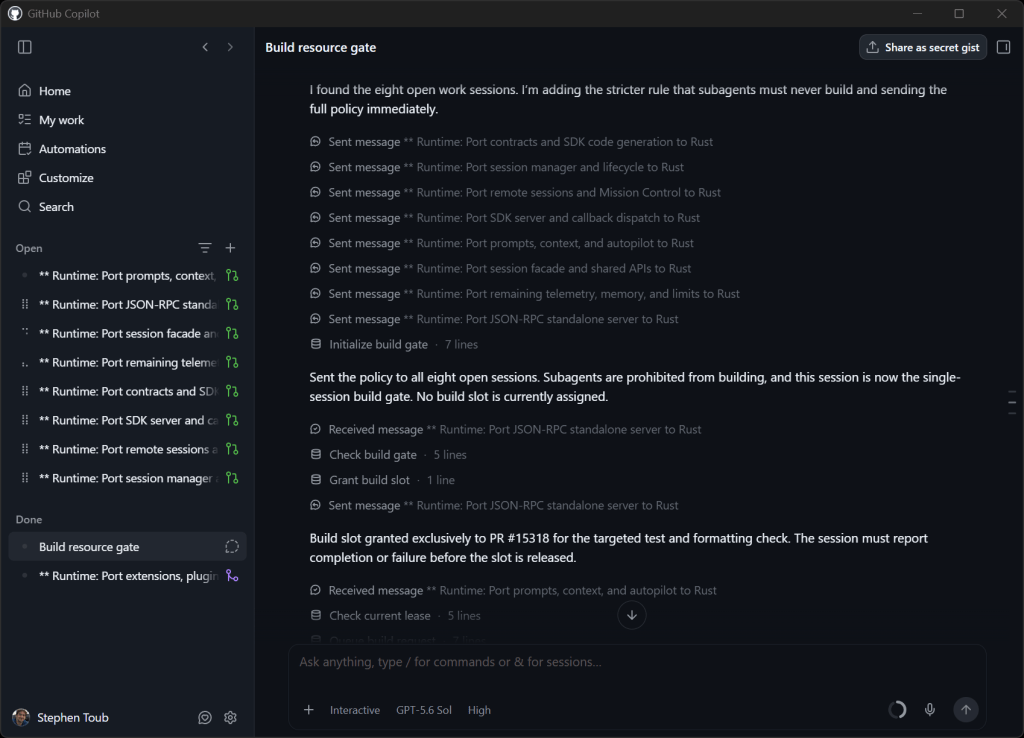
While the scale of the rewrite suggests total automation, the reality was a high-touch collaboration between human and machine. The project was not a simple case of providing a prompt and waiting for the final output. Instead, the developer acted as an "operator of the control loop." This involved framing problems, defining architectural boundaries, choosing strategies, and adjudicating exceptions.
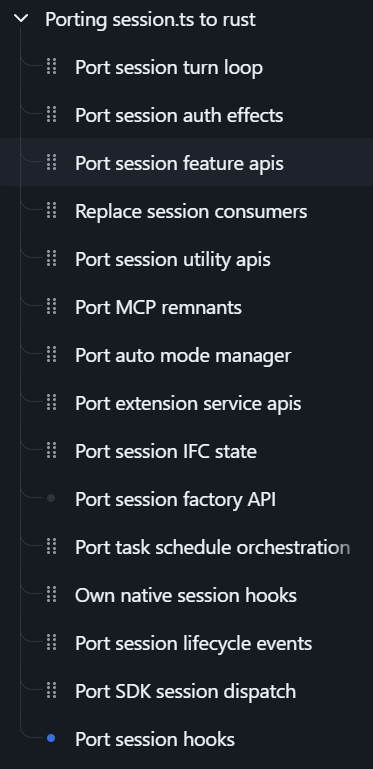
The AI agents acted as an extension of the developer’s capacity, handling the mechanical translation, routine static analysis, and unit test generation. However, human judgment remained central to managing the project’s trajectory. The developer manually intervened approximately 2,600 times, primarily to handle complex rebasing, resolve architectural conflicts, and enforce quality gates. This model allowed a single engineer to supervise an effort that would have historically required a large team working for over a year.
The agents utilized a vast array of tools to manage the codebase, spending significantly more time on investigation than on actual code modification. They frequently utilized shell tools, grep, and Git inspection to orient themselves within the rapidly evolving repository. This "investigative" phase—forming a hypothesis, making a change, and verifying—mirrored the workflow of a senior software engineer, albeit at a significantly higher speed.
The Impact of Rust’s Compiler and Safety
A common narrative surrounding Rust is that its strict compiler makes it an ideal target for AI-generated code. The Copilot porting data confirms this, though perhaps not for the reasons often cited. The vast majority of compiler diagnostics were related to standard static typing—renaming, signature mismatches, or missing implementations—which are common mechanical errors in bulk translations.
Interestingly, ownership and lifetime errors—the aspects of Rust often considered the most challenging for developers—represented only a tiny fraction of the diagnostic output. The agents were highly effective at navigating Rust’s memory safety rules once the initial scaffolding was established. The use of unsafe blocks was strictly limited and confined to clear external boundaries, such as C ABI interfaces, Windows API calls, or system environment access. Every unsafe block was audited, and notably, not a single regression occurred within these blocks during the migration.
Performance and Future Potential
The move to Rust has yielded substantial performance dividends. Benchmarking the new in-process runtime against the previous Node.js-based architecture revealed order-of-magnitude improvements. A full client-session-turn lifecycle that previously took 5.25 seconds was reduced to just 292 milliseconds when running in-process, and as low as 55 milliseconds in optimized scenarios.
Memory efficiency saw equally dramatic gains. The resident private memory footprint for ten concurrent client lifecycles dropped from 1,383 MB to just 126 MB, a 91% reduction. These improvements are critical for the long-term scalability of GitHub Copilot, enabling the system to support significantly higher session densities on existing hardware.
The project cost approximately $120,000 in token spend and about three weeks of dedicated engineering time. Beyond the immediate metrics, the migration has fundamentally shifted the capabilities of the Copilot SDK. Because the runtime is now a standard platform shared library, it can be loaded directly into host processes using languages like C#, Go, Java, or Python, eliminating the need for an external Node.js runtime and reducing the complexity of the deployment environment.
As the team looks toward the future, the focus will shift from simple translation to architectural optimization. The port was intentionally designed to maintain behavioral parity with the original TypeScript implementation. Now that the underlying constraints of the Node.js environment have been removed, the team plans to redesign components to take full advantage of Rust’s native concurrency and ownership models. This transition marks the end of a massive porting project and the beginning of a new chapter in the evolution of GitHub’s AI-powered developer tools, built on a foundation that is faster, safer, and far more portable than the one that preceded it.