








For years, continuous fuzzing has been a cornerstone of modern software security, yet it remains an imperfect solution. Even high-profile projects enrolled in programs like OSS-Fuzz for years often harbor critical, undiscovered vulnerabilities. The bottleneck is rarely the fuzzing technology itself, but rather the human element required to oversee it. Maintaining effective fuzzing requires a persistent commitment to monitoring code coverage, writing and refining harnesses for neglected code paths, and laboriously triaging the resulting crashes. Now, the GitHub Security Lab is looking to bridge this gap with the introduction of its new Fuzzing Taskflow, an autonomous pipeline designed to offload this intensive, manual workload to an AI-driven agent.
The Fuzzing Taskflow is built upon the GitHub Security Lab Taskflow Agent, a framework specifically engineered for LLM-driven security automation. By leveraging this infrastructure, the pipeline enables developers to point an autonomous agent at a C or C++ repository and effectively hand over the entire fuzzing lifecycle. From identifying suitable entry points and analyzing complex build systems to writing harnesses, executing the fuzzer, and generating detailed vulnerability reports, the system is designed to operate with minimal human intervention.
Bridging the Gap Between Human Expertise and Automation
The development of the Fuzzing Taskflow was born from a fundamental question: how much of the tedious, manual labor required in the fuzzing process can be reliably transferred to an LLM agent? The resulting architecture reflects a strict separation of responsibilities. The LLM agent is tasked with high-level decision-making—determining what to fuzz, how to construct a harness, and which coverage gaps to prioritize. Conversely, the system utilizes the Model Context Protocol (MCP) to handle execution, exposing specific primitives such as compilation tools or fuzzer commands. By ensuring the agent never interacts directly with low-level tools but instead composes a pipeline through these defined building blocks, the system maintains a robust, modular design.

A critical aspect of this architecture is the persistence layer. All operational state is managed within a SQLite database, ensuring that no data is lost or improperly handled between stages. Furthermore, the pipeline implements a dual-compilation strategy for every harness. Each harness is built twice: once as an AFL binary for active fuzzing, and again as a coverage binary for deep analysis. This ensures that the instrumentation used to guide the fuzzer does not interfere with the generation of accurate, human-readable source-line and branch coverage reports, which are essential for identifying blind spots in the code.
The Evolution of the Coverage-Feedback Loop
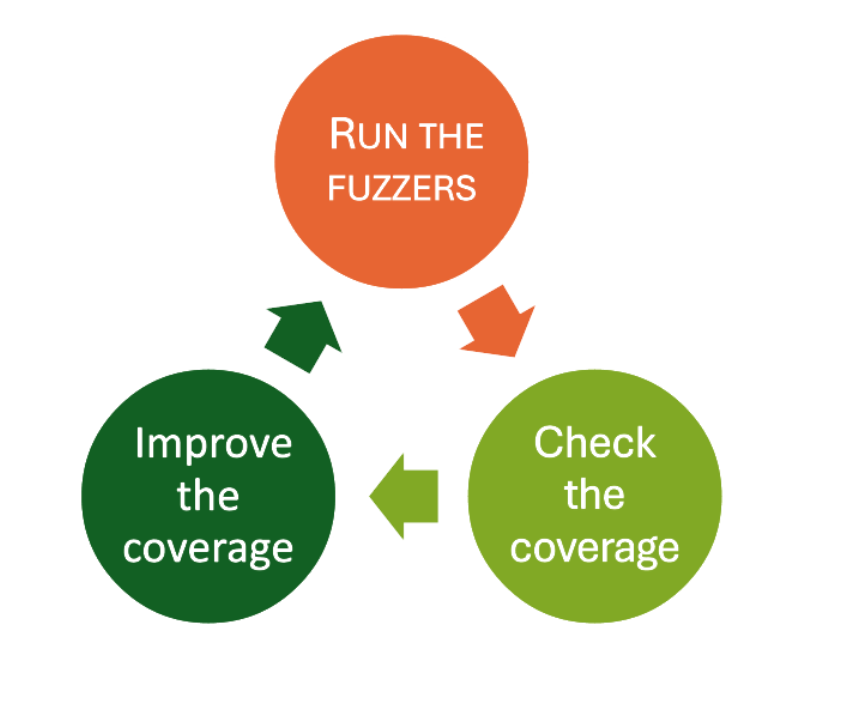
The core innovation of the Fuzzing Taskflow lies in its automated coverage-feedback loop, which replicates the iterative workflow typically performed by a security researcher. In a manual setting, a researcher will run a fuzzer, inspect an LCOV report to find uncovered branches, and then manually craft new inputs or harnesses to reach those gaps. The Fuzzing Taskflow automates this entire cycle.
In each iteration, the agent executes the fuzzer for a set time budget, replays the queue against the coverage binary to generate a precise report, and analyzes the list of uncovered branches. Based on these findings, the agent decides whether to modify the harness, update the dictionary, or shift focus to a different target. To ensure efficiency, the system utilizes an escalating time-budget strategy, beginning with short, 30-second bursts and gradually increasing duration to up to 16 minutes per target. This allows the system to capture low-hanging fruit quickly while allocating more resources to the difficult, deep-seated logic that requires persistent fuzzing to breach.
A key feature designed to prevent wasted compute is the implementation of plateau detection. Once the agent determines that consecutive iterations are yielding diminishing returns—specifically, gains of less than 1% in absolute line coverage—the system concludes its work on that particular segment and moves forward. This ensures that the agent remains focused on productive tasks rather than attempting to exhaustively fuzz every corner of a codebase at the cost of efficiency.
Advancing Structure-Aware Fuzzing
While traditional fuzzers excel at binary-level mutations, they often struggle with highly structured, text-based inputs. The Fuzzing Taskflow addresses this through four distinct, complementary mechanisms. First, it employs per-format dictionaries and custom mutators for recognized formats like JSON, XML, and PNG. These custom mutators handle complex operations like token splicing or balanced-bracket duplication while still delegating a portion of the workload to standard AFL mutators to maintain randomness.
Second, for unknown formats, the pipeline dynamically generates mutators by scanning the target project’s own source code. By extracting string literals and numeric constants from definitions and enumerations, the agent can infer the "magic values" the parser expects. Third, these tokens are used to enrich an AFL dictionary that grows in real-time as the fuzzer encounters new code. If the fuzzer hits a block it cannot bypass, the system inspects the nearby guards and adds those tokens to the dictionary, effectively guiding the fuzzer toward the uncovered logic. Finally, a corpus-splice operator allows the system to recombine existing inputs, a technique that significantly improves performance over standard, non-structured mutation approaches.
Streamlining Triage and Vulnerability Reporting
The final, and perhaps most time-consuming, phase of the security pipeline is triage. The Fuzzing Taskflow automates the minimization and deduplication of crashes, utilizing stack-top hashing to collapse semantically identical issues. Once identified, the agent performs a deep-dive analysis by tracing the call chain from the public API to the crashing function.
Each crash is classified by the agent into distinct categories, such as potential vulnerabilities, harness-specific bugs, or benign issues. The generated reports provide a comprehensive root-cause analysis, including file and line references, an assessment of reachability, and even a suggested fix in the form of a unified diff. While the project lead emphasizes that these suggestions are not final and require human review, they provide an invaluable starting point for maintainers, transforming a process that once took hours into one that requires only a quick validation.
Getting Started with the Pipeline
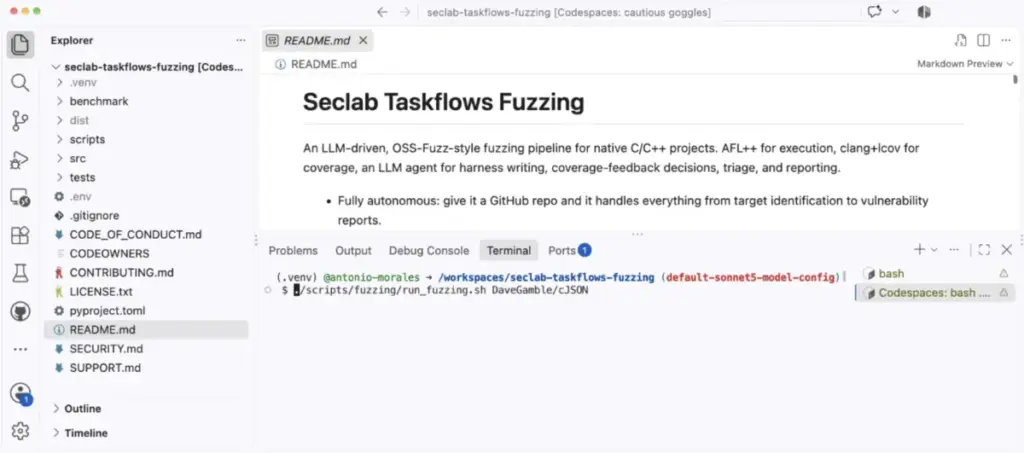
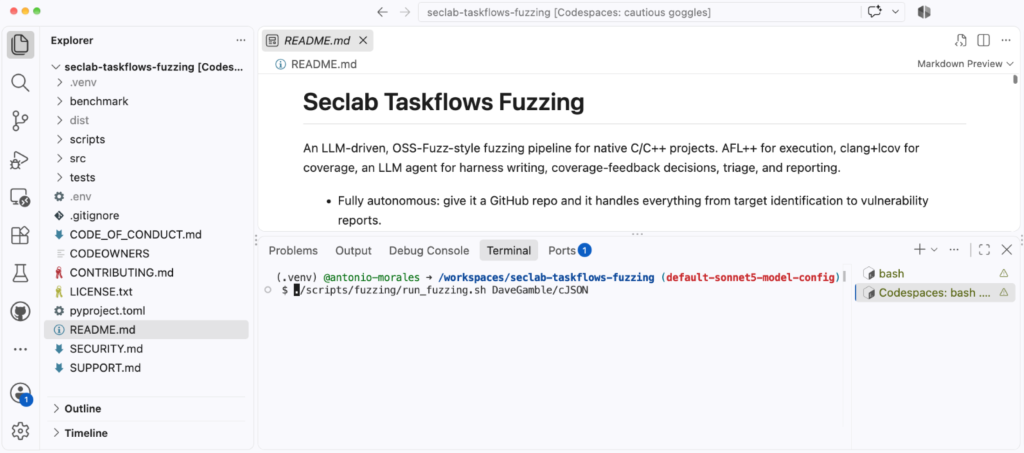
For those interested in deploying the Fuzzing Taskflow, the GitHub Security Lab has prioritized accessibility. Users can launch a Codespace directly from the project’s repository and initiate a campaign with a simple shell command, pointing the tool toward any GitHub owner/repo slug. Because the agent is capable of executing arbitrary build commands, the security team strongly advises that the tool be run exclusively within isolated, disposable environments like a Codespace or a throwaway virtual machine, without elevated privileges.
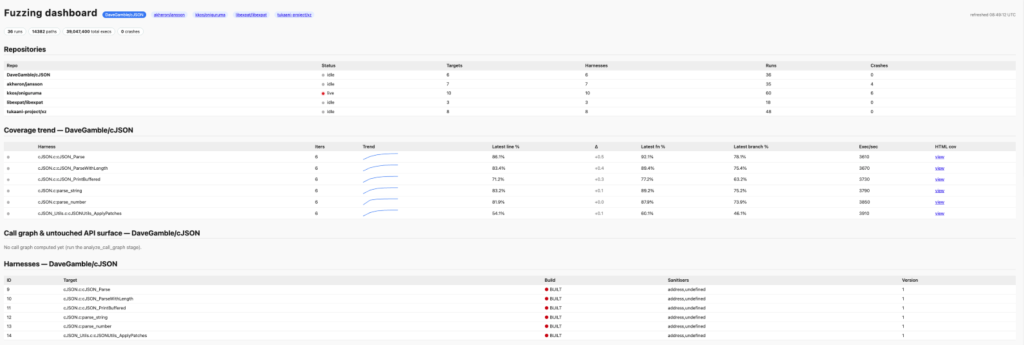
To maintain transparency throughout the campaign, the pipeline automatically generates a live HTML dashboard on a local port. This dashboard provides real-time visibility into the agent’s progress, displaying coverage statistics, discovered crashes, and current task status. By moving the bottleneck of manual oversight to an intelligent, automated system, the Fuzzing Taskflow aims to empower maintainers to secure their projects more effectively, whether they are just beginning their fuzzing journey or looking to deepen the testing of a long-standing codebase. The project is open-source, and as it continues to evolve, the development team is actively encouraging contributions and feedback from the community to further refine its capabilities.