









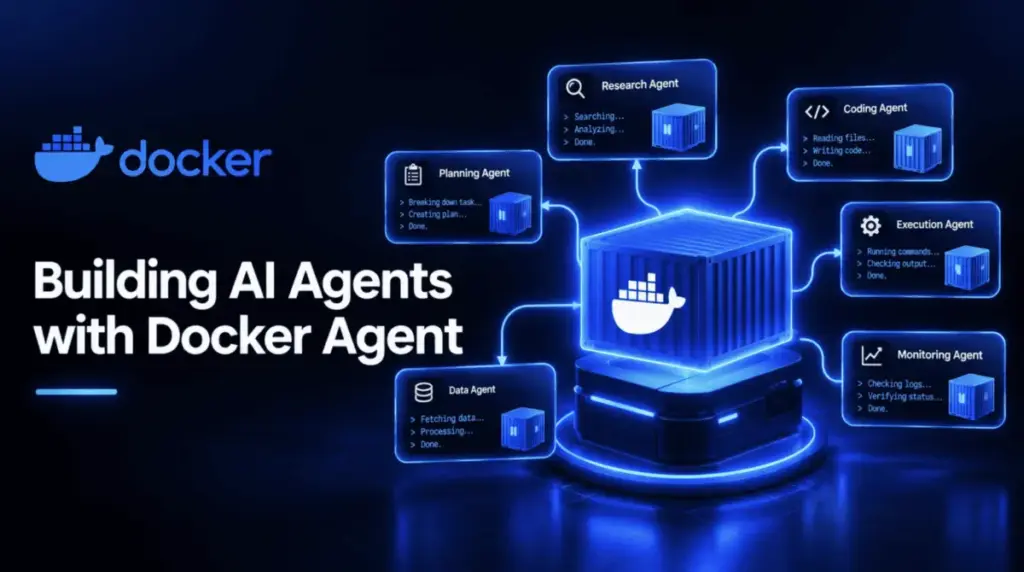
Docker, the company that revolutionized software distribution by introducing the concept of packaging applications into standardized containers that run identically anywhere, is applying that same foundational philosophy directly to artificial intelligence. With the introduction of Docker Agent, developers and technical teams can now define AI agents through declarative configurations, manage them via a specialized command-line interface plugin, and distribute them seamlessly through established Open Container Initiative (OCI) registries that currently store standard container images.
This development bridges a critical gap in modern software engineering, allowing AI agents to be defined, versioned, and shared with the exact same reliability and predictability as traditional containerized applications. Emerging from early releases and rapid open-source development that has already garnered significant attention within the developer community, Docker Agent represents a major maturation of the ecosystem surrounding autonomous software entities.
The release builds upon strategic groundwork laid throughout the previous year, during which Docker integrated Docker Compose to natively support agents and AI models, alongside the introduction of Docker Model Runner to facilitate local model execution without reliance on external cloud application programming interface keys. Docker Agent consolidates these capabilities into a dedicated, robust tool designed to streamline agentic workflows.
A defining characteristic of Docker Agent is its reliance on declarative configurations written in YAML or HCL formats rather than traditional programming code. This design choice effectively lowers the barrier to entry for constructing sophisticated autonomous systems, allowing individuals without extensive software engineering backgrounds to orchestrate complex AI workflows. Furthermore, the tool is entirely provider-agnostic, maintaining compatibility with major artificial intelligence providers including OpenAI, Anthropic, Google Gemini, AWS Bedrock, Mistral, and xAI, as well as fully localized models running through Docker Model Runner. This flexibility ensures that organizations are not locked into a single vendor’s ecosystem when designing their automated infrastructure.
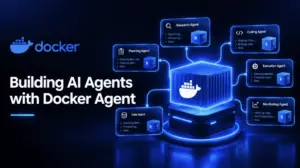
Beyond individual assistant configurations, the platform supports genuine multi-agent orchestration. Teams of specialized agents can be constructed to delegate tasks among themselves, mirroring human collaborative structures. The tool’s integration capabilities extend to a comprehensive ecosystem of built-in utilities alongside any Model Context Protocol server, which can be executed locally, remotely, or securely isolated inside dedicated Docker containers. Once finalized, these agent teams can be published to and retrieved from any OCI-compatible registry, utilizing the identical distribution mechanisms long trusted by enterprise engineering teams.
Getting started with the framework requires a compatible environment, a running instance of the Docker engine, and access to at least one underlying language model. For users operating recent versions of Docker Desktop, the plugin is included out of the box and can be accessed immediately through the standard command-line interface. Alternative installation paths include package managers and direct binary downloads from the project’s public software repositories.
Configuring model access follows a straightforward path, accommodating both traditional cloud-based authentication via environment variables and offline execution through local runtimes. Once installed, verifying the setup confirms access to the suite of commands required to build, validate, and execute agent configurations.
The simplest implementation of an agent involves a single configuration file defining the model parameters, operational descriptions, behavioral instructions, and designated toolsets. These configurations can be executed interactively through a terminal user interface or invoked non-interactively for automated tasks within software scripts and continuous integration pipelines.
To expand utility beyond basic code generation and local file manipulation, agents can incorporate external capabilities through secure Model Context Protocol servers. By running these servers within isolated container environments rather than as uncontained local processes, security and system isolation are preserved while granting the agent access to web search engines, persistent memory databases, and external data sources.
The true capability of the platform is demonstrated through multi-agent collaboration. Rather than relying on a single, monolithic entity to handle diverse responsibilities, administrators can construct structured teams where individual members fulfill specialized roles. A typical configuration might feature a coordinator agent responsible for task delegation, a dedicated research agent tasked with gathering and summarizing credible information from external sources, and a writer agent responsible for synthesizing those findings into cohesive, readable reports.
This architecture accommodates heterogeneous model selection, allowing different members of the same collaborative team to utilize models from distinct providers based on their specific strengths. For instance, an organization might deploy one vendor’s model for coordination and synthesis while leveraging another provider’s model for complex web research, all within a unified, validated schema.
Ensuring the reliability of these complex configurations is supported by strict schema validation. Because configurations are defined declaratively, tools can validate the structural integrity of every YAML file against published interface schemas before runtime execution. This validation step catches configuration anomalies, incorrect toolset definitions, and structural errors early in the development lifecycle, preventing unexpected failures during deployment.
Once validated, configurations can be executed across various operational modes. While interactive terminal sessions provide real-time visibility into agent reasoning and tool execution, automated environments benefit from single-execution flags and auto-approval mechanisms designed for unattended workflows.
The culmination of the Docker Agent workflow lies in its distribution model. Finished agent configurations and multi-agent teams can be packaged and pushed to standard OCI-compliant registries. This allows teams to share sophisticated autonomous workflows globally without requiring local configuration files on the consuming end. Furthermore, agents can reference external team members hosted within registries, blending local definitions with shared, externally maintained components. Referencing these external dependencies by immutable content digests rather than mutable tags ensures operational consistency, predictable performance, and rapid startup times across distributed deployments.
The introduction of Docker Agent reflects a fundamental shift in how artificial intelligence is integrated into software architectures. By shifting the focus from prompt engineering to infrastructure-level portability, version control, and declarative orchestration, Docker provides engineering teams with the tools needed to manage AI agents with the same rigor traditionally reserved for production container deployments. The technology provides a scalable path from individual experimental assistants to robust, multi-agent enterprise teams managed seamlessly through established cloud-native distribution channels.