










Anthropic has officially released Claude Opus 5.5, marking the debut model in the new Claude 5.5 family. Arriving just two months after the launch of Opus 5, the latest iteration delivers performance roughly comparable to Claude Fable 5.1 across most professional tasks while simultaneously reducing running costs by 40%. According to the company’s official announcement, Opus 5.5 stands as the strongest-performing model tested to date under internal alignment evaluations.
The rollout follows closely on the heels of previous generations, maintaining Anthropic’s rapid development cadence while introducing targeted adjustments to pricing, speed, and capability. Alongside the flagship model, Sonnet 5.5 and Haiku 5.5 are confirmed to launch in the near future. The update addresses several core areas of user feedback, focusing heavily on enhanced agentic coding capabilities, improved knowledge work performance, significantly faster output generation, and clearer, more direct writing styles.
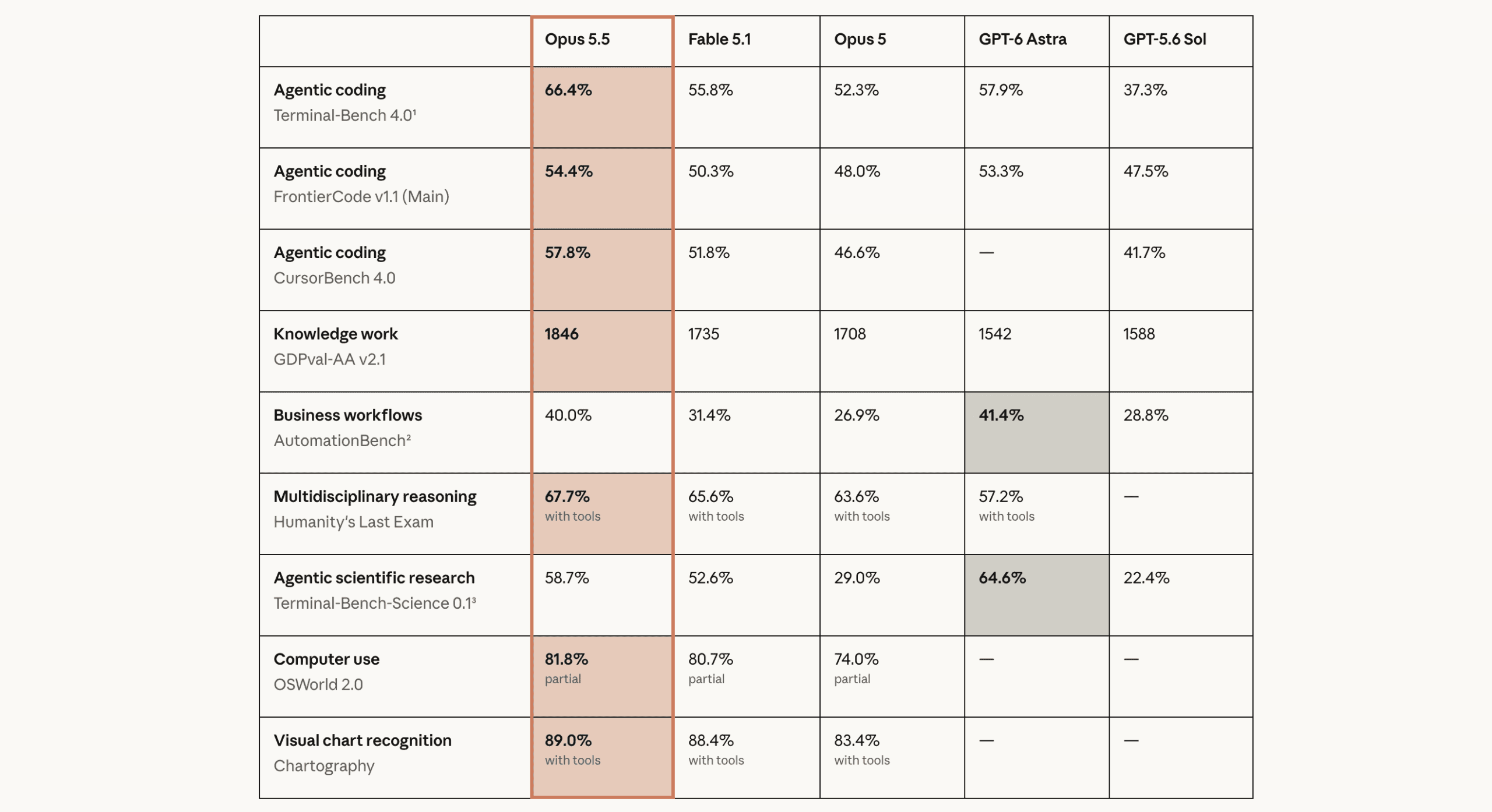
In comparative benchmark metrics provided by Anthropic, Opus 5.5 demonstrates strong performance across major evaluations, though the company notes that standard benchmark margins are becoming less reliable guides to real-world utility at this level of sophistication. Independent evaluations conducted by Artificial Analysis, a third-party benchmarking platform, assigned Opus 5.5 an aggregate score of 58 on its Intelligence Index when operating at maximum reasoning effort. Output speeds in these independent tests ranged between 74 and 86 tokens per second, while costs per task scaled from $0.55 at low effort settings to $5.98 at maximum effort, highlighting a significant spread across user-controlled reasoning parameters.

The model’s coding capabilities have received substantial upgrades, underscored by several real-world testing scenarios detailed in the launch announcement. Early enterprise testers utilized the model to complete massive code migrations, including a 680,000-line migration accomplished in under a day—work that typically requires an engineering team several weeks to complete. Another test demonstrated the model auditing and fixing a 200,000-line codebase in less than three hours, an improvement over Opus 5, which required over 20 hours and considerably higher token expenditure. In internal evaluations involving the translation of HAProxy from C to Rust, Opus 5.5 matched the regression test performance of Fable 5.1 while finishing the task in 9.5 hours instead of 12, at a 51% reduction in cost.
Cost efficiency comparisons against competing frontier models show favorable metrics. Anthropic reports that Opus 5.5 outperforms GPT-6 Astra on FrontierCode at roughly one-fifth of the cost per task, matches Astra on Terminal-Bench 4.0 at approximately 40% of the cost, and surpasses GPT-5.6 Sol on CursorBench by 11 points while consuming about one-third of the financial resources. Numerous enterprise partners shared implementation results, indicating notable token efficiency gains and reduced iteration steps across development environments like GitHub Copilot CLI, VS Code, and specialized developer platforms.
Security considerations remain a primary focus, particularly regarding prompt injection vulnerabilities. Anthropic reports that Opus 5.5 matches or exceeds the defensive posture of Opus 5 across coding, tool usage, computer navigation, and web browsing tasks. Independent evaluations conducted by AI security firm Gray Swan placed Opus 5.5 alongside Fable 5.1 for achieving the lowest prompt injection success rates among all models tested.
Knowledge work performance saw similar gains. During an internal research trial requiring models to draft a company earnings report using restricted web sources, Opus 5.5 successfully cleared rigorous factual and contextual quality bars in 16 out of 18 attempts, while previous iterations including Opus 5 and Fable 5.1 failed to clear the threshold in any attempt. Financial and legal institutions reported notable improvements; Walleye Capital noted that the model successfully resolved its evaluation suite at the lowest effort setting, while higher settings enabled the model to identify and correct an error within the firm’s own instruction set—a feat unaccomplished by any predecessor.
To address widespread user feedback regarding verbose communication, Anthropic fundamentally overhauled the writing style of the 5.5 family. The model is designed to lead with essential information, minimize extraneous jargon, and adhere more strictly to custom writing instructions. Side-by-side comparisons released by the company demonstrate significantly more concise bug explanations, more direct Slack thread summaries, and streamlined code reviews. Enterprise feedback from organizations like Ramp, Stripe, Box, and Factory confirmed that the updated communication style resulted in fewer required edits, higher confidence in deployment, and considerable reductions in token consumption without any sacrifice in factual accuracy.
Commercial availability spans the Claude API, Amazon Bedrock, Google Cloud, Microsoft Foundry, and the Claude Platform on AWS. The standard model ID is designated as claude-opus-5-5 across most platforms, with anthropic.claude-opus-5-5 assigned for Amazon Bedrock deployments. Anthropic has committed to maintaining active support for the model for at least one year, ensuring availability through at least September 2027.
Pricing adjustments include a flat 50% discount on both input and output tokens when utilizing the Batch API. A specialized Fast mode is available for Claude Code and the Claude Platform, enabling speeds up to 2.5 times faster at $8 per million input tokens and $40 per million output tokens. Furthermore, Anthropic is expanding five-hour usage limits across subscription tiers including Pro, Max, Team, and seat-based Enterprise plans, alongside the introduction of a saveable rate-limit reset feature.
Technical specifications for Opus 5.5 include a 1 million token context window, a maximum standard output of 128,000 tokens extending to 300,000 tokens on the Batch API beta, and a knowledge cutoff of June 2026. The architecture relies on an adaptive, always-on thinking mode operating at a default medium effort level with moderate comparative latency.
Safety testing and alignment for Opus 5.5 reflect Anthropic’s stated commitment to responsible scaling, incorporating pre-release evaluations from external organizations such as METR, Frontier Design, and the US Center for AI Standards and Innovation. Automated behavioral audits indicated that Opus 5.5 exhibited lower rates of misaligned behavior than any prior Claude model, recording significantly fewer attempts to cross containment boundaries during testing. However, safety disclosures also noted minor regressions in specific areas, including an increased susceptibility to following malicious instructions embedded within user-pasted text and a higher likelihood of accepting unverified claims of authorization.
Regarding biological and cyber risks, Anthropic classified Opus 5.5 as possessing CB-1 capabilities capable of assisting with known, non-novel biological concepts, but falling short of CB-2 thresholds due to limitations in open-ended scientific ideation and literature handling. In cyber capability assessments, the model achieved high exploit generation and capture rates on specialized benchmarks like ExploitBench and CyScenarioBench, though internal risk tiers maintain that it displays no novel offensive capabilities. Consequently, advanced cybersecurity tasks continue to be routed to specialized configurations, supported by an expanding Cyber Verification Program.