











In the wake of the massive security breach that saw cryptocurrency exchange Bitget lose approximately $351.6 million, stablecoin giants Circle and Tether have intervened by blacklisting a wallet address associated with the theft. While the move represents a proactive step in limiting the attacker’s ability to off-ramp stolen funds, industry experts have pointed out that the frozen amount is merely a fraction of the total haul. The incident has once again highlighted the inherent limitations of centralized control in a decentralized ecosystem, particularly when dealing with non-custodial assets like Ether.
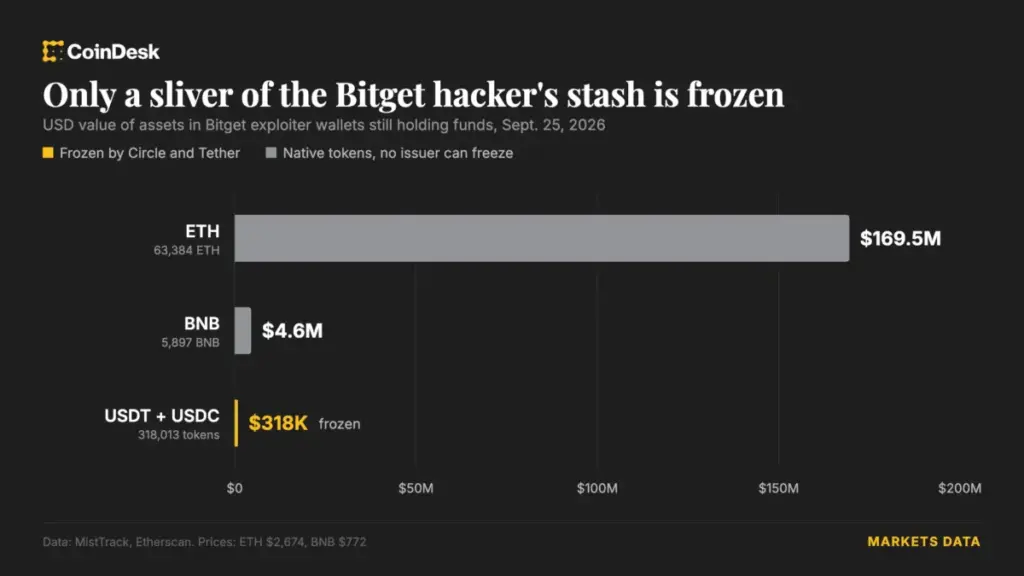
On Friday, at 05:00 UTC, the blockchain analytics platform Etherscan identified that Circle had blacklisted an address tagged as "Bitget Exploiter 8." Following this, the blockchain security firm MistTrack confirmed that Tether had similarly acted to ban the wallet. According to on-chain data, this specific address held approximately $318,000 worth of stablecoins—comprised of roughly 218,023 USDT and 99,990 USDC—alongside 170.47 ETH. By blacklisting this address, the issuers have essentially rendered those specific tokens unusable, preventing the exploiter from transferring or liquidating them through mainstream centralized exchanges or liquidity pools that adhere to issuer-defined compliance standards.
However, the impact of these measures is dwarfed by the sheer scale of the theft. The vast majority of the $351.6 million stolen in the Thursday attack remains held in other wallets under the attacker’s control, primarily denominated in Ether. Because Ether is a native layer-one asset, it operates independently of the centralized controls that allow companies like Circle and Tether to freeze their respective tokens. According to tracking data from MistTrack, the exploiter continues to hold more than 63,000 ETH across various associated addresses. Since no central entity has the authority to "freeze" or "blacklist" Ether, these funds remain entirely under the attacker’s control, posing a significant challenge for recovery efforts.

The Mechanism of the Breach
The details surrounding how such a significant sum was extracted from one of the industry’s prominent exchanges have begun to emerge. Bitget CEO Gracy Chen addressed the community on Wednesday, providing clarity on the nature of the security failure. Contrary to early speculation that the exchange’s private keys had been compromised, Chen clarified that the attackers managed to breach a backend system within the exchange’s internal wallet infrastructure.
By successfully gaining access to these systems, the perpetrators were able to spoof transaction data, effectively tricking the exchange’s authorization protocols into believing the outgoing transfers were legitimate. By manipulating the backend to bypass standard verification checks, the hackers were able to move vast sums of assets out of the exchange’s hot wallets without triggering the typical security alarms that would follow a private key leak. This sophisticated "spoofing" attack underscores the evolving threat landscape, where attackers are increasingly focusing on the middleware and administrative infrastructure of exchanges rather than the cryptographic keys themselves.
Despite the severity of the loss, Bitget has attempted to reassure its user base. CEO Gracy Chen stated that the exchange maintains a user protection fund currently valued at over $464 million. According to the exchange, this reserve is specifically designed to handle such contingencies, and the company has committed to using these funds to ensure that no individual user suffers a loss of their deposits. This pledge is critical for maintaining market confidence, as the aftermath of such high-profile hacks often involves a mass exodus of liquidity from the affected platform.
Centralized Intervention and the "Freezing" Debate
The decision by Circle and Tether to blacklist the address associated with the Bitget exploit has reignited a broader conversation within the crypto community regarding the extent of centralization in stablecoin issuers. While many users view the ability to freeze assets as a necessary "kill switch" to prevent criminals from profiting, others argue that it demonstrates the fundamental vulnerability of centralized stablecoins.
The situation mirrors the controversy surrounding the $285 million Drift Protocol hack, which occurred in April of this year. In that incident, the attacker successfully moved roughly $232 million in USDC from the Solana blockchain to the Ethereum network using Circle’s native Cross-Chain Transfer Protocol (CCTP). At the time, prominent blockchain investigator ZachXBT and other industry figures criticized Circle for what they perceived as a sluggish response in blacklisting the addresses involved.
Critics argued that the delay allowed the attacker more time to obfuscate the funds through various mixers and decentralized protocols, making the eventual recovery much more difficult. In its defense, Circle has consistently maintained that its ability to blacklist is not an arbitrary power to be exercised at whim. The company has clarified that it only executes freezes when legally required to do so—usually following requests from law enforcement or as part of a formal compliance mandate. This legalistic approach is designed to prevent the company from being weaponized in private disputes or acting outside of its regulatory jurisdiction.
However, the contrast between the quick action taken in the Bitget case and the slower response in the Drift hack highlights the complexities of managing digital assets in a decentralized environment. When assets are held in smart contracts or across different chains, the process of verifying a hack and issuing a blacklist command is rarely instantaneous. For issuers like Circle and Tether, every freezing action carries legal weight and must be carefully vetted to avoid accidental interference with legitimate, non-malicious transactions.
The Reality of On-Chain Recovery
As the investigation into the Bitget hack continues, the reality of on-chain recovery remains stark. While the $318,000 frozen by Circle and Tether is a symbolic victory for security, it represents less than 0.1% of the total stolen amount. The remainder of the funds, held in Ether and likely other non-freezable tokens, presents a far more difficult hurdle.
The attacker’s ability to move such a massive amount of capital across the blockchain suggests a high level of technical sophistication. Typically, after such a theft, perpetrators will look to cycle the funds through decentralized exchanges (DEXs) or privacy-preserving protocols to "clean" the assets. Once the Ether has been passed through these mixers, tracing the funds becomes exponentially more difficult for exchanges and law enforcement agencies.
For the wider crypto industry, the Bitget hack serves as a sobering reminder that even as platforms improve their security protocols, the backend infrastructure remains a prime target for sophisticated actors. The shift toward spoofing transaction data rather than attacking private keys signals that exchanges must look beyond just protecting keys and focus on the integrity of their entire data communication chain.
As the industry moves forward, the role of centralized stablecoin issuers as a "buffer" against total loss will likely remain a topic of intense debate. While the ability to blacklist funds is one of the few tools available to reclaim stolen capital, it is inherently limited by the nature of the underlying blockchain technology. Until there are more robust, industry-wide standards for how exchanges and asset issuers coordinate in the immediate aftermath of a hack, incidents like the Bitget exploit will continue to test the limits of what centralized oversight can achieve in a decentralized, permissionless world.
For now, the focus for Bitget remains on the stabilization of its operations and the fulfillment of its promise to cover user losses from its protection fund. Meanwhile, blockchain security firms continue to monitor the exploiter’s addresses, waiting to see if any of the remaining, non-freezable assets will eventually be moved into an environment where they can be intercepted. Whether through law enforcement collaboration or further on-chain monitoring, the pursuit of the remaining funds is expected to be a long and complex process, illustrating the enduring challenges of security and accountability in the digital age.