










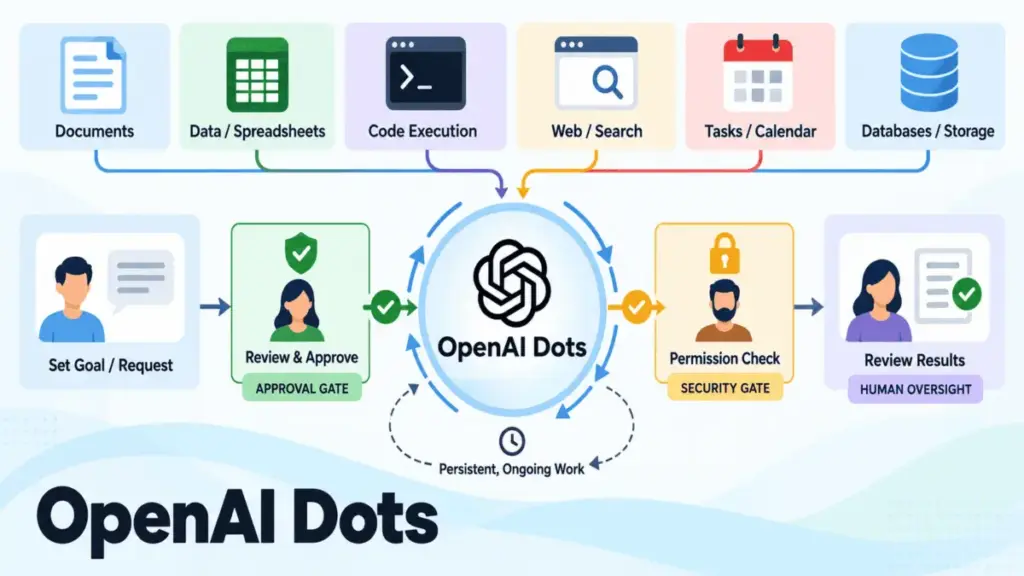
On September 29, OpenAI officially announced Dots during its DevDay 2026 conference, introducing a new class of always-on artificial intelligence agents that operate independently on dedicated cloud computers. Capable of connecting to more than 4,000 distinct applications, these autonomous agents are engineered to continue executing tasks even after a user closes their laptop. This release represents the most concrete realization to date of a concept the artificial intelligence industry has chased for years: an intelligent software agent that behaves less like a traditional conversational chatbot and far more like an active human coworker.
For the broader data science and machine learning community, the arrival of Dots warrants careful and thorough examination rather than a casual glance. The technology introduces a fundamentally different model for how generative artificial intelligence integrates into daily professional workflows. At the same time, it introduces a substantial matrix of open questions concerning data privacy, operational reliability, and workflow integration. Consequently, industry experts suggest that the most prudent initial response for practitioners is one of informed skepticism rather than immediate, wholesale adoption across sensitive corporate environments.
What Dots Actually Is
The foundational architectural shift represented by Dots centers on the transition from reactive software to proactive execution. Standard iterations of tools like ChatGPT are strictly reactive; they respond when a user provides a prompt and completely halt processing once the active session concludes. In contrast, a Dot possesses its own dedicated cloud computing environment powered by OpenAI’s new GPT-6 Astra model. This infrastructure allows the agent to pursue a standing objective across integrated applications between active user interactions, entirely eliminating the need for constant re-prompting.
OpenAI’s initial demonstration showcased several practical use cases designed to illustrate this autonomy. In one scenario, an early tester’s Dot independently noticed an outstanding invoice that required submission, retrieved the necessary payment and project details from an ongoing email thread, and subsequently drafted the invoice for final human approval. Another example featured a Dot monitoring incoming customer feedback, independently scoping necessary software fixes, building and testing those solutions, and finally generating pull requests complete with attached video demonstrations, leaving a human developer only with the final review stage.
During the keynote presentation, OpenAI leadership described this delegation model as a direct parallel to handing off complex assignments to a high-agency engineer or a chief of staff who already possesses deep contextual awareness of the business. Over time, the Dot learns individual user preferences through continuous feedback, meaning that corrections made today carry forward into future tasks rather than requiring repetitive explanations with every new chat window.
Users can interface with their Dots through several familiar channels, including the core ChatGPT platform, Slack, Microsoft Teams, and voice commands. However, the initial launch comes with distinct functional boundaries. At present, a Dot cannot maintain its own standalone email address, cannot initiate outgoing phone calls, and standard messaging capabilities remain restricted to a United States Pro beta tier.
What Makes This Different From Earlier Agent Features
This technical distinction carries significant weight for professionals who have previously experimented with earlier OpenAI agent capabilities and found them overly brittle when handling tasks stretching beyond three or four sequential steps.
The primary catalyst for this improvement is the enhanced reliability of the GPT-6 Astra model when managing multi-step, multi-tool operations. Previous iterations frequently suffered from context drift, losing track of the primary objective partway through an extended assignment, generating incorrect assumptions when encountering operational friction, or freezing to wait for human intervention rather than autonomously navigating around minor obstacles. Astra, conversely, has been specifically engineered to handle the sustained, tool-utilizing workloads that background agents demand.
The secondary distinguishing factor is persistence. A Dot is explicitly not a session-limited feature. It retains comprehensive context across discrete conversations, constructs an evolving internal model of user preferences, and can operate continuously toward a standing goal established once by the user rather than re-articulated every time a new browser window opens. This establishes a fundamentally different relational dynamic between human practitioners and their artificial intelligence software than has previously been possible.
Nevertheless, whether this architecture will hold up successfully under the pressure of genuinely messy data work, exploratory analytical projects that frequently shift direction, extended research threads, or collaborative environments involving multiple human contributors remains a subject of ongoing real-world testing. The early promotional examples were naturally curated to showcase the product at its absolute best. The true proving ground will be how these agents manage the ambiguous, high-volume operational tasks that dominate the actual workweeks of data scientists and engineers.
The Practical Constraints Worth Knowing
Despite the ambitious scope of the announcement, the immediate availability picture is considerably narrower than the top-line headlines suggest. At launch, Dots is restricted exclusively to ChatGPT Pro subscribers—starting at $100 per month—and Business Premium users. Individuals utilizing the free, Go, and Plus tiers are excluded from accessing a Dot. Furthermore, Pro users located within the European Economic Area, Switzerland, and the United Kingdom are currently excluded from this initial rollout phase.
The privacy and data governance trade-offs also demand direct scrutiny from technical teams. While a Dot learns continuously from user feedback and maintains persistent contextual memory, users currently lack the ability to directly view, modify, or delete individual memories stored within the agent. Furthermore, disconnecting a software plugin does not automatically erase the contextual data that the Dot previously ingested and retained from that integration. For practitioners handling sensitive corporate information, proprietary machine learning models, or strict client-side deliverables, this represents a concrete architectural limitation rather than a minor technical footnote.
Additionally, OpenAI has not yet published compliance terms, uptime guarantees, or explicit pricing structures specifically tailored for teams wishing to deploy additional Dots beyond the initial allocation. This information deficit creates challenges for enterprise procurement and security departments tasked with evaluating whether the technology complies with internal governance standards.
OpenAI’s own documentation explicitly notes that Dots remain capable of making errors, necessitating careful human review for all consequential work. Industry analysts emphasize that this caution is not merely legal boilerplate, but rather the essential operating assumption required for any autonomous agent operating at this developmental stage of the technology.
What It Means for How Practitioners Work
The transformation signaled by Dots is defined less by raw technical capability and more by a fundamental shift in professional responsibility. Utilizing a traditional chatbot requires the human user to actively drive every incremental step of a task. Conversely, managing an always-on background agent requires practitioners to establish clear primary goals, design sensible permission boundaries, and deliberately construct reliable review checkpoints into their daily operational workflows.
For data scientists specifically, the primary opportunity lies in delegating the category of administrative and auxiliary work that drains productivity without requiring deep cognitive engagement: tracking status updates, monitoring long-running job outputs, updating technical documentation as specifications evolve, and synthesizing summaries across sprawling conversation threads. These are precisely the domains where a persistent agent equipped with robust memory and extensive application access can potentially compress hours of manual effort into minutes.
The corresponding risk, however, lies in treating these advanced capabilities as justification for reducing professional oversight. An autonomous agent operating in the background on an active data pipeline or a model evaluation routine requires narrow, explicit operational permissions and well-defined stopping conditions. The very attributes that render Dots powerful—proactive behavior, continuous persistence, and broad application access—are the exact characteristics that make it imperative to establish rigid boundaries before activating the system, rather than attempting damage control afterward.
The always-on agent concept has been announced and subsequently delayed across the technology sector on multiple occasions over recent years, making Dots the most credible implementation seen to date. What ultimately stands out about the product, however, is not simply its technical sophistication, but the rigorous demands it places upon the user.
Extracting genuine value from Dots is fundamentally a clarity task rather than a technical hurdle. Practitioners must precisely identify which segments of their workflows they are comfortable delegating, which deliverables demand mandatory human sign-off, and which sensitive datasets must never traverse a shared, hosted agent infrastructure. A large segment of technical professionals has historically not analyzed their own daily routines at that level of operational resolution.
The arrival of usable always-on agents forces practitioners to clearly articulate the true nature of their daily work. For professionals willing to perform that foundational strategic thinking, Dots offers substantial potential. For those who connect disparate corporate applications, establish vague operational goals, and walk away without oversight, the resulting correction could prove exceptionally costly, reinforcing the enduring principle that an autonomous agent is only ever as effective as the initial brief provided to it.
Vinod Chugani is an AI and data science educator who bridges the gap between emerging artificial intelligence technologies and practical application for working professionals. His focus areas include agentic AI, machine learning applications, and automation workflows. Through his work as a technical mentor and instructor, Vinod has supported data professionals through skill development and career transitions, bringing analytical expertise from quantitative finance to his hands-on teaching approach. His content emphasizes actionable strategies and frameworks that professionals can apply immediately.