










In an era where the tech industry has increasingly been pressured to embrace the "Right to Repair" movement, Apple’s latest foray into the smart display market has hit a significant roadblock. The recently released Apple HomeView, which launched to considerable fanfare last week, has undergone a rigorous internal inspection by the experts at iFixit. The resulting teardown paints a troubling picture for those who hope to maintain or repair their devices beyond the standard warranty period, revealing a design that is, by almost every measurable standard, a formidable challenge to disassemble.
While recent product releases from various manufacturers have trended toward improved modularity—often featuring easier access to batteries, logic boards, and display assemblies—the Apple HomeView appears to be a stark step backward in that evolution. iFixit’s investigation suggests that the device was engineered with little consideration for the repair technician or the hobbyist, relying heavily on aggressive adhesive bonding that makes even basic entry nearly impossible without risking damage to the hardware.
iFixit Tears Apple HomeView Apart in More Ways Than One
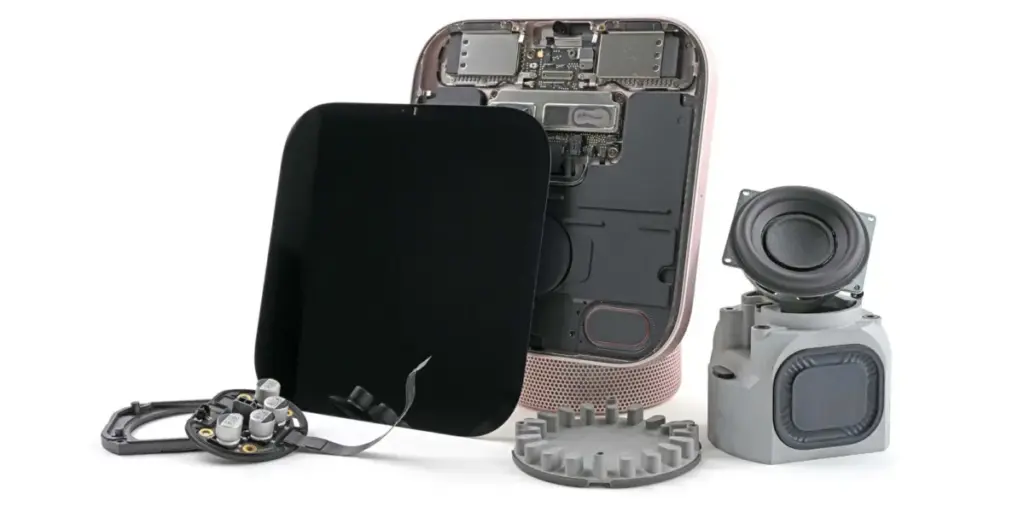
The teardown process, which is documented in full on iFixit’s platform, highlights a design philosophy that prioritizes a seamless, ultra-compact aesthetic at the direct expense of serviceability. The team at iFixit found that the device is essentially locked together with high-strength adhesives that hold the display, internal speakers, antennas, and the main logic board in a death grip. Even after employing industry-standard techniques, such as soaking the display’s internal speaker assembly in isopropyl alcohol to soften the adhesive, the components refused to yield without a fight.


The struggle was not merely academic. During the extraction process, the internal components proved so resistant to separation that one of the speakers actually fractured under the physical stress required to pry it from the chassis. Similarly, the logic board—the central brain of the HomeView—was anchored with thermal adhesive so robust that it required significant, potentially hazardous force to dislodge. This level of integration poses a massive barrier for any independent repair shop or consumer attempting to resolve hardware failures after the device leaves the factory.
Internal Variations Between Models
One of the more interesting findings from the teardown was the structural distinction between the two versions of the HomeView currently on the market: the standard tabletop model and the wall-mounted variant. Despite sharing a name and a primary feature set, Apple has opted for different internal layouts to accommodate the physical constraints of each form factor.
The wall-mounted version features a slightly wider logic board. This design choice was necessitated by the need to house capacitors that, in the tabletop version, are located in the base. Because the wall-mounted unit lacks that base, the internal engineering had to be rearranged to maintain the device’s functionality. This divergence also impacts the audio experience; the wall-mounted model utilizes smaller internal speakers to fit within its slimmer profile. This confirms suspicions raised during the product’s launch, where Apple noted subtle differences in the audio performance between the two configurations. The teardown provides the visual proof of exactly how those trade-offs were made at the engineering level.

Design Hurdles in the Tabletop Variant
The tabletop model presents its own unique set of obstacles. The connection between the display assembly and the base is a masterclass in complexity, with Apple routing critical data and power cables through a pivot mechanism that is effectively sealed. Accessing these cables without causing irreparable damage requires either highly specialized, proprietary tooling or an invasive, destructive disassembly process that would likely ruin the display in the attempt.
However, the teardown was not entirely devoid of positive findings. Once the iFixit team managed to penetrate the outer shell and reach the base of the tabletop model, they discovered that certain components were surprisingly accessible. The USB-C port, for example, is modular and can be replaced with relative ease. Furthermore, the passive radiators and the power board responsible for the lower assembly are positioned in a way that suggests some level of modular thinking.
Yet, these minor victories are undermined by poor design choices elsewhere. Even when components are accessible, their connections are often fraught with difficulty. For instance, the cable connecting the woofer to the power board is exceptionally short. This extreme brevity makes reassembly a daunting task, leaving the technicians at iFixit to question how a standard repair process could possibly be completed without damaging the fragile connector or the cable itself. It creates a "catch-22" for technicians: they may be able to reach the part, but they lack the physical room to maneuver and reconnect it properly.

A Verdict of "BEEP This Thing"
The frustration expressed by the iFixit team during the process is palpable. Shahram Mokhtari, who spearheaded the teardown, offered a blunt assessment of the device’s repairability. While iFixit typically assigns a numerical score to quantify how easily a device can be fixed, the HomeView defied traditional metrics. Mokhtari jokingly—though perhaps accurately—gave the Apple HomeView a rating of "BEEP this thing" out of 10. The expletive-laden sentiment underscores the sheer level of frustration involved in navigating a device so resistant to intervention.
This assessment serves as a critical counter-narrative to the marketing of the HomeView as a centerpiece of the modern smart home. While the device may offer a premium user experience in terms of software and aesthetics, its physical construction suggests a future where the product is destined for the landfill the moment a hardware component fails, rather than being serviced and restored.
For those interested in the deep-dive details, iFixit has provided a comprehensive look at the device, including an interactive 3D CT scan that allows users to peer through the outer casing to see the internal arrangement of the HomeView’s components. This digital scan confirms the dense, adhesive-heavy reality that the technicians faced on their workbench.

The HomeView remains an intriguing piece of hardware that has earned its place in many households for its functionality, as noted in previous reviews. However, this teardown serves as a stark reminder of the divide between consumer-facing design and the long-term sustainability of the electronics we buy. As the industry continues to evolve, the HomeView stands as a clear example of the challenges that remain in balancing sophisticated technology with the principles of repairability and longevity. The full video of the teardown is available for those who wish to witness the arduous process firsthand, illustrating just how far removed the device is from the user-serviceable products of the past.