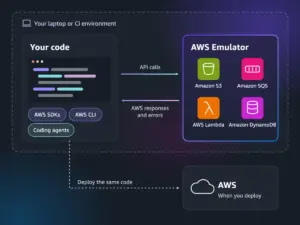











In a significant move to streamline the development lifecycle for cloud-native applications, Amazon today announced the general availability of AWS Emulator. This new tool allows developers to run a local emulation of Amazon Web Services directly on their own machines, providing a high-fidelity environment that mirrors cloud behavior without the need for active deployment. By enabling the AWS Command Line Interface (AWS CLI), AWS SDKs, and AI coding agents to interact with a local HTTPS endpoint, the emulator offers a seamless bridge between local development and cloud-scale infrastructure.
The release marks a pivotal shift in how developers can iterate on their code. Traditionally, testing infrastructure-heavy applications—such as those involving Amazon DynamoDB tables or complex S3 bucket configurations—required constant deployment to a live AWS Region. This often introduced latency into the feedback loop. With the new emulator, those interactions happen locally on a developer’s laptop, facilitating faster testing cycles and more rapid prototyping. The tool is being released as an open-source project, with its source code now available on GitHub, and is designed to be free of additional service fees, ensuring that users only incur costs when they choose to deploy their finished work to the AWS cloud.
Architecture and Operational Mechanics
The AWS Emulator is engineered for efficiency, written in Rust to ensure a minimal footprint on both CPU and memory resources. When a developer initializes the emulator, it automatically generates the necessary local credentials, configuration files, and security certificates, placing them in a designated directory. By adjusting environment variables, developers can redirect their AWS SDKs and CLI tools to communicate with this local endpoint instead of the public cloud. Because the emulator is built directly from the same AWS API models used by the SDKs themselves, the requests and error responses maintain the same structural integrity as those encountered in a production AWS environment.

For Linux users, the emulator is available as an RPM or Debian package, while macOS and Windows developers can run the tool within a Docker container. Once active, the emulator serves requests over a secure HTTPS connection, ensuring that developers can maintain a consistent security posture during the local testing phase. The tool assigns itself a unique account identifier and issues its own access keys, which are clearly distinguished from production keys to prevent any risk of confusion or accidental configuration errors.
Transforming the Developer Workflow
The utility of the AWS Emulator is particularly pronounced for developers integrating AI-driven coding assistants into their daily workflows. Agents such as Kiro or Claude Code can now interact with the emulator to create, read, and manipulate resources in a sandbox environment. A developer can ask an AI agent to architect a database schema, populate it with test data, and run complex queries—all without leaving the local environment or waiting for cloud-side provisioning. This capability allows for highly complex AWS interactions to be tested in a continuous, rapid loop, which significantly lowers the barrier to entry for experimenting with new cloud architectures.
In addition to its standalone server mode, the emulator offers an embedded mode for more integrated testing scenarios. This allows developers to instantiate the emulator directly within their test processes. By wiring the emulator into the SDK through its HTTP client rather than relying on network-based communication, teams can achieve greater parallelization of their test suites. Each embedded instance maintains its own isolated state, meaning that individual tests do not interfere with one another’s buckets, tables, or queues. This embedded functionality is currently available for the AWS SDK for Rust, providing a robust solution for developers looking to incorporate infrastructure testing directly into their CI/CD pipelines.
Fidelity and Continuous Improvement
A central challenge in building any emulator is ensuring that the local environment behaves exactly like the production service. To address this, Amazon has implemented a rigorous system of "fidelity tests." These are short, focused programs that execute specific workflows—such as uploading, reading, and deleting an object in Amazon S3—and compare the emulator’s response against the known behavior of real AWS services. A test is only considered successful if the emulator matches AWS in every detail, including status codes, body content, and specific error messaging.
To maintain transparency, Amazon publishes the status of these fidelity tests for each service, presenting the data as a fraction—for instance, 40 of 50—to indicate how many scenarios currently match production. This score serves as a snapshot of an evolving project. As more fidelity tests are added to the evaluation suite, it is possible for these scores to fluctuate even as the tool improves. The entire suite of fidelity tests is public, allowing the developer community to review what has been verified and to run the tests independently.
Development and Security Standards
The development of the AWS Emulator is itself a reflection of modern, automated engineering. The tool is maintained by agents that utilize Amazon Bedrock AgentCore, AWS CodePipeline, and AWS CodeCommit. One group of agents is tasked with identifying parity gaps by comparing the emulator’s behavior against real AWS responses and static analysis of Smithy models. Once a gap is identified, another set of agents handles the implementation, testing, and review of the necessary code changes. This automated pipeline ensures that the emulator remains in sync with the rapidly changing AWS ecosystem.
Security remains a primary consideration in this automated workflow. Every change proposed by the development agents is subjected to an adversarial review by an independent security agent. This dual-layer check happens both during the initial fix and again within the release pipeline as a final safety measure. While the emulator is designed for safe local use, Amazon emphasizes the principle of shared responsibility. Because the emulator does not perform full IAM policy evaluation or resource-based policy checks, it is intended for functional testing rather than security auditing. Developers are strongly encouraged to continue validating their security settings and final applications directly on AWS before moving to production.
Looking Ahead
With its general availability today, the AWS Emulator represents a major advancement in the developer experience. By minimizing the friction between writing code and testing it against cloud APIs, it empowers teams to build more reliably and move faster. While there are inherent limitations—such as the lack of cross-account or cross-Region simulation—the tool provides a foundational capability that will likely grow in scope and fidelity over time.
For developers eager to integrate this into their current projects, the AWS Emulator is available for installation across major operating systems. Detailed documentation and the public GitHub repository provide the necessary resources to begin configuring local environments. By shifting the initial phases of cloud development to the local machine, Amazon is providing a tool that not only simplifies the daily tasks of engineers but also enhances the overall quality of cloud-native software by encouraging thorough, local testing from the earliest stages of development.