








The ability to test, iterate, and refine software applications is the bedrock of modern engineering. Often, the true character of an application—its resilience, its error handling, and its ability to recover from unexpected states—is revealed not during a flawless "happy-path" demonstration, but during the messy, iterative process of development. Tools that shorten the feedback loop for these edge cases while a project is still in its infancy are invaluable. This week, AWS has centered its updates around this philosophy of rapid iteration and enhanced control, headlined by the release of the AWS Emulator, a tool designed to bring cloud-based API interactions directly onto a local machine.
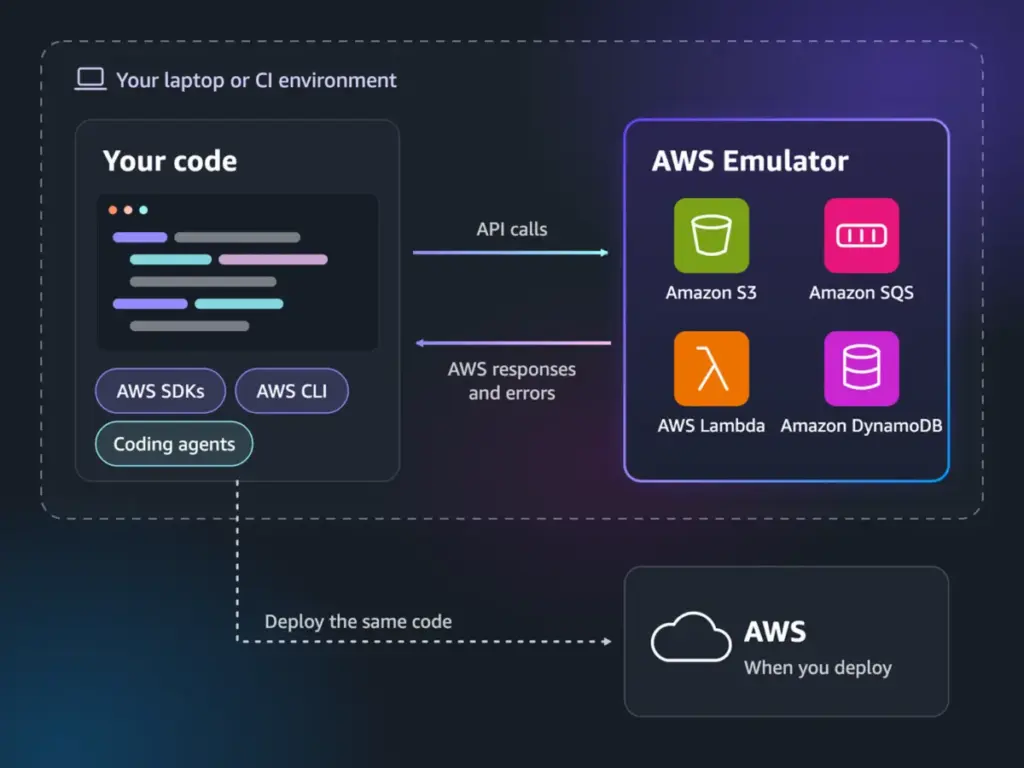
The launch of the AWS Emulator is arguably the most significant development in this week’s news cycle. By allowing developers and automated coding agents to exercise AWS API interactions locally, the tool removes the friction of provisioning cloud resources for every trial-and-error attempt. Whether you are working on a laptop or within a continuous integration pipeline, the Emulator provides a local environment that mimics the behavior of AWS services. By simply pointing the AWS CLI or the AWS SDKs at the emulator’s HTTPS endpoint, developers can conduct tests without the need for an active AWS account or the associated service fees.
The practical applications for this are broad. For instance, a coding agent can use the emulator to create an Amazon DynamoDB table, write data items, and perform read operations in a sandbox environment. This creates a concrete feedback loop: the agent runs a call, inspects the result, and revises its code accordingly. However, it is important to note that the emulator is a tool for development, not a perfect replica of the production environment. While it covers many core functionalities, it does not currently simulate Identity and Access Management (IAM) policies, resource-level security enforcement, or complex cross-account and cross-Region behaviors. Developers are encouraged to consult the published fidelity documentation to understand which calls are supported, as unimplemented requests will return an HTTP 501 error. The emulator is available now via Linux packages, as well as through Docker for macOS and Windows, with its source code publicly available on GitHub for those who wish to inspect or contribute to the implementation.
Beyond the local development experience, AWS is also placing a renewed focus on workload isolation. The introduction of Nitro Sandboxes represents a significant leap in how users can manage shared infrastructure. With this update, developers can assign an individual Amazon EKS pod or an Amazon ECS task its own virtual machine boundary, even while it remains on a shared Amazon EC2 instance. This provides a "defense-in-depth" approach to security, which is particularly beneficial for multi-tenant workloads, high-stakes build jobs, or instances where an agent is executing generated code.
The Nitro Sandboxes offer two distinct modes of operation: an isolated mode, which provides a clean separation between workloads and their neighbors, and a confidential mode, which adds an extra layer of protection against node operators and provides cryptographic attestation. Because this feature leverages the underlying Nitro hardware, it is available without any additional charges on supported instances, though standard compute and management fees still apply. This move reflects an industry-wide push to make hardware-level security more accessible for containerized environments, ensuring that individual tasks can run with the confidence that they are protected from neighboring processes.
The updates from the past week also extended to identity and security protocols. Amazon Cognito now supports OAuth 2.0 token exchange, a feature that significantly simplifies how developers handle downstream service permissions. Users can now exchange a primary user token for one specifically scoped to a downstream service, which effectively eliminates the need to pass around sensitive refresh tokens. This token exchange process also allows for the inclusion of an act claim, which explicitly identifies the intermediary agent when it calls a backend on a user’s behalf. This is a critical development for building secure, delegated architectures, particularly as organizations lean more heavily on AI agents that act as proxies for end-user requests. This functionality is currently available across all Cognito Regions on both Essentials and Plus plans.
In the realm of artificial intelligence, Amazon Bedrock has added support for Claude Fable 5.2, positioning it as a highly capable model for intensive technical workloads. Designed to handle complex engineering tasks, scientific research, and quantitative finance modeling, Fable 5.2 represents the latest step forward for Anthropic’s offerings on the AWS platform. As with many high-end models, there are specific retention requirements in place for traffic to ensure abuse detection, though temporary exceptions exist for certain internal use cases. Furthermore, the AgentCore runtime for Amazon Bedrock has received a significant update, now defaulting to a next-generation runtime. This change results in faster startup times—under two seconds—and more efficient resource usage, allowing for scaling up to 8 vCPUs and 32 GB of memory while simultaneously reducing memory billing by up to 68%.
Data management and availability also saw notable improvements this week. Amazon ElastiCache Serverless has expanded its capabilities to include vector, full-text, and hybrid search, combined with server-side aggregations for Valkey. This enhancement is aimed at developers building recommendation engines or agent-memory retrieval systems that rely on frequently changing data. By integrating these search capabilities directly into the cache, developers can reduce latency and complexity. Meanwhile, Amazon OpenSearch Service has introduced managed cross-Region disaster recovery, allowing users to pair domains running version 3.7 or later across different regions within the same account. This feature targets aggressive recovery objectives, aiming for less than one minute of data loss and under 20 minutes for total recovery time, providing a robust safety net for mission-critical search applications.

In the management of cloud resources, Amazon CloudWatch Logs has introduced account-level retention policies. This allows platform administrators to define log retention rules globally or by name prefix, ensuring consistency across a large, distributed architecture. This feature is particularly useful for maintaining compliance, as it allows security logs to be kept for extended periods without requiring manual updates to every individual log group.
Finally, the AWS ecosystem continues to highlight best practices through shared knowledge and community engagement. Recent publications include a guide on optimizing the cost-per-task for agents on Amazon Bedrock, emphasizing the importance of measuring outcomes against a clear baseline. Another case study detailed how Zillow handles over 100 million daily notifications using AWS Step Functions, demonstrating the power of idempotent modules and configuration-driven workflows. As the community looks toward the upcoming AWS re:Invent in Las Vegas, these updates underscore a period of intense focus on developer productivity, robust security, and the refinement of AI-agent architectures. Whether through the local convenience of the new AWS Emulator or the high-level security of Nitro Sandboxes, the recent stream of announcements points toward a more capable, efficient, and secure cloud experience for developers worldwide.