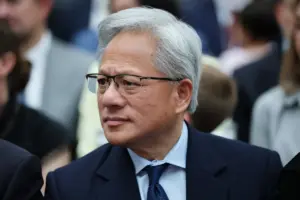











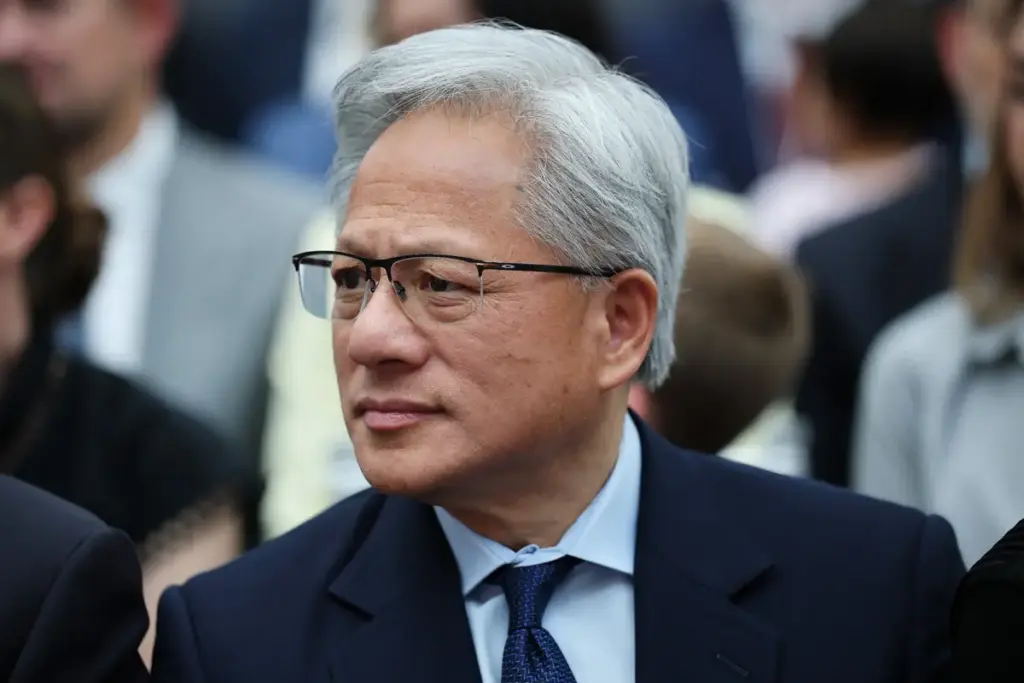
Nvidia Chief Executive Jensen Huang officially resigned from his post on Thursday, bringing a sudden and dramatic end to his decades-long tenure leading the world’s most valuable artificial intelligence chipmaker. The resignation comes just days after Huang admitted to having an affair with a Chinese data center executive whom U.S. intelligence agencies suspected of operating as a Chinese government agent. Compounding the corporate governance crisis, The New York Times reported on Wednesday that Huang had also engaged in an undisclosed affair with an internal Nvidia executive.
In response to the sudden departure, Nvidia’s board of directors announced that Chief Financial Officer Colette Kress will step in as interim chief executive. Kress will manage the day-to-day operations of the tech giant until the board formally identifies and appoints a permanent successor.
Huang’s abrupt exit has injected profound uncertainty into the global technology sector. As the undisputed titan of the artificial intelligence hardware market, Nvidia has long functioned not merely as a commercial supplier, but as an indispensable pillar of the broader AI ecosystem—acting as a primary venture investor, a technological pacesetter, and a community leader. The leadership vacuum and subsequent security fallout are expected to send immediate shockwaves across international markets, carrying heavy strategic repercussions for mainland China, which still relies heavily on foreign hardware, as well as for Taiwan and South Korea, where the vast majority of Nvidia’s hardware suppliers and manufacturing partners are located.

The unprecedented leadership crisis has raised a series of urgent questions regarding the future of the global semiconductor supply chain, international trade controls, and the geopolitical landscape of artificial intelligence.
How does Huang’s exit affect China’s chip access?
Throughout his leadership, Jensen Huang was widely recognized as the most vocal corporate advocate for maintaining commercial ties with China. Huang consistently argued that permitting U.S. technology companies to sell high-performance semiconductors to Chinese buyers was vital for preserving American technological leadership, as it ensured that U.S. firms captured the revenue necessary to fund next-generation research and development.
Despite stringent export controls imposed by the United States government designed to restrict the flow of advanced Nvidia accelerators to China, Chinese enterprises have consistently sought out creative channels to secure high-end computing power remotely. Many domestic firms established operational partnerships with cloud and data center facilities located across Southeast Asia to bypass direct trade limitations.
According to investigative reporting by The Information, Alice Huang—the executive with whom Jensen Huang admitted to having an affair—served as a senior leader at Megaspeed, a Singapore-based data center operator that ranked among Nvidia’s largest regional customers. Investigators and industry reports indicate that Alice Huang facilitated the diversion of approximately 240,000 advanced Nvidia semiconductors, including H100, H200, and selective A100 models, into mainland China. Furthermore, corporate entities linked to her network reportedly invested heavily in prominent domestic AI developers like DeepSeek, explicitly promising to supply them with restricted Nvidia hardware capacity.
The unfolding scandal is widely expected to prompt the U.S. federal government to close existing regulatory loopholes and drastically tighten export restrictions on AI hardware. Anticipating an immediate and aggressive regulatory crackdown, Chinese artificial intelligence laboratories have scrambled to lock down overseas Nvidia chip capacity. Simultaneously, independent technology traders inside China have intensified efforts to stockpile restricted processors, according to recent reporting by Reuters.
Can China do without Nvidia chips?
While domestic Chinese semiconductor manufacturers have made measurable strides in narrowing the technological performance gap, Nvidia’s hardware architectures remain fundamentally essential to the global and domestic artificial intelligence industry.
Market intelligence data illustrates both the persistence of Nvidia’s dominance and the steady rise of domestic alternatives. During the first half of the year, Nvidia shipped 678,000 artificial intelligence accelerators to customers within China. Although this represented a substantial 44% decline compared to the same period in the previous year, Nvidia products still accounted for 34% of the total Chinese market, according to IDC data cited by Reuters.
In parallel, leading Chinese semiconductor manufacturer Huawei expanded its market footprint significantly during the same timeframe. Huawei shipped 572,000 domestic AI accelerators, marking a sharp increase from the roughly 300,000 units shipped the year prior, and capturing 28% of the domestic market share. Other local competitors also claimed notable market segments: Alibaba’s dedicated semiconductor unit, T-Head, captured 7% of the market, followed by Cambricon with 5%. Meanwhile, Baidu subsidiary Kunlunxin held a 4% market share, and Hygon accounted for 3%.
Despite these localized gains, a wide performance and production chasm remains. Although Chinese AI laboratories are increasingly collaborating with domestic chipmakers to ensure their foundational models can execute effectively on homegrown infrastructure, the vast majority of premier AI developers still rely on Nvidia hardware to train state-of-the-art models. Industry benchmarks underscore this disparity; research firm Epoch AI noted that Nvidia’s B300 accelerator delivers roughly 6.75 times the arithmetic performance of Huawei’s flagship Ascend 950 processor. In addition to performance metrics, Huawei continues to face significant challenges in achieving the manufacturing volume necessary to fully replace Nvidia at scale.
What do people in Asia think about Jensen Huang’s downfall?
Across Asia, Jensen Huang had cultivated a reputation akin to a rock star, particularly in Taiwan, the island of his birth. During his frequent visits, he was widely celebrated for visiting bustling local night markets, sharing traditional street snacks with admirers, and hosting lavish banquets with the executives of crucial Taiwanese supply chain partners. Demonstrating his deep commitment to the region, Huang had previously announced plans for Nvidia to invest upwards of $150 billion annually in Taiwan, cementing the island’s status as a central node in the global technology supply chain.
The news of his sudden downfall elicited widespread shock and disappointment across Asian technology circles, where many entrepreneurs and engineers viewed him as an inspirational role model who broke barriers at the highest levels of global enterprise. In regional technology forums, some internet commentators expressed concern that the high-profile espionage allegations and subsequent scrutiny surrounding Huang might exacerbate broader biases or discrimination faced by Asian professionals working within the Western technology sector.
Huang’s abrupt departure also injects a degree of strategic uncertainty into Nvidia’s intricate supplier relationships with major Asian manufacturers. However, senior executives at several of Nvidia’s primary Taiwanese supplier firms expressed confidence in near-term stability. Speaking to Taiwan’s Central News Agency, these executives noted that they still anticipate steady and robust hardware orders from Nvidia in the years ahead, driven by the relentless, sustained global demand for advanced artificial intelligence infrastructure.