







When a large health insurer decided to introduce artificial intelligence to write full determinations for benefits appeals specialists, the product team expected a straightforward win. On paper, the technology worked exactly as specified. Yet, rather than boosting productivity, the tool triggered an unexpected user backlash. Specialists assigned to the appeals stopped using the feature entirely. Those who persisted actually took longer to clear each case than colleagues who ignored the technology altogether.
A brief evaluation with the frontline specialists quickly exposed the root cause. Reading an AI-generated determination carefully enough to sign off on it took roughly the same amount of time as writing the document from scratch. Worse, the specialists found themselves hunting for subtle mistakes they never would have made themselves. Instead of lightening their load, the feature added invisible administrative labor to a task they had already mastered.
The product team ultimately resolved the issue by rescoping the release. In its second iteration, the tool was redesigned to surface the policy provisions and prior decisions relevant to each specific appeal, leaving the actual writing to the human specialist. The tedious search phase vanished, review times dropped, and the core analytical work remained in the hands of the human expert. Crucially, the underlying technology remained identical in both versions. The entire difference lay in which part of the task the AI was assigned to handle.
Finding The Break-Even Line
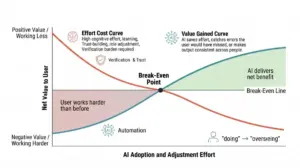
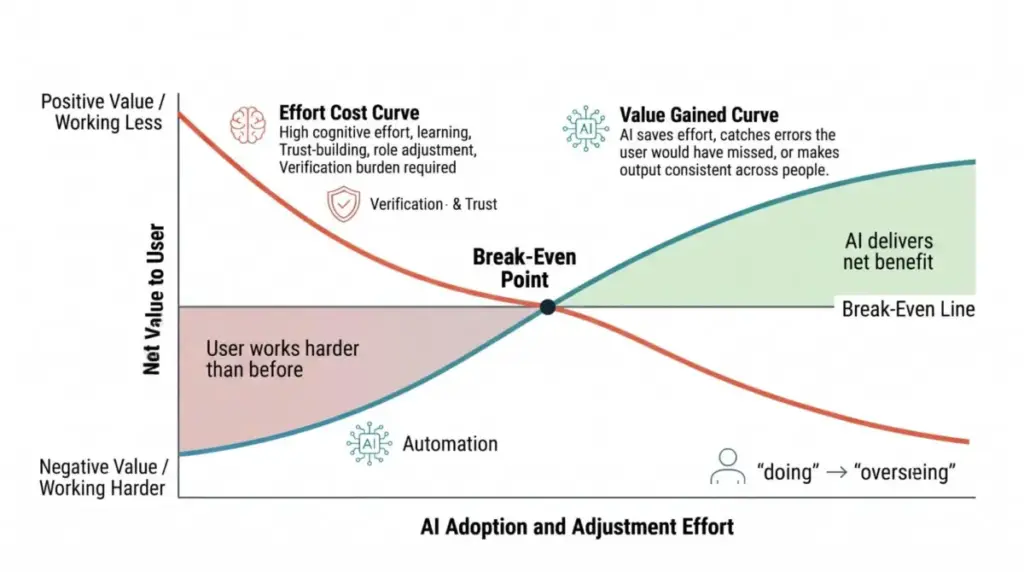
Every interface change exacts a cognitive toll from the user before it delivers any tangible payback. Users must mentally reconstruct how a tool operates, locate updated features, and calibrate how much trust to place in the outputs provided by the system. Cognitive research into working memory capacity indicates that the human brain holds strict limits on concurrent mental processing. Enterprise software features that incorporate artificial intelligence demand even more mental bandwidth than a routine menu redesign because they fundamentally alter daily operational workflows.
When an organization delegates synthesis to an algorithm, the human operator is abruptly relegated to the role of a checker. If the system takes over recommendations as well, the job shrinks down to a mere sign-off. Both adjustments consume valuable human attention. For professionals whose status and workplace identity are rooted in their specialized training, these shifts can feel less like an upgrade and more like a demotion. Studies evaluating clinicians working alongside AI-assisted diagnostic tools have shown that asking professionals to rubber-stamp machine decisions can generate serious threats to professional identity, while providing detailed explanations of the AI’s reasoning can inadvertently heighten both user trust and professional friction at the same time.
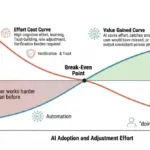
An artificial intelligence feature successfully earns its place in a workflow only when the productivity gains it returns outweigh the adjustment costs imposed on an individual user performing a specific task. That threshold represents the break-even line. User returns typically manifest in three distinct ways: catching errors that would otherwise slip through, accelerating throughput, or scaling analytical capacity across complex datasets. For instance, an AI-powered fraud screening tool justifies its operational footprint by catching anomalies that human analysts would likely miss. Although reviewing these automated flags costs attention, the high catch rate successfully offsets the cost, placing the feature safely above the break-even line.
Evaluating these dynamics prior to design work helps product teams determine whether an AI feature will genuinely assist workers or merely create extra labor. Addressing these considerations collectively during the initial proposal phase prevents teams from sinking weeks into building features that ultimately frustrate users. Engaging directly with workers who perform the task daily—such as loan officers, risk analysts, or benefits specialists—surfaces where mental effort actually resides and whether a proposed feature will alleviate friction or compound it.
Assessing Total Effort and Workflow Realities
Calculating the total effort demanded by a task requires accounting for every cognitive and physical action required of the user, including thinking, clicking, and the downstream checking owed to automated outputs. Reducing the number of clicks proves nothing on its own, as a feature can easily streamline interface interactions while leaving the human operator working harder overall. For example, a loan officer reviewing numerous financial disclosures to identify policy conflicts is engaged in heavy cognitive labor, and AI that surfaces those specific conflicts directly reduces that burden.
By contrast, typing a loan tracking number into a database costs a few seconds and virtually no thought. Pre-filling that field merely relocates the labor rather than eliminating it, because the loan officer must now manually verify what the machine entered. Conventional product wisdom often advises automating repetitive and monotonous tasks, but pre-filled data fields represent a classic instance where that guidance misfires.
User demographics matter just as much as task structures. A single AI feature can easily cross the break-even line for a junior analyst while falling short for a senior team member. Providing a junior analyst with an automated risk summary offers a valuable starting point that they lack the experience to produce independently. A senior analyst, however, reads that same summary against an established mental framework, spends precious minutes reviewing it, and gains no new insight. Recognizing these distinctions allows product teams to scope additions precisely to the user segments they serve while designing appropriate exits for others.
Comparing an AI-driven approach against a user’s current working methods—including self-built spreadsheets and established workarounds—reveals whether the technology offers genuine utility. Artificial intelligence frequently comes out ahead when tasks involve genuine ambiguity, complex scaling needs, high speed, or cross-team consistency. However, once a user has established a practiced, reliable route to a known answer, the advantage of automation tends to evaporate.
Managing Error Visibility and Long-Term Judgment
Every artificial intelligence system makes mistakes; the critical factor is whether the human operator will notice them before consequences materialize. Error visibility varies enormously, and product teams frequently misjudge how easily mistakes can be spotted. An automated trip planner that suggests visiting a museum on its weekly closing day produces an invisible error because nothing in the interface output appears inherently incorrect. Conversely, a suggested flight itinerary that departs before a connecting flight lands presents an obvious contradiction directly on the screen.

Automation bias frequently exacerbates invisible errors. Decades of human factors research demonstrate that operators tend to defer to automated outputs even when those systems are demonstrably wrong, a phenomenon observed across aviation, medicine, and industrial process control. As trust climbs—often unconsciously—users gradually stop applying the rigorous scrutiny required to catch mistakes. Mapping potential error types, assessing their visual prominence, and evaluating the consequences of an undetected failure must occur before design work begins.
Establishing provenance—clearly displaying where output originated and how the system generated it—allows user trust to settle at appropriate levels. People who can inspect source documents, underlying datasets, and retrieval timestamps catch errors far more frequently than those presented with confident-sounding paragraphs stripped of context. High-consequence, low-visibility error surfaces require robust provenance displays and verification prompts to remain viable in production environments.
While offloading routine tasks is a primary benefit of integrating artificial intelligence, the human judgment required to catch machine errors must remain sharp. Disuse degrades critical evaluation skills just as it degrades any other capability. Controlled experimental research involving medical imaging demonstrates how rapidly automated suggestions can override professional judgment, lowering diagnostic accuracy even among highly experienced practitioners. Relying on an automated system year after year without exercising independent oversight leaves professionals in a significantly weaker position.
To prevent the erosion of human oversight, product workflows must incorporate mechanisms that keep verification skills active. Periodic blind reviews, where users form independent judgments before viewing machine outputs, or rotating a share of operational cases off AI assistance entirely, help maintain essential evaluative capabilities over the long term. Without deliberate structural safeguards, teams risk misinterpreting subsequent failures as mere model quality issues when the root cause is the atrophy of human judgment.
Integrating these considerations directly into project requirements ensures that AI features remain genuinely useful rather than burdensome. By carefully evaluating total effort, workflow alignment, error visibility, and the preservation of human judgment, product teams can successfully navigate the pressures of modern software development and build tools that genuinely serve their users.