










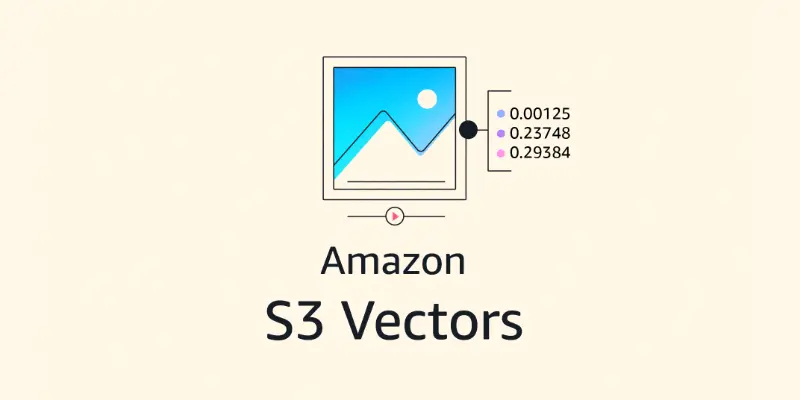
Amazon has announced a significant upgrade to its Amazon S3 Vectors service, introducing a new metadata pre-filtering feature designed to improve the recall performance of filtered queries. By allowing the system to evaluate metadata constraints—such as tenant IDs, document categories, or specific time ranges—before initiating a similarity search, the update ensures that applications can retrieve more relevant matches from their vector indexes without the overhead of re-ingesting data or modifying existing query logic. This development represents a strategic move to optimize how developers build Retrieval-Augmented Generation (RAG) pipelines, multi-tenant document stores, and agentic applications.
In modern cloud-native architecture, most applications do not perform global searches across an entire index. Instead, they typically operate within a specific scope, such as a single user’s private account, a specific department’s documentation, or a particular product category. Developers traditionally express these boundaries through metadata filters. However, in previous iterations of vector search technology, the challenge often lay in balancing these filters with the underlying similarity search. With this latest update, Amazon S3 Vectors ensures that the similarity search is performed only against the subset of vectors that satisfy the metadata requirements, leading to significantly higher recall for filtered searches.
Understanding the Mechanics of Enhanced Pre-Filtering
The effectiveness of this new capability is rooted in how Amazon S3 Vectors manages index modes. Every vector index in the system now operates under one of two modes: "CLASSIC" or "ENHANCED." Under the traditional CLASSIC mode, the system performs the vector similarity search and the metadata filter evaluation in tandem. In this scenario, the engine validates each candidate vector against the specified filters during the search process. While functional, this approach can sometimes limit the number of highly relevant results returned if the filter is particularly restrictive, as the initial candidate pool may not contain enough matches that satisfy both the similarity requirement and the metadata constraints.

By shifting to the ENHANCED mode, the system fundamentally changes its execution order. The engine now resolves the metadata filter first, creating a narrowed search space that includes only the vectors that meet the user’s specific criteria. Only after this filter is applied does the system execute the similarity search within that refined pool. This ensures that the retrieved results are not just the most similar, but also the most relevant to the user’s specific context.
This architectural shift is particularly impactful for large-scale operations. For example, consider a support knowledge base containing eight million individual tickets. If a customer service agent needs to search for a specific, recurring error within a single client’s history—a history that might consist of only 400 tickets—the ENHANCED mode proves its value immediately. By resolving the customer_id filter first, the system ignores the noise of the other 7,999,600 tickets and focuses its computational resources exclusively on the relevant subset. This allows the agent to see a much more comprehensive view of that specific client’s prior occurrences, whereas previously, the system might have struggled to pull enough relevant candidates from the massive, unfiltered dataset. Amazon indicates that on highly selective filters, this pre-filtering approach can return up to five times more matching vectors than the previous method.
Flexibility and Ease of Integration
A key highlight of this release is that it is designed to be developer-friendly, requiring no re-ingestion of existing data and no fundamental changes to existing query structures. Each vector in an S3 Vectors index can store up to 2 KB of application-defined metadata, providing sufficient room for complex attributes. Furthermore, each query supports up to 100 distinct filter constraints, allowing for nuanced, multi-layered search requirements.
The system also introduces the $startsWith operator, a powerful addition for developers working with hierarchical data. This prefix-matching capability allows for the efficient filtering of paths, URLs, and nested keys. For instance, a document store that encodes folder structures into a document ID can now scope a search to a specific subtree by simply using a prefix match, significantly simplifying the logic required to query complex, organized datasets. This joins a robust suite of existing operators, including equality checks, numeric ranges, set membership, and boolean logic using $and and $or.
The integration process is designed to be seamless. For new indexes, developers can define their requirements by setting the appropriate parameters during the index creation phase. For existing indexes, the transition to the more efficient ENHANCED mode is handled through a straightforward update call. Once an index is updated, the benefits of pre-filtering are realized immediately without any disruption to the application’s runtime environment. For organizations managing large fleets of indexes, Amazon has also introduced the ability to set a default index mode at the bucket level, ensuring that all future indexes are created with the desired configuration automatically.
Strategic Implications for RAG and Agentic Workloads
The move toward more granular, metadata-aware searching is a direct response to the evolving requirements of AI-driven applications. As businesses increasingly rely on RAG to provide their generative AI models with access to proprietary data, the ability to accurately scope that data is critical. If a RAG application accidentally retrieves information from a document that is restricted to a different department or a different tenant, it could lead to significant security or privacy issues.
By pushing the metadata filtering to the earliest possible stage of the retrieval process, Amazon is not only improving recall but also reinforcing the boundaries of data access. This ensures that when an agent or a chatbot queries a document store, the context it retrieves is strictly confined to the scope defined by the user’s permissions and the system’s constraints.
Furthermore, this update avoids the common pitfalls of "over-engineering" search solutions. Because there is no schema that must be declared upfront, developers can maintain the flexibility they need as their data models evolve. Every metadata field is filterable by default, allowing for an agile development lifecycle where schema changes can be accommodated without the need for index migrations or complex database updates.
Availability and Future Outlook
Metadata pre-filtering is now available at no additional cost in all commercial AWS Regions where Amazon S3 Vectors is currently supported, as well as in the AWS China Regions. Users will continue to pay only the standard S3 Vectors pricing for storage, PUT requests, and query operations, ensuring that the performance gains from this update do not come with an increased financial burden.
As the ecosystem for vector search continues to mature, features like metadata pre-filtering are likely to become standard requirements for enterprise-grade applications. By embedding these capabilities directly into the storage layer, Amazon is reducing the complexity that developers must manage in their application code. This allows teams to focus more on the higher-level logic of their AI agents and less on the underlying mechanics of search optimization.
For developers looking to leverage these improvements, comprehensive documentation and guidance are available through the official Amazon S3 Vectors resources. As teams begin to transition their workloads to the ENHANCED mode, the feedback loop provided by platforms such as AWS re:Post will likely be essential in refining these tools further to meet the diverse and complex search requirements of the modern cloud landscape. Whether managing massive product catalogs, secure multi-tenant RAG environments, or complex, hierarchical document stores, the addition of metadata pre-filtering provides a robust foundation for more accurate, reliable, and efficient information retrieval.