










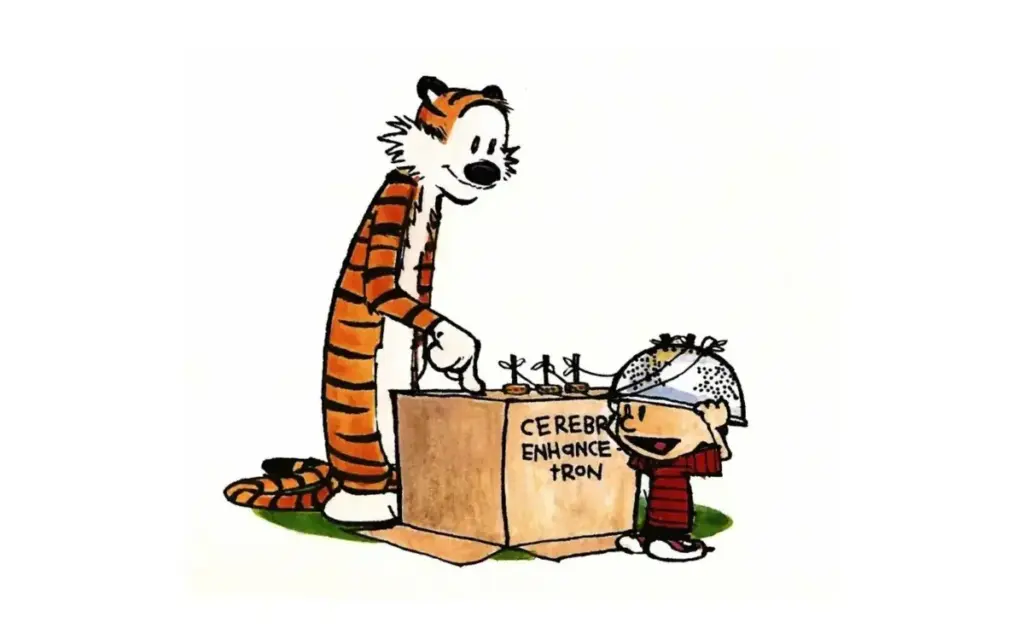
Bill Watterson’s Calvin and Hobbes remains a singular achievement in the history of the newspaper comic strip. Over a prolific ten-year run that produced more than 3,000 individual strips, Watterson crafted a world that was both intellectually rigorous and deeply empathetic, centered on the dynamic between a precocious, imaginative six-year-old boy and his cynical, sardonic stuffed tiger. While the characters became cultural icons, the true magic of the strip lay in Watterson’s extraordinary versatility as an artist and a storyteller. In an industry often constrained by the rigid formatting of the "funny pages" and the demands of daily syndication, Watterson consistently pushed the boundaries of the medium, demonstrating a range that few of his contemporaries could match.
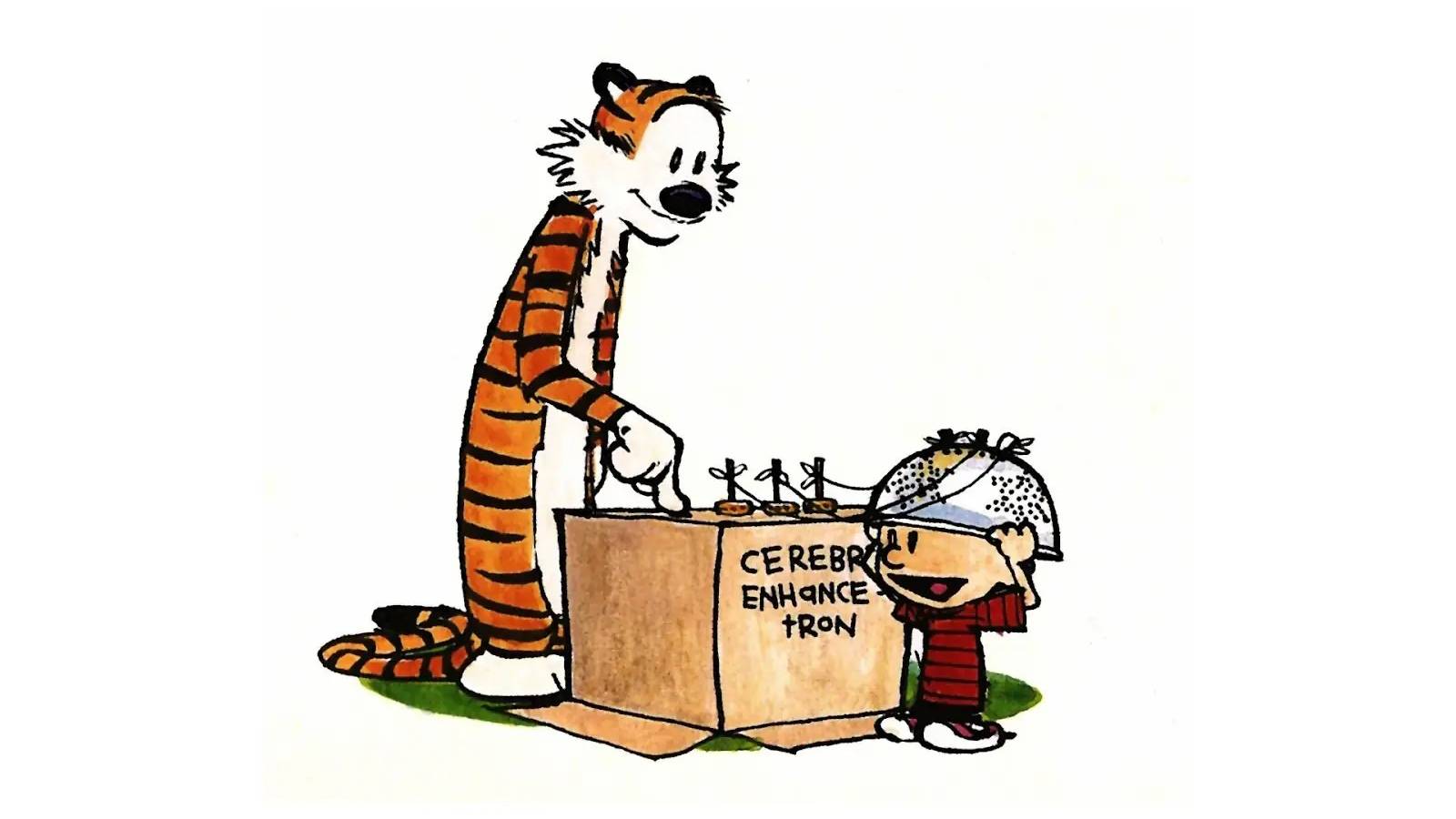
The legacy of Calvin and Hobbes is not merely one of humor, but of artistic evolution. Watterson treated the comic strip as a legitimate canvas for philosophical inquiry, environmental commentary, and experimental visual storytelling. To look back at the final years of the strip—the 1990s—is to witness an artist at the height of his powers, finding new ways to challenge his audience while maintaining the core emotional resonance that made the characters feel like real, breathing entities to millions of readers. While any list of his work is inevitably incomplete, examining nine specific instances from the 1990s offers a window into the breadth of Watterson’s genius.

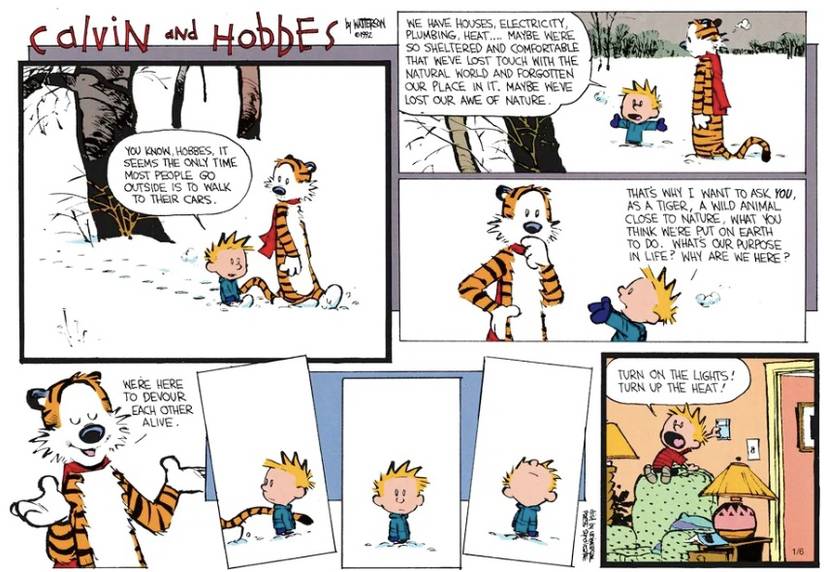
One of the most profound elements of the strip was Watterson’s unwavering commitment to the natural world. Long before environmentalism became a ubiquitous theme in mainstream media, Watterson was using the innocence of childhood to highlight the fragility of the planet. His work often functioned as a quiet, thoughtful critique of human detachment from the environment. In an April 1992 strip, for example, Watterson captured a moment of genuine vulnerability, as Calvin expressed a deep-seated lament that modern humanity had largely abandoned its sense of awe for the natural world. This was not a preachy or didactic message; rather, it was presented through the lens of a child who, unlike the adults around him, was still capable of experiencing wonder at the scale and beauty of the wilderness.
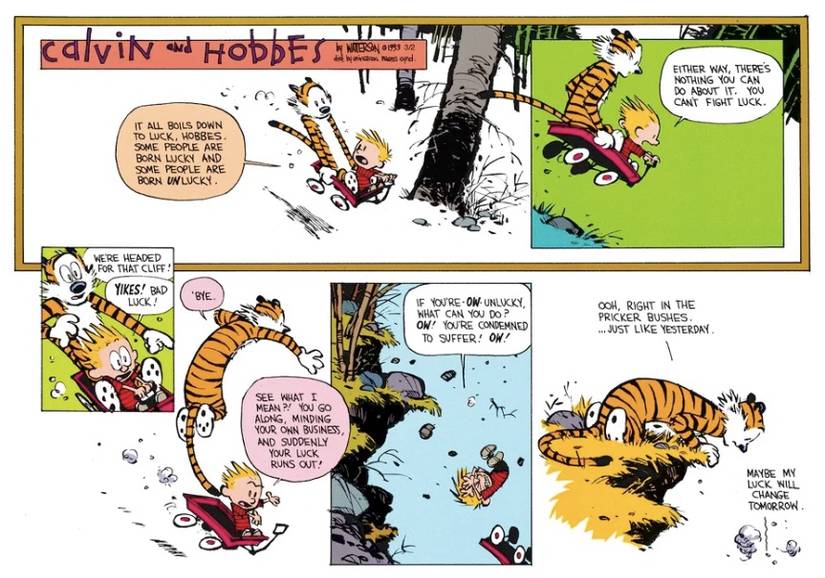
This ability to weave complex themes into the fabric of daily life was a hallmark of Watterson’s philosophical approach. He frequently utilized the strip as an intellectual playground, allowing his characters to engage with existential questions that were, on the surface, far beyond the maturity level of a six-year-old. A memorable example of this occurred when Calvin and Hobbes engaged in a lengthy, nuanced debate regarding the nature of luck. What elevated the strip from a simple dialogue to a classic piece of comedic art was the setting: the pair were mid-descent in their iconic red wagon, careening down a massive hill. The juxtaposition of a profound discussion about the chaos of life with the immediate, physical danger of a crash landing—culminating in Calvin landing in a prickly bush—perfectly encapsulated Watterson’s ability to balance the abstract with the tangible.
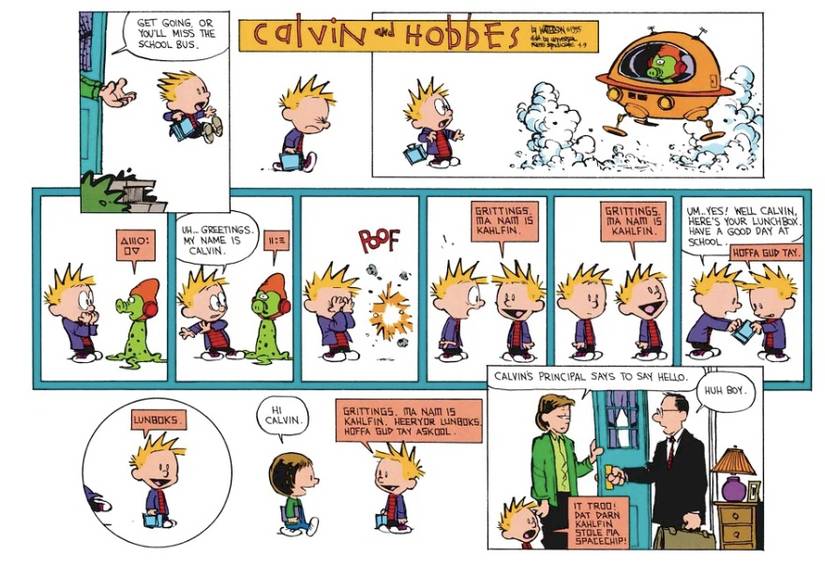
Yet, Watterson never allowed these intellectual pursuits to overshadow the simple, pure joy of childhood imagination. While Calvin was often depicted as a philosophical outlier, he was also just a kid—prone to wild fantasies and elaborate play. In a Sunday strip from 1995, Watterson explored the boundary between reality and make-believe when Calvin imagined an encounter with an alien who possessed the ability to perfectly mimic his appearance. The narrative arc, which saw the real Calvin attempting to navigate his school day by pretending to be the alien visitor, resulted in a quintessential comedic mishap in the principal’s office. It served as a reminder that for all his complexity, Calvin’s world was still governed by the rules—and the consequences—of being a primary school student.
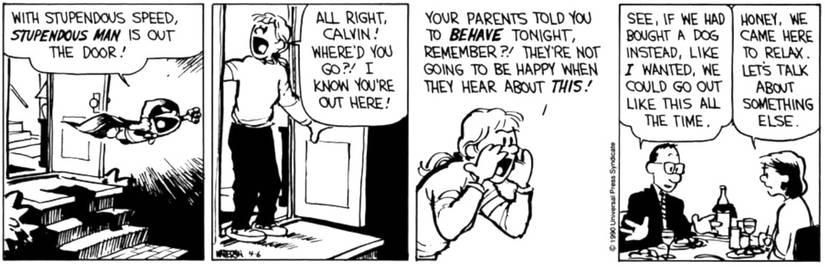
Watterson’s mastery also extended to his structural ingenuity. While the "joke-a-day" format was the standard for the medium, Watterson frequently experimented with long-form storytelling. He would often craft multi-day or even multi-week narrative arcs that allowed for greater character development and higher stakes. A prime example of this was the recurring presence of Rosalyn, the babysitter. Their interactions were rarely one-off gags; instead, they were treated as epic sagas. In a 1990 storyline, Watterson depicted an intense power struggle between the two, with Calvin adopting his "Stupendous Man" alter ego to drive his nemesis to the brink of insanity. These arcs allowed Watterson to show off his skill at pacing and character continuity, turning a simple babysitting scenario into a tense, high-stakes battle of wits.
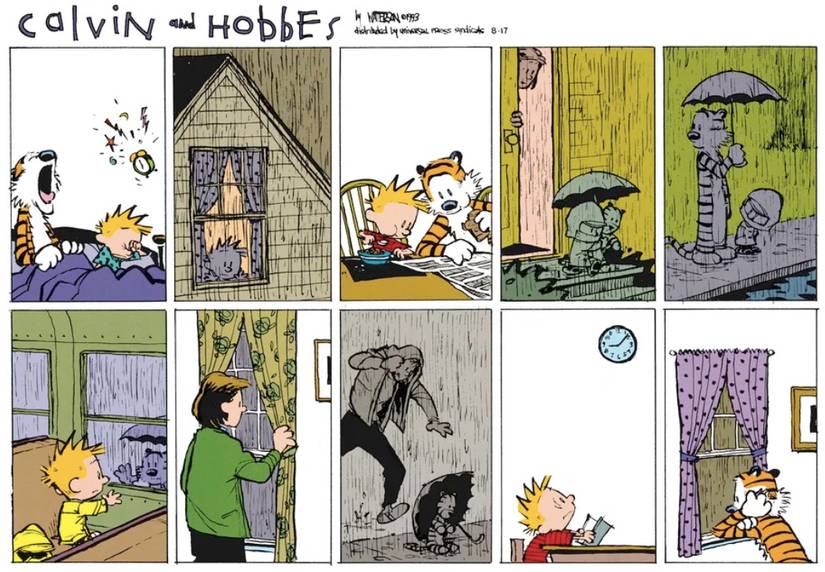
Perhaps the most touching aspect of the strip was its capacity for silence. Watterson understood that the most powerful moments in a visual medium often require no words at all. In a 1993 strip, he bypassed dialogue entirely, focusing instead on a quiet "day in the life" sequence. The imagery focused on the shared longing of Calvin and Hobbes to be reunited, capturing the deep, unspoken emotional bond between the boy and his companion. By stripping away the text, Watterson forced the reader to focus entirely on the body language and facial expressions of his characters, proving that his artistic range was just as capable of conveying intimacy as it was of delivering punchlines.
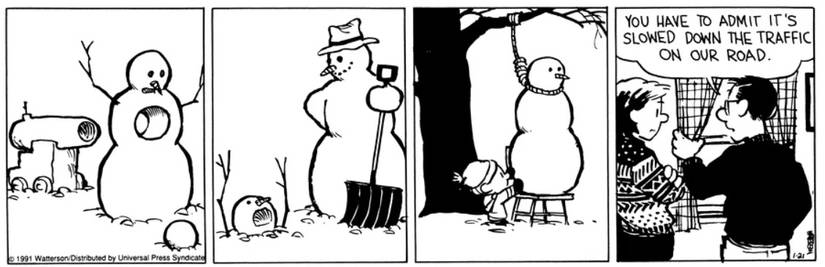
Conversely, Watterson was never afraid to venture into darker, more unsettling territory. This was most visible in his recurring snowman sequences. While other comic strips of the era, such as Peanuts or The Family Circus, remained firmly within the bounds of lighthearted domesticity, Watterson used his snowmen to explore themes of violence, existential dread, and absurdism. A particularly stark example from January 1991 featured three distinct, gruesome scenarios: a snowman being executed by a firing squad, another being buried alive, and a third hanging from a noose. These strips were jarring, not because they were gratuitous, but because they displayed a willingness to confront the morbid side of the human experience that few other cartoonists were brave enough to touch.
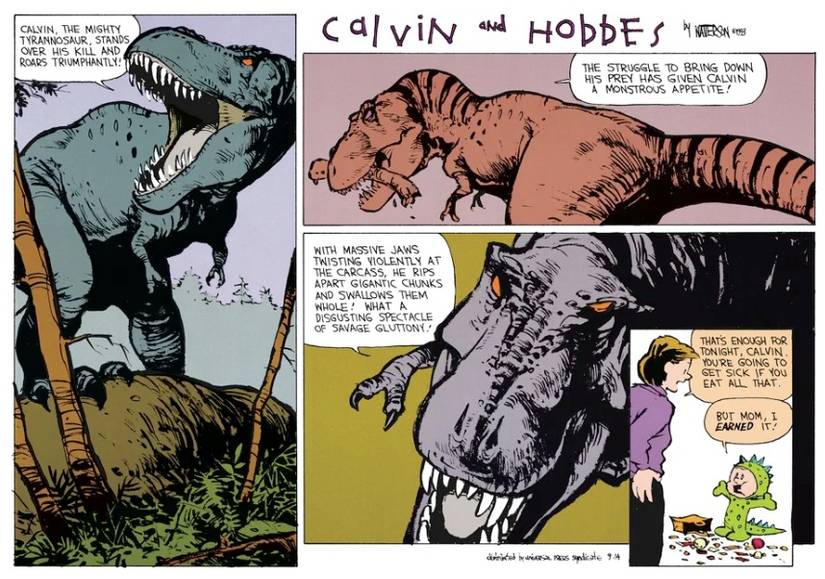
Watterson’s technical skill as an illustrator also deserved recognition. While he generally maintained a consistent, approachable style, he frequently pivoted to highly detailed, intricate illustrations when the story demanded it. When Calvin imagined himself as a dinosaur, the art style would shift, showcasing Watterson’s talent for texture and form. A 1993 Halloween strip serves as a perfect example of this, where the visual depiction of the T-Rex added a layer of grandeur and genuine threat to the scene, contrasting sharply with the mundane suburban setting of the rest of the strip.
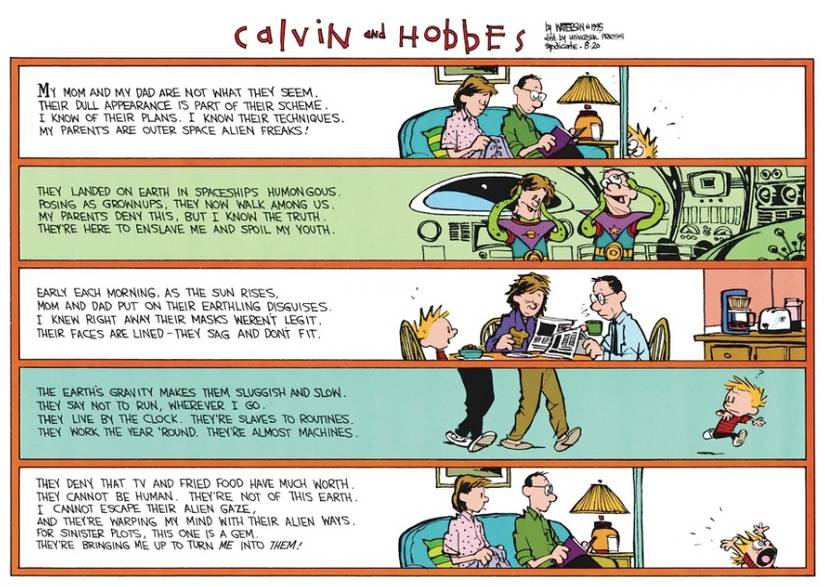
Even when working within the rigid, rectangular constraints of the newspaper layout, Watterson often found ways to subvert the format. He was known for playing with panel borders and layout to convey scale, speed, or internal states of mind. In an August 1995 strip, he broke the traditional panel structure to emphasize an extended internal monologue, allowing the narrative to spill over its boundaries in a way that mirrored the chaotic, expansive imagination of his protagonist.
Ultimately, the journey of Calvin and Hobbes reached its conclusion on December 31, 1995. Watterson’s final strip was a masterclass in restraint. It offered no grand resolution, no final moral lesson, and no heavy-handed farewell. Instead, it provided a simple, poignant moment of wonder as the pair looked out at a fresh, snow-covered landscape and ventured off into the unknown. It was an ending that felt entirely consistent with the spirit of the strip—open-ended, hopeful, and deeply human. By choosing to end the series on his own terms while it was still at the height of its creative influence, Watterson ensured that the legacy of his work would remain untarnished, leaving behind a body of work that continues to resonate with new generations of readers.