










the Mir Space Station to Conquering the Stratosphere: Walt Anderson’s New Telco Venture
Decades after making headlines by briefly taking possession of the aging Russian Mir space station and attempting to pioneer space tourism, American telecom entrepreneur Walt Anderson is setting his sights on a very different kind of altitude. Today, Anderson is channeling his decades-long telecom background into a new venture aimed at challenging the satellite industry using stratospheric airships, also known as high-altitude platform stations, or HAPS.
Back in late 1999, using a portion of the millions he had amassed from various telecommunication businesses, Anderson and a small group of investors established MirCorp. The private venture leased the decrepit Russian spacecraft, planning to fix it up for space tourism and other commercial ventures. They even dispatched a pair of cosmonauts to kickstart renovations, securing businessman Dennis Tito as their inaugural customer—a milestone that would ultimately position Tito to become the world’s very first space tourist.

However, Anderson’s grand vision for commercializing space was cut short in early 2001 when the Russian government made the decision to deorbit the station. As a result, Tito never made it to Mir and was instead redirected to the International Space Station.
More than 25 years later, Anderson retains his deep-seated passion for space, but his latest enterprise, Avealto, is firmly grounded in his extensive telecom roots. With Avealto, he aims to take on the dominant satellite industry by deploying stratospheric airships to provide essential backhaul connectivity to telecom operators, effectively extending cellular coverage into remote and underserved areas.
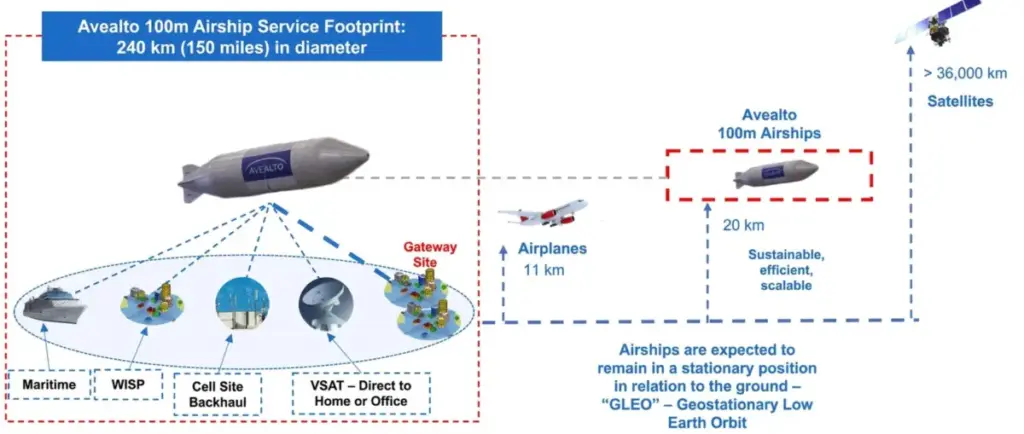
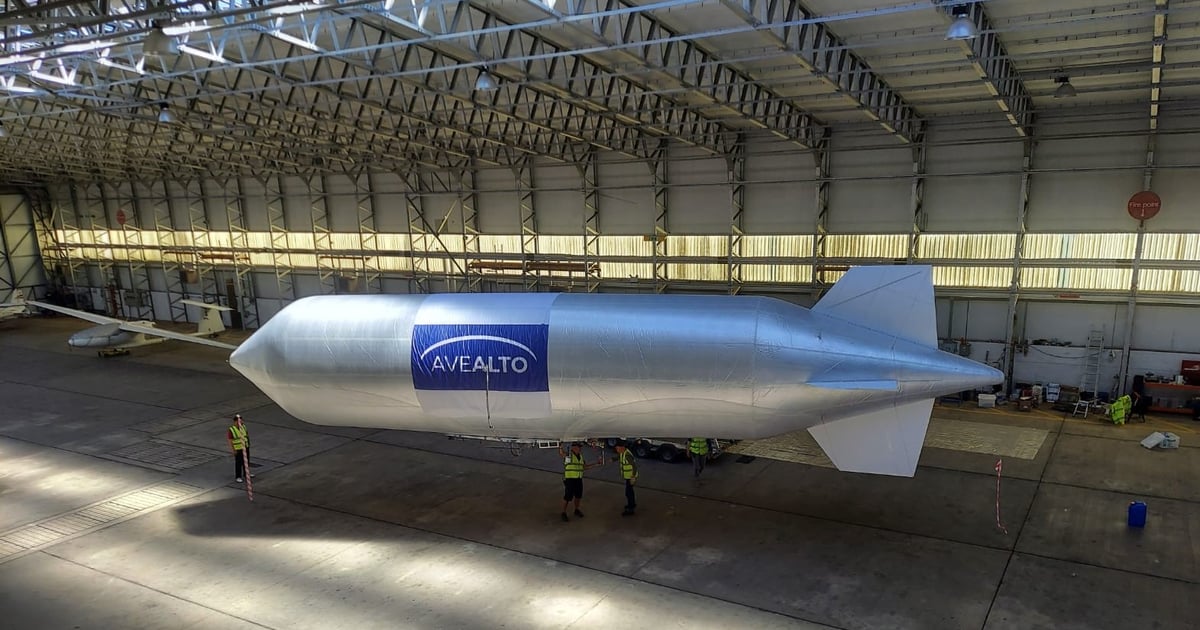
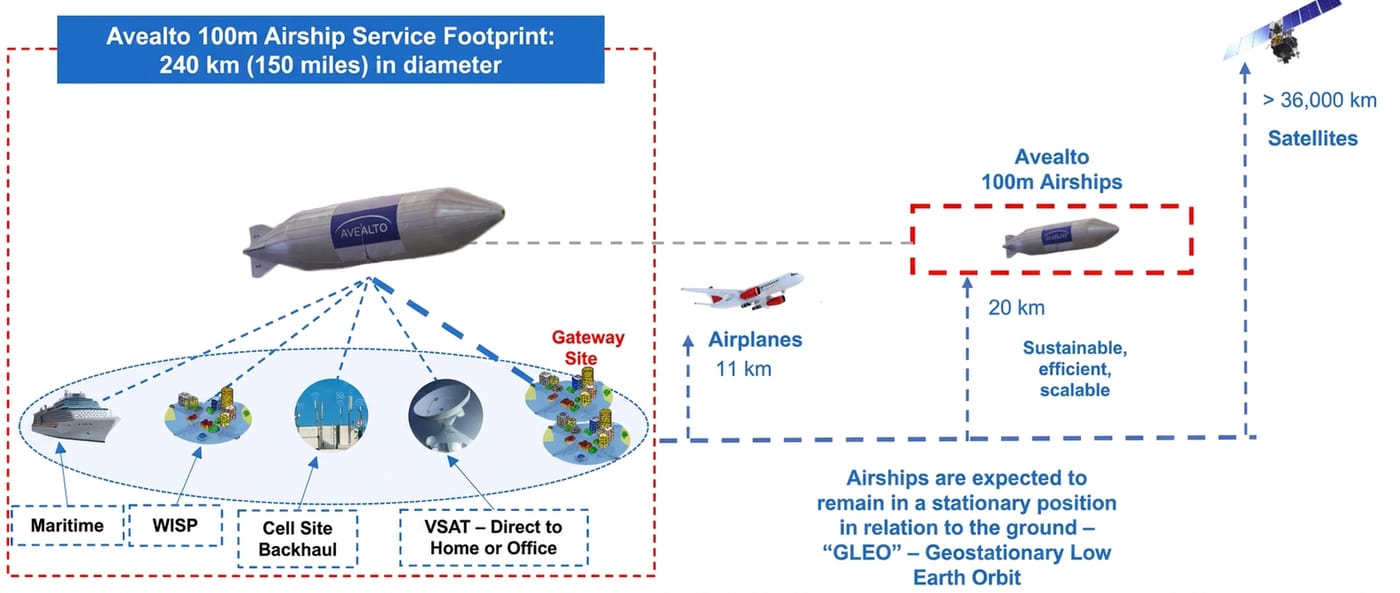
Founded in the UK in 2013—with a name meaning "high bird" in Spanish—Avealto has been quietly developing helium-filled, solar-powered, unmanned airships designed to operate at an altitude of 65,000 feet in the stratosphere. Resembling a modern version of the iconic Goodyear blimp, these massive aircraft are engineered to hover in a stationary position for months at a time. Each airship covers a 150-mile-diameter area utilizing 16 spot beam antennas capable of supporting between 30 and 40 cell towers from multiple telecom operators simultaneously.
Anderson asserts that the wholesale connectivity delivered by these airships will be roughly 80 percent cheaper and capable of offering vastly superior service compared to Starlink or any other low-Earth orbit satellite provider currently operating on the market.
"We’re going to offer service at a disruptive discount," Anderson told Light Reading in an interview. "So that gives our customers the ability to buy from us, make a margin, and it gives the mobile operators the ability to make a profit operating towers in remote areas. They can’t make a profit on satellite."
Unlike many other HAPS hopefuls and low-Earth orbit players that focus heavily on the direct-to-device market to connect individual consumers, Avealto is consciously bypassing that path. Anderson notes that the direct-to-device segment remains a relatively small market that ultimately fails to fully close the persistent digital divide.
Instead, Avealto is targeting areas that currently rely exclusively on satellite coverage, focusing its efforts on regions with population densities exceeding ten people per square kilometer. For spectrum utilization, the startup plans to leverage parts of the Ka- and Ku-bands—frequencies traditionally utilized by satellites—while also sharing the terrestrial spectrum belonging to mobile network operators.
The company’s primary target customers include mobile operators, which are expected to account for roughly 60 percent of its business, alongside internet service providers, wireless internet service providers, and very small aperture terminal operators. These entities will gain the capability to effectively compete with Starlink in geographical regions where they currently lack network coverage. Avealto’s very first customer is Edotco, the infrastructure services arm of Malaysian telecommunications giant Axiata, which recently signed a memorandum of understanding with the startup.
"We’re facilitating [operators’] ability to open that territory and be lower cost than the other option, which is satellites, so they can compete with each other like they always do in that territory," Anderson explained. "In the areas we serve, satellites are going to be pretty much out of the picture because 80% is just such a huge discount. But unless you’re an Elon Musk fanboy, you’re not going to continue to use Starlink if you can get a better deal."
HAPS Are Back
To bring its business model to life, Avealto needs to secure $50 million in funding. This capital would be dedicated to building a manufacturing facility in the UK, constructing the first three full-size, 100-meter-long commercial airships, and getting them successfully deployed and operational in Malaysia. Thus far, the startup has attracted $825,000 in its current funding round. In its earlier stages, the company successfully raised $11.6 million earmarked for research and development, of which Anderson personally contributed $3.2 million.
Anderson acknowledges that developing Avealto’s airships and securing adequate financial backing has taken longer than he initially hoped. The company holds multiple patents and has already developed a smaller, 17-meter-long test vehicle that has undergone rigorous evaluation, having been "tested to death," according to Anderson. However, additional funding remains a prerequisite for producing the first fleet of full-size commercial vehicles.
Despite the capital-raising hurdles, recent industry developments have made investors significantly more receptive to the HAPS value proposition. One major catalyst is SpaceX’s IPO trajectory and the sheer scale of Starlink’s revenue generation. "We no longer have to argue with investors about is there a market?" Anderson noted.
Another significant momentum boost came when U.S. rival Sceye completed a successful roundtrip flight from New Mexico to Japan in September. That milestone preceded Japanese telecom operator SoftBank’s announcement that it plans to launch commercial HAPS services alongside Sceye in 2027.
Furthermore, underlying technologies have caught up with the ambition. The battery and solar panel technologies utilized by Avealto have become markedly more efficient over the past decade, while the software required to autonomously control unmanned aircraft has also matured considerably, Anderson pointed out during the recent Mobile Network Innovation Summit virtual event.
The company is currently preparing for a final test flight of its 17-meter airship in coordination with the UK Civil Aviation Authority before the end of the year. These combined factors give Anderson immense confidence that the market timing is finally right for stratospheric airships in the telecommunications sector. "A lot of things are falling into place right now that are very positive," he said.
If the company manages to secure financing at a steady, manageable pace on a month-by-month basis, Anderson calculates that the first two commercial airships could be actively in service in Malaysia within roughly 23 months. At that juncture, he does not anticipate needing to sell additional equity, planning instead to fund subsequent vehicles through debt, as each deployed airship is projected to generate profitable revenue from its very first day of operation.
"[Avealto] is a new business, but it’s the most amazing recurring revenue conservative business plan," Anderson said.
The pursuit of stratospheric connectivity is not entirely new; various forms of HAPS have been attempted by major tech players over the years, though none have yet achieved widespread commercial service delivery. Google spent nearly a decade developing its Loon internet-beaming balloons before ultimately pulling the plug in 2021 due to prohibitive operational costs. Meanwhile, Airbus has continued its own HAPS endeavors, spinning off its Zephyr high-altitude pseudo-satellite program into a dedicated subsidiary named Aalto in 2022. Similarly, European telecom heavyweight Deutsche Telekom has long championed the concept of "flying basestations" to eliminate rural coverage gaps, serving as a founding member of the HAPS Alliance and recently testing twin aircraft in the Czech Republic.
This Is Telecom, Not Space
To understand Anderson’s current trajectory, it helps to look at his extensive track record across both the telecommunications and aerospace sectors during the 1980s and 1990s. Throughout those decades, he was deeply involved in launching and scaling telecom companies while simultaneously making high-risk investments in ambitious space ventures.
In 1984, Anderson founded long-distance service provider Mid-Atlantic Telecom, which was subsequently acquired by Rochester Telephone Corp. in 1993 for $19 million—an entity that later transformed into Frontier Communications. He also co-founded pan-European telecom operator Esprit Telecom in 1993, which was sold to Global TeleSystems for $850 million in 1998 before eventually collapsing during the dot-com crash. Additionally, Anderson served as a shareholder in Telco Communications, a firm that Excel Communications purchased for $1 billion in 1997.
Alongside his telecommunications pursuits, he actively supported pioneering space initiatives, including the Space Frontier Foundation and the International Space University, driven by a lifelong interest in advancing space exploration for the benefit of humanity. Long before billionaires like Jeff Bezos, Elon Musk, and Richard Branson entered the fray to commercialize the space economy, Anderson invested in Rotary Rocket, an ambitious mid-90s startup that attempted to build a revolutionary reusable rocket.
Then came the tumultuous MirCorp chapter, which required navigating complex negotiations with both the Russian government and the private Russian aerospace enterprise RSC Energia. An extensive feature published in The New York Times Magazine in July 2000 chronicled the wild, high-stakes saga of the Mir venture.
"[MirCorp] was not a successful enterprise, other than the fact that I got to own a space station for a year," Anderson reflected. "I’ve done a lot of unique things. I’ve been the first guy to try to do various things, and then 20 years later, somebody does it commercially. In the space field, I’m not a rational investor. Avealto is a telecom investment, not a space investment."
Anderson is also widely recognized for his involvement in one of the most prominent U.S. tax evasion cases of the early 2000s. After pleading guilty to a portion of the charges in 2007, he was sentenced to nine years in federal prison, ultimately serving seven years, ten months, and two days. He began laying the groundwork for the Avealto business concept prior to his release from custody in December 2012.
With the launch and growth of Avealto, Anderson finds himself once again squaring off against industry behemoths, much like he did decades ago when his early telecom companies competed against giant incumbents such as AT&T in the United States, or BT, Deutsche Telekom, and Telefónica across Europe. This time around, however, his sights are locked firmly on SpaceX’s Starlink and the broader satellite operator community.
"I enjoy competing with companies that need competition," he said, "but in this case, I’ll enjoy it a little bit more."