











Soon after completing a rigorous round of tower fan evaluations, home technology reviewer John Carlsen encountered the Balmuda NatureWind Studio. Priced at a hefty $429, this standing fan places itself squarely in the luxury home appliance category, competing directly with high-end cooling solutions such as Dyson’s AM07 tower fan. Driven by curiosity to see what a consumer receives when spending more than $400 on a fan from the renowned Japanese design brand, Carlsen brought in a test sample to evaluate its performance, build quality, and overall value during warm weather conditions.
While major market players like Dyson and Balmuda heavily emphasize minimalist aesthetics and whisper-quiet operation in their expensive cooling hardware, Balmuda takes a distinctly understated approach to quality. The brand focuses on engineering a functional appliance capable of faithfully simulating a gentle, organic outdoor breeze within a convenient indoor package. After spending weeks putting the Balmuda NatureWind Studio through its paces, testing revealed that despite the steep cost, the appliance offers a compelling proposition for specific buyers searching for advanced cooling solutions.

Balmuda’s Unconventionally Conventional Design
Standing at approximately three feet tall, the Balmuda NatureWind Studio is noticeably shorter than many contemporary office tower fans. Its physical composition blends predominantly metal components with select plastic parts, ensuring that the assembly feels robust and durable rather than fragile or cheap, though users are advised to handle the plastic elements with reasonable care to ensure long-term longevity.

Unlike the vast majority of tower fans currently on the market, which typically arrive pre-assembled or require minimal effort, the Balmuda demands a surprising amount of setup out of the box. However, this design choice allows the product to ship in a significantly smaller packaging footprint. The included setup instructions are clear and direct, printed in a larger typeface that aids readability for individuals with vision impairments. The entire tool-free assembly process is intuitive, requiring approximately 10 minutes from unboxing to full operation.

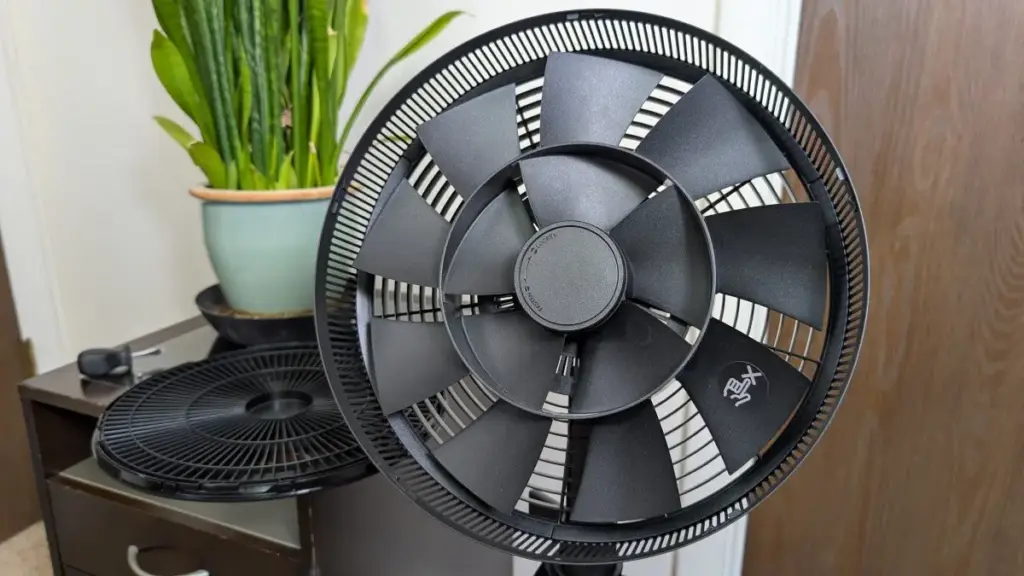
At the core of the fan’s engineering is a unique dual-blade system, utilizing an inner ring comprising five blades paired with an outer ring of nine blades. According to Balmuda, these dual sets of blades generate two distinct airflow patterns that intentionally interfere with one another. This mechanical interaction produces an irregular, organic-feeling breeze that mimics natural wind far more accurately than the standard rotating vortex generated by traditional single-blade fans. Testing confirmed that the resulting breeze feels exceptionally comfortable across all operational speeds, outperforming the dedicated breeze modes found on competing devices that rely merely on fluctuating motor speeds.
Another notable detail is the inclusion of a high-end power cord wrapped in a flexible woven fabric outer casing, which prevents kinking and reduces resistance during movement. Excess cord length can be conveniently managed using an integrated storage hook, and the cable itself is entirely removable to help maintain a clean and tidy living space.

Notably, the Balmuda NatureWind Studio omits a physical or digital remote control entirely. Instead, users operate the device exclusively through a minimalist interface of physical buttons positioned on top of the motor housing. The control layout provides standard adjustments, including a basic timer ranging from one to four hours, five discrete speed settings, and manual oscillation controls. While the short-range timer is fairly standard, the inclusion of an 18-hour auto-off feature prevents the motor from running indefinitely, providing a helpful safeguard for the hardware.
Users can cycle through four of the standard speeds via a simple tap of the wind speed button, while the high-power jet mode requires a sustained press to engage maximum velocity. This jet mode produces robust airflow, prompting the manufacturer to temporarily disable oscillation while active to maintain structural stability.

The manual oscillation feature stands out as a particularly intuitive element of the design. Rather than relying on fixed digital presets, users activate the oscillation mode, manually rotate the fan head to one side until an audible beep confirms the boundary, and then turn it to the opposite side until a second beep sounds. This mechanism allows the user to customize the exact sweep angle of the fan without navigating complex menu systems. Additionally, the fan head can be manually tilted upward or downward to target airflow precisely within a room, though vertical adjustments rely on fixed angles rather than automated movement.
These design choices represent the full extent of the appliance’s capabilities, reflecting a deliberate philosophy of minimalism that strips away superfluous smart features and secondary functions that often go unused by consumers.

Performance and Energy Efficiency
Evaluating the Balmuda NatureWind Studio involved applying the same rigorous testing methodology used for standard tower fans, with the minor exception of omitting an enclosed cardboard testing tunnel to measure unobstructed airflow directly.
Based on the standardized rating scale utilized in previous tower fan assessments, the Balmuda NatureWind Studio achieved an overall score of 8 out of 10. This places it on par with comparable models reviewed from manufacturers such as Dreame, Dyson, and OmniBreeze. While the score is highly respectable, the final rating is primarily tempered by the product’s high retail price, the absence of a remote control, and noticeable operational noise when running at higher fan speeds. Aside from these minor caveats, the device delivers impressive aerodynamic performance and strong electrical efficiency.

Purchasing Considerations and Market Context
When weighing whether to invest in the Balmuda NatureWind Studio, prospective buyers must balance the high financial outlay against the minimalist design philosophy and performance capabilities. Aside from the elevated price tag, the lack of a bundled remote control, and increased noise output at maximum velocity, testing revealed few drawbacks for consumers who possess the necessary budget and appreciation for high-end industrial design.
For many users, the missing remote control ultimately proves negligible due to the straightforward nature of the onboard physical controls. However, consumers shopping with strict budgetary constraints may find more cost-effective alternatives, such as the Vornado Strata 8 Omni, which can retail for significantly less depending on prevailing market promotions and sales.