




The lineage of knowledge transfer has deep historical roots, stretching far beyond the digital age. Long before the invention of writing in ancient Mesopotamia—modern-day Iraq—laws, historical records, myths, and cultural songs were passed down orally from generation to generation through direct instruction and storytelling. Over centuries, this dynamic evolved into formal and informal relationships between teachers and students. Human history is defined by these intellectual lineages: Jesus taught his twelve disciples, Socrates mentored Plato, and Plato established an academy where he instructed Aristotle for two decades, ultimately shaping the foundations of science, logic, and politics.
In the twenty-first century, this lineage of mentorship and knowledge transfer finds a direct parallel in the architecture of deep learning artificial intelligence. During the twentieth-century AI winter, when widespread skepticism led many to believe that neural networks were a scientific dead end, a small community of researchers kept the discipline alive through a similar teacher-student tradition. Geoffrey Hinton, widely recognized as a foundational figure in modern artificial intelligence, ran academic laboratories where he trained researchers such as Yann LeCun and Ilya Sutskever. LeCun went on to invent the convolutional neural network, while Sutskever co-founded OpenAI before pursuing subsequent ventures in safe superintelligence.
While human knowledge transfer is universally understood, a parallel evolution is reshaping computational science: knowledge transfer from machine to machine, a process known as model distillation. As modern artificial intelligence systems scale to unprecedented sizes, the industry faces an urgent deployment bottleneck. Cutting-edge models are trained on trillions of parameters—the internal variables learned automatically from vast training datasets—making them extraordinarily expensive, computationally heavy, and energy-intensive to operate.

Model distillation, or knowledge distillation, addresses this challenge by transferring the learned behavior of a massive, highly accurate model to a smaller, computationally efficient model tailored for practical deployment. In this framework, the smaller system, referred to as the student model, learns to mimic the outputs and internal representations of a larger, more complex teacher model. The ultimate objective is for the student to achieve a level of performance comparable to the teacher while operating with significantly fewer parameters.
The Mechanics of Knowledge Distillation
To understand why model distillation is necessary, developers must look at the immense resource demands of frontier artificial intelligence. Operating models with trillions of parameters requires specialized, expensive hardware and substantial power consumption, creating financial and logistical barriers for widespread integration. Distillation provides a pathway to capture the performance of these massive systems within lightweight architectures, making them cheaper and more practical to run on consumer hardware, mobile phones, and edge devices.
Researchers employ several distinct techniques for model distillation, depending on the specific type of knowledge being transferred from the teacher to the student. These methods range from copying final predictions to mirroring internal representations, attention maps, and reasoning steps.
Response-based distillation represents the classic teacher-student approach, originally popularized by Geoffrey Hinton and his colleagues. This technique centers on the relationship between hard labels and soft labels during training. Hard labels deal strictly with fixed categorical targets. For instance, when an image of a dog is processed by a classifier using hard labels, the model predicts the correct category as a dog while assigning zero probability to alternatives like a cat or a horse.
Conversely, soft labels incorporate probabilities, indicating that an image possesses an eighty-five percent probability of being a dog, a ten percent probability of resembling a cat, and a minor probability of looking like a horse. In response-based distillation, the student model learns directly from these probability distributions rather than binary targets. This supplementary information, often described as dark knowledge, enables the smaller network to absorb the nuanced behavior of the larger model while maintaining high accuracy. While response-based distillation is stable and straightforward to implement, it treats the teacher as a black box, transferring final outputs without revealing the underlying reasoning process.
Feature-based distillation addresses this limitation by transferring the internal feature representations of the larger model rather than just its final output. During this process, the student model is trained to produce hidden layer activations that match those of the teacher using metrics such as mean squared error. The student is penalized if its internal functional systems diverge from the teacher, effectively learning the intermediate steps of problem-solving rather than merely memorizing correct answers. Although highly effective in computer vision applications involving convolutional neural networks and vision transformers, feature-based distillation demands substantial memory and computational power because the student must track and match internal feature maps during every training iteration.
Attention distillation focuses specifically on where a complex model directs its computational focus. In transformer architectures, which analyze relationships across entire sentences rather than isolated words, attention maps highlight the input tokens or regions deemed most important for making predictions. The student model attempts to replicate these attention distributions, learning precisely where to look when resolving a task. While powerful, this approach introduces significant computational overhead because metrics like Kullback-Leibler divergence must be calculated across massive attention tensors.
Self-distillation offers an alternative path where a network trains itself through knowledge transfer between earlier and later versions or across different internal layers. This allows a model to enhance its performance iteratively without scaling up its physical size, bypassing the need for a separate, massive teacher model.
Implementing Knowledge Distillation in Practice
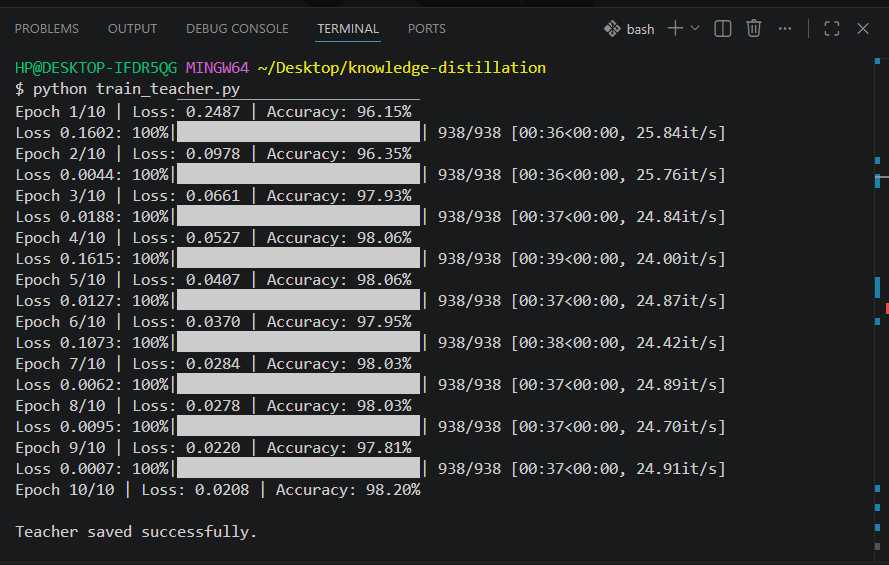
To demonstrate the practical application of model distillation, developers often turn to standard classification tasks using frameworks like PyTorch and datasets such as MNIST, which contains seventy thousand grayscale images of handwritten digits. The workflow typically involves training a large baseline teacher network, freezing its parameters, and subsequently training a smaller student network using a combination of ground-truth hard labels and soft targets generated by the teacher.
The experimental architecture relies on core Python libraries, including PyTorch for building and training neural networks, Torchvision for dataset management, NumPy for numerical operations, Matplotlib for data visualization, and Tqdm for tracking training progress.
The implementation begins by defining the neural network architectures. A larger teacher network incorporates multiple linear layers with rectified linear unit activation functions, while a smaller student network utilizes a compact design with significantly fewer parameters. A utility module handles downloading and normalizing the MNIST dataset, structuring it into batch loaders for efficient processing during training and evaluation loops.
The training engine provides reusable learning algorithms that manage batch iteration, forward propagation, loss calculation, backward propagation, and parameter optimization. For the distillation phase, a specialized loss function combines traditional cross-entropy loss with Kullback-Leibler divergence. This function incorporates a temperature parameter to control the softness of the probability distributions during softmax calculations, alongside a weighting alpha parameter that balances the influence of hard ground-truth labels against the soft targets provided by the teacher.
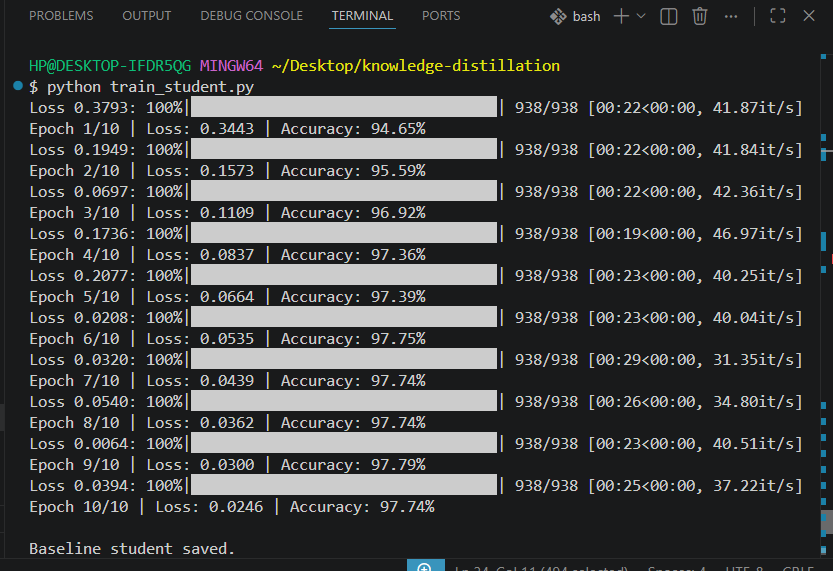
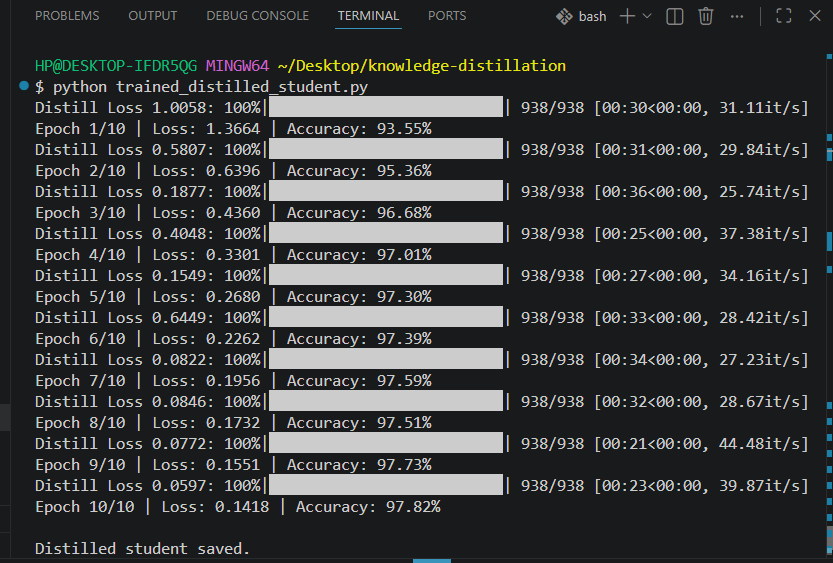
Following the initial training of the teacher network, developers train a baseline student model independently to establish a performance benchmark without teacher guidance. Next, the distilled student model is trained using the frozen teacher’s soft outputs alongside the original dataset labels. Experimental evaluations across ten training epochs consistently demonstrate the efficacy of this approach. While a baseline student network trained independently achieves strong performance, the distilled student model matches or exceeds performance benchmarks established by much larger architectures, successfully narrowing the performance gap while retaining a lightweight footprint.
Alternative Approaches to Model Size Reduction
Model distillation is one of several methodologies deployed by engineers aiming to mitigate the latency, memory footprints, and computational costs associated with large artificial intelligence models. Other prominent techniques include quantization, pruning, and low-rank factorization, each targeting distinct architectural inefficiencies.
Quantization achieves efficiency by reducing the bit-width of the numerical data types used to store the weights and activations of a neural network. Rather than altering the underlying model architecture, quantization targets memory bandwidth bottlenecks by converting high-precision numerical formats into lower-precision representations, dramatically shrinking file sizes with minimal loss in accuracy.
Pruning operates on the premise that large networks frequently contain redundant, low-impact parameters. By identifying and removing weak connections or redundant weights, developers can streamline the network architecture, resulting in faster execution times and reduced memory requirements.
Low-rank factorization utilizes linear algebra to simplify the matrix multiplications that dominate deep learning architectures, substituting complex operations with streamlined approximations. While quantization is primarily deployed to resolve memory constraints, pruning and distillation are specifically designed to reduce computational time and improve execution speed across edge devices and consumer hardware.
As artificial intelligence continues to scale, knowledge distillation remains a critical bridge between frontier research and practical deployment. By extracting and transferring foundational knowledge from massive computational models into efficient student architectures, developers can ensure that advanced artificial intelligence capabilities remain accessible outside of heavily funded data centers.