








For organizations scaling their operations on Amazon Web Services (AWS), the transition from a monolithic application to an event-driven architecture is often a journey of initial simplicity followed by growing complexity. Typically, developers begin this journey with a single custom event bus in one AWS account. For a small, centralized team, this configuration is ideal, offering a streamlined path for routing events between services. However, as organizations grow and adopt a multi-account strategy—a foundational AWS best practice—that original simplicity begins to fracture.
In a standard multi-account environment, each team operates within its own dedicated AWS account to ensure isolation, security, and autonomy. To connect these disparate accounts, teams have historically relied on complex networks of cross-account rules or intricate bus-to-bus configurations. While functional, this "workaround" architecture often reintroduces the very operational burdens that serverless computing was designed to eliminate. Platform teams frequently find themselves struggling to maintain visibility into event subscriptions, while the compounding costs of cross-account routing can become a significant fiscal concern. Furthermore, when business requirements demand advanced features like strict event ordering, teams are often forced to either architect convoluted workarounds or adopt entirely separate, specialized technologies to bridge the gap.
Recognizing these challenges, AWS today announced a significant evolution for Amazon EventBridge: the introduction of an enhanced custom event bus. This new capability is purpose-built to support organizations that need to scale event-driven applications across multiple teams and accounts without sacrificing performance or manageability. By deploying a single, centralized event bus that is shared across an entire AWS organization, the new offering promises to simplify infrastructure while introducing advanced features such as guaranteed event ordering, unified subscriber management, and a modernized pricing model designed to align with organizational scale.
Navigating the New Architecture
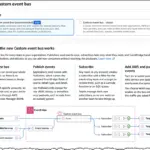
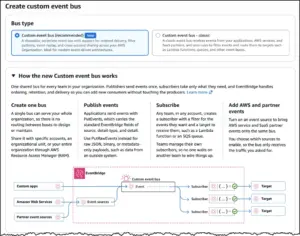
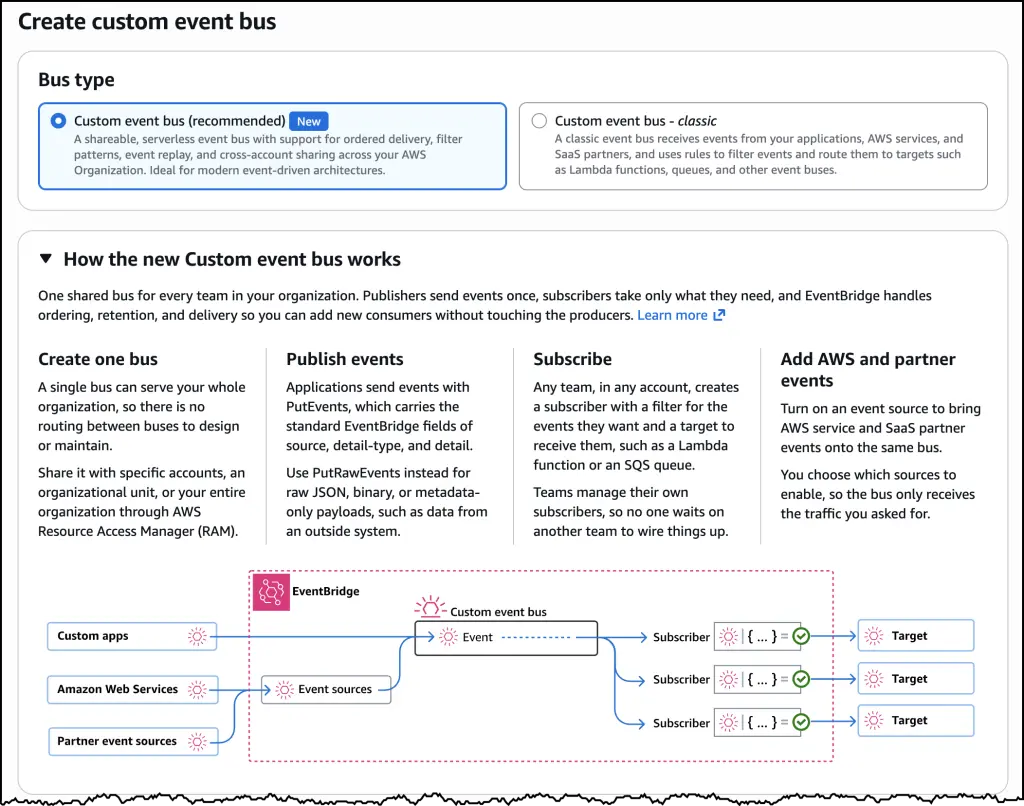
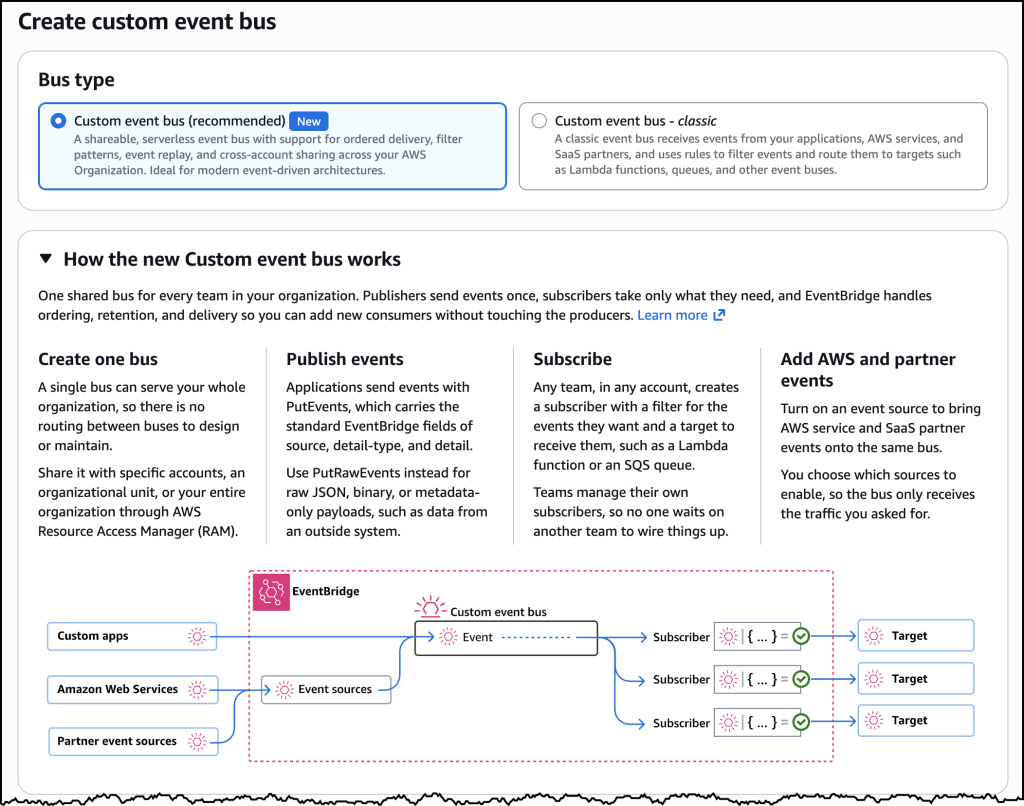
For developers looking to leverage this enhancement, the process begins within the AWS Management Console. When navigating to the EventBridge console, users will now encounter a refined "Create custom event bus" page. The console presents a clear choice: the new "Custom event bus," which is the recommended path for modern, scalable workloads, and the "Custom event bus – classic," which remains fully supported for existing applications that do not require the new feature set.
The architectural shift is centered on a shared-bus model. Instead of maintaining a web of interconnected buses, a single shared bus acts as the central backbone for the entire organization. Publishers send their events to this central hub, and subscribers consume only the specific data they require. Behind the scenes, EventBridge manages the complex tasks of routing, retention, delivery, and—crucially—event ordering.

Integrating this new bus into an existing environment is facilitated by AWS Resource Access Manager (AWS RAM). Users can enable event bus sharing with a few clicks, selecting the scope of the sharing—whether it be a specific AWS account, an organizational unit, or an entire AWS organization. This integration removes the need for manual cross-account permission management or the constant maintenance of bus-to-bus routing rules, effectively offloading the "plumbing" of the architecture to AWS.
Scaling Across the Organization
The primary benefit of the enhanced custom event bus is its ability to serve as a unified event backbone. By eliminating the need to configure individual cross-account permissions, platform teams can provide application teams with a self-service environment. Developers can publish and subscribe to events on this shared infrastructure without waiting for manual infrastructure provisioning, significantly increasing developer velocity.
From a governance perspective, the platform team retains clear visibility into all event flows, ensuring that security and compliance standards are met. This centralized control does not come at the cost of scalability; the enhanced custom event bus supports a default quota of 10,000 subscribers per bus, with the option for organizations to request higher limits. This high capacity effectively ends the era of architectural fragmentation, where teams were previously forced to split their event traffic across multiple buses simply to stay within subscription limits.
Addressing the Need for Event Ordering
While many event-driven patterns rely on asynchronous processing where the sequence of events is secondary to the outcome, there are specific domains where timing is critical. In logistics, for example, driver location updates must be processed in the exact order they were generated; out-of-sequence events can cause routing algorithms to make decisions based on stale or contradictory data.
The enhanced custom event bus addresses this by supporting both traditional asynchronous patterns and strict ordered delivery on the same bus. Publishers can include an EventGroupId in their event metadata. When an EventGroupId is present, EventBridge ensures that events sharing that same ID are delivered in sequence to subscribers that have opted for ordered delivery. This allows organizations to maintain strict sequence integrity for critical processes while allowing other consumers on the same bus to continue processing events in a standard, high-throughput asynchronous manner.

Furthermore, to bolster the reliability of these ordered workflows, the new bus supports synchronous invocation for targets such as AWS Lambda. This mode confirms successful processing before acknowledging the event, removing the common requirement to insert Amazon Simple Queue Service (SQS) between an event bus and a Lambda function to ensure reliability.
Streamlining Subscriptions and Event Evaluation
The introduction of the "Subscriber" resource represents a major step forward in operational simplicity. Previously, achieving reliable event consumption required the configuration of disparate rules, targets, and retry settings across multiple resources. The Subscriber resource consolidates event filtering, target configuration, retry policies, and dead-letter queue destinations into a single, cohesive unit. This makes it easier for teams to manage the lifecycle of their integrations and simplifies the onboarding of new consumers.
The new model also introduces advanced capabilities for event evaluation. Publishers can now enable content-based deduplication, which allows EventBridge to detect and drop retries of the same event based on the payload itself. This feature provides exactly-once delivery semantics for sources that cannot inherently generate a unique deduplication ID, helping to resolve issues caused by partial failures or network timeouts.
Subscribers also gain more power through the use of JSONata expressions. This allows for complex event reshaping—such as extracting specific fields, renaming keys, or calculating new values—before the event is delivered to its destination. Additionally, for organizations using data formats like Apache Avro or Protocol Buffers, EventBridge can now deserialize these payloads into JSON. This allows subscribers to perform fine-grained filtering and routing on the full event payload without requiring them to implement their own custom deserialization logic.
A Modernized Economic Model
With the launch of the enhanced custom event bus, AWS is also updating its pricing structure to better reflect the realities of modern, high-scale architectures. The new model shifts toward an ingress and egress throughput-based approach. Publishers pay for the volume of events ingested, and subscribers pay for the volume of events delivered.
This structure is a direct response to the "hidden" costs of the previous model, where cross-account and bus-to-bus routing charges could quickly escalate in complex multi-bus architectures. By moving to a simpler throughput-based model, AWS aims to provide better cost predictability and more accurate cost allocation across publishers and subscribers within an organization. Existing "classic" custom event buses will continue to function under their current pricing model, allowing organizations to transition to the enhanced bus at their own pace.
The enhanced custom event bus is available immediately across a broad range of AWS Regions, including US East (N. Virginia, Ohio), US West (Oregon), Europe (Ireland, Frankfurt, Stockholm, Spain), and several Asia Pacific locations, including Hong Kong, Malaysia, Mumbai, Singapore, Sydney, Thailand, and Tokyo. As organizations continue to move toward increasingly complex, distributed, and event-driven systems, this new toolset provides the infrastructure necessary to scale without the burden of excessive operational complexity.