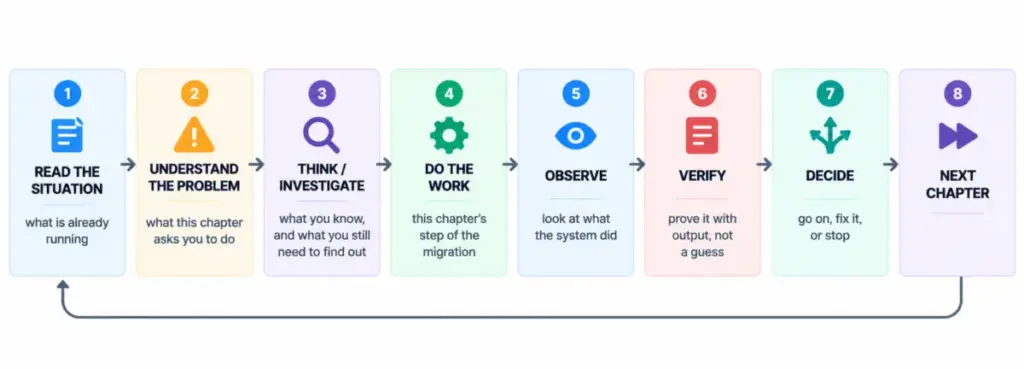
Migrating a production application across cloud providers represents one of the most delicate challenges in modern enterprise engineering. When engineering teams attempt to shift workloads between major cloud ecosystems, the margin for error is razor-thin, particularly for financial infrastructure where transaction integrity is paramount. A comprehensive new technical publication details a guided laboratory framework designed to solve this exact challenge: migrating a payment processing application featuring a React user interface and an Express API from Amazon Web Services (AWS) to Google Kubernetes Engine (GKE) while maintaining zero customer-facing downtime.
![How to Migrate an Application from AWS to GKE [Full Book]](https://cdn.hashnode.com/uploads/covers/5e1e335a7a1d3fcc59028c64/8a1803ba-c9c9-496d-b2c4-58392cc655eb.png)
The migration strategy focuses on a microservices-inspired architecture running a small payments application. Initially, the application operates entirely within a single AWS EC2 instance, with its PostgreSQL database hosted on Amazon RDS. The core objective of the migration project is to transition the user interface and API components to Google Kubernetes Engine while preserving the existing public uniform resource locator utilized by customers. By leveraging weighted traffic routing via a global load balancer, engineering teams can incrementally shift live production traffic from AWS to Google Cloud a few percentage points at a time, closely monitoring system performance and error rates throughout the transition.
![How to Migrate an Application from AWS to GKE [Full Book]](https://cdn.hashnode.com/uploads/covers/698d563262d4ce66226a844a/a72eb451-8e75-4125-ba27-070c73054436.png)
Architectural Planning and Infrastructure Preparation
Achieving a seamless transition requires meticulous preparation and a clear understanding of system dependencies. According to the project specifications, the migration journey begins locally before expanding into cloud environments. Engineers first run the application locally using containerization tools to establish a trusted baseline of correct behavior, particularly regarding critical financial logic such as idempotency keys, which ensure that duplicated requests—such as a customer clicking a payment button multiple times due to a lagging connection—never result in accidental double-charging.

![How to Migrate an Application from AWS to GKE [Full Book]](https://cdn.hashnode.com/uploads/covers/698d563262d4ce66226a844a/8abff4c2-ba02-41d0-907f-5c167d485d31.png)
Once the local environment is verified, the infrastructure deployment commences on AWS using Terraform to provision the baseline EC2 server and RDS PostgreSQL database. This initial phase establishes the performance benchmark against which all subsequent cloud environments are measured. Engineers conduct rigorous load testing to record baseline metrics including request throughput and p95 latency. These metrics serve as critical success criteria; any future deployment on Google Cloud must meet or exceed these operational standards before receiving production traffic.
![How to Migrate an Application from AWS to GKE [Full Book]](https://cdn.hashnode.com/uploads/covers/698d563262d4ce66226a844a/6fd0931a-5d4d-44ff-8531-74ce76b75023.png)
With the AWS baseline established, the engineering team shifts focus to provisioning the Google Cloud destination environment using an eight-stage Terraform workflow. Rather than deploying the entire infrastructure in a single monolithic operation, the staged approach ensures granular verification at every layer. The process systematically enables necessary Google Cloud application programming interfaces, configures private networking and Cloud NAT for secure outbound connectivity, provisions a private GKE cluster, establishes an Artifact Registry for container images, configures secure workload identities without static key files, sets up Secret Manager parameters, establishes error-monitoring metrics, and finally deploys a global external managed load balancer with weighted routing capabilities.
![How to Migrate an Application from AWS to GKE [Full Book]](https://cdn.hashnode.com/uploads/covers/698d563262d4ce66226a844a/b613b3b6-75c8-4b75-9cca-02750c9bab8a.png)
Executing the Staged Migration and Managing Traffic
A critical architectural decision highlighted in the project is the deliberate choice to leave the PostgreSQL database on AWS throughout the initial phases of the migration. Decoupling the database layer from the compute layer significantly reduces architectural complexity, allowing engineering teams to isolate and resolve networking, security, and container orchestration challenges on GKE without simultaneously risking data migration anomalies. Secure cross-cloud connectivity is achieved by allowing inbound database connections from the specific static IP address utilized by the GKE cluster’s Cloud NAT gateway, protected by mandatory Transport Layer Security requirements.
![How to Migrate an Application from AWS to GKE [Full Book]](https://cdn.hashnode.com/uploads/covers/698d563262d4ce66226a844a/e734e16e-0bec-4f5e-b542-03b2cecc1980.png)
Once the GKE staging environment is prepared, automated continuous integration and deployment pipelines take over. Code commits trigger automated container image builds and vulnerability scans before deployment manifests are applied to the Kubernetes cluster via Kustomize overlays. Before any live user traffic touches the new environment, automated promotion gates rigorously test the staging deployment against functional benchmarks, verifying database connectivity, authentication flows, and transaction integrity.
![How to Migrate an Application from AWS to GKE [Full Book]](https://cdn.hashnode.com/uploads/covers/698d563262d4ce66226a844a/3dfe597d-2949-4ce8-beae-285d3a5a13f2.png)
With staging successfully verified, production workloads are deployed to GKE and connected to a GKE Gateway resource. The final phase of the migration involves shifting live customer traffic using the global load balancer’s weighted routing capabilities. Beginning with a conservative one percent allocation, engineers incrementally raise the traffic weight toward 100 percent while continuously observing system telemetry, latency distributions, error logs, and database connection pools.
![How to Migrate an Application from AWS to GKE [Full Book]](https://cdn.hashnode.com/uploads/covers/698d563262d4ce66226a844a/fff6c8f3-be7d-4bb3-a525-403f424af320.png)
Throughout this gradual rollout, the system maintains a fully tested rollback mechanism. If anomaly detection systems or synthetic health monitors indicate degraded performance exceeding predefined operational thresholds, engineers can immediately redirect 100 percent of production traffic back to the AWS environment within seconds, invoking a rollback banner in the user interface to maintain total operational transparency.
![How to Migrate an Application from AWS to GKE [Full Book]](https://cdn.hashnode.com/uploads/covers/698d563262d4ce66226a844a/30d53ba8-7337-4be6-8b45-3d37955315b2.png)
Ultimately, the guided project demonstrates that successfully migrating a payments application from AWS to GKE is less about the mechanics of container orchestration and more about rigorous planning, quantitative benchmarking, and disciplined, incremental traffic management. By keeping the database stable, automating deployments, and maintaining a robust safety net throughout the transition, engineering teams can modernize their infrastructure successfully while preserving complete transactional reliability for their customer base.